Unknown Facts About Sumatra Coffee Beans The Story of Indonesian Mandheling Climate Formation Characteristics Processing Methods
For professional barista communication, please follow Coffee Workshop (WeChat official account: cafe_style)
Indonesia's Coffee Origins
Indonesia's main coffee-growing islands are Sumatra, Java, and Sulawesi—and of all Indonesian coffees, the "Mandheling" from Sumatra is the most famous.
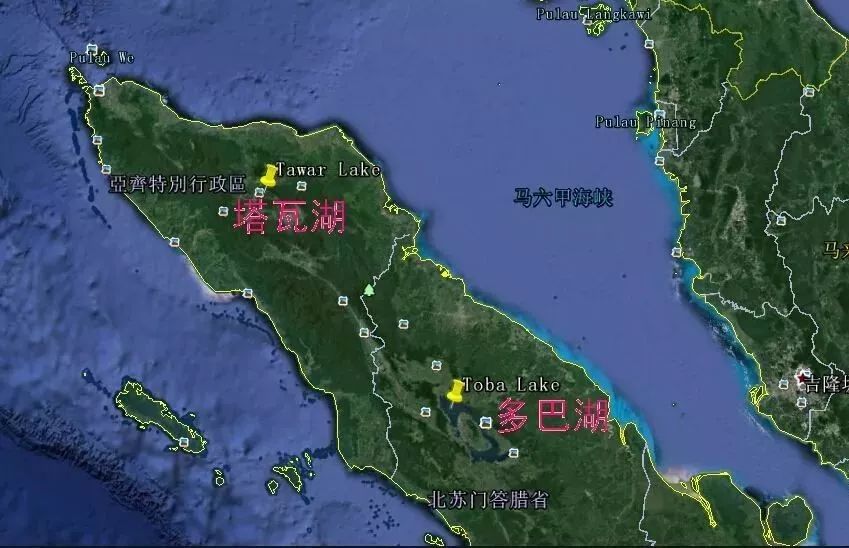
Mandheling is also known simply as "Sumatra coffee." Most coffee from northern Sumatra is Gayo, largely of the Ateng variety. Coffee from around Lake Tawar in the north can be labeled Aceh coffee or Lake Tawar coffee, while the Lintong and Lake Toba areas in the south are properly called Mandheling—Lintong being the true heartland of Mandheling production. The finest Mandheling varieties include four: Sidikalang, Bergendar, Siborongborong, and Telok Sanggul.
Lake Toba
Lake Toba lies in central North Sumatra Province. In 1888, Dutch colonists moved "Java Mandheling" north into the Lake Toba region, and the modern Mandheling legend began.
Lake Tawar
Lake Tawar sits in central Aceh Special Autonomous Region, at the northern tip of Sumatra, covering less than one-tenth of Lake Toba's area. In recent years, however, both its quality and its production have overtaken Lake Toba.
The Gayo Mountains rise in the Aceh region of northern Sumatra, where most of the coffee farmers are local. The name "Gayo" comes from the indigenous tribes of Aceh. The area offers ideal growing conditions, a long history and culture, and distinctive flavors. Farmers here cultivate coffee widely with organic methods and no chemical fertilizers, and the region is regarded as a world-class green coffee source—which is why Gayo coffee is often marketed as "green coffee" or "Gayo organic coffee."
What Is "Golden Mandheling"?
To understand "Golden Mandheling," you first have to understand PWN. The abbreviation gets appended to Mandheling names all the time, but it actually stands for the Pwani Coffee Company.
PWN is one of Indonesia's most famous coffee trading companies, dealing chiefly in Mandheling. It has bought up nearly all of the country's best production areas, so most of its beans are genuinely distinctive specialty coffees. Golden Mandheling is one of its products: after acquiring the green beans, the company sorts them repeatedly by hand, keeping only plump, defect-free beans. Only beans that survive this layer-by-layer audition earn the Golden Mandheling classification.
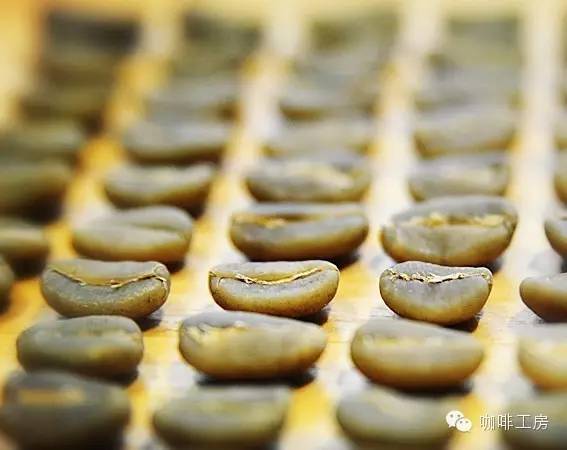
There's a catch, though: PWN has registered "Golden Mandheling" as a trademark. Strictly speaking, only Golden Mandheling produced by PWN is the real thing—similar beans from other producers should really be labeled "Premium Mandheling."
In other words, "Golden Mandheling" is, at root, a product name invented by one company.
Processing: Wet Hulling
Wet hulling—called Giling Basah in the local language—is Indonesia's traditional processing method. Judging by the name alone, it sounds nearly identical to washed processing, but the two produce completely different cups. Wet-hulled coffee typically tastes thick and intense, with a very strong personality of its own.
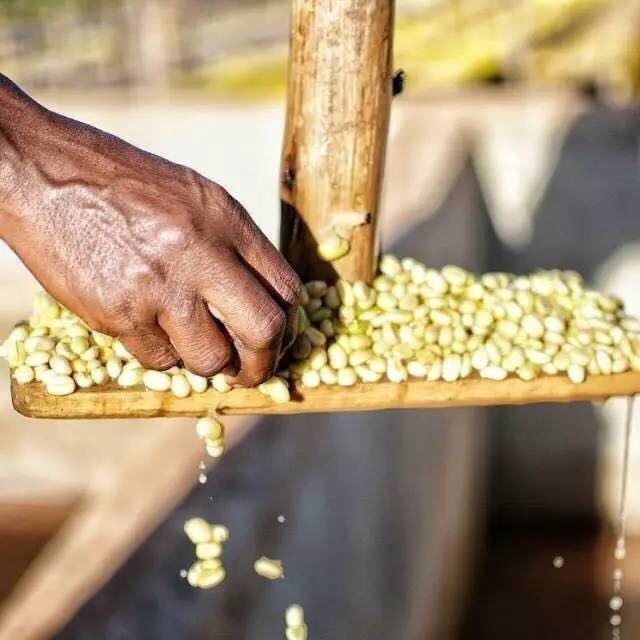
Wet Hulling Step by Step
① Remove the skin and pulp, keeping the parchment and mucilage
② Ferment in a water tank
③ Wash off the mucilage
④ Sun-dry in parchment for 2–3 days, until moisture reaches 20–24%
⑤ Hull off the parchment
⑥ Continue drying the green beans to 12–13% moisture
⑦ Prepare for export
Why Wet Hulling Exists
a. Climate
The tradition is rooted in Indonesia's weather. Humidity holds between 70% and 90% year-round, typhoons roll through regularly, and in some regions annual rainfall reaches 2,000mm. Green beans are at their most vulnerable during drying—so how does Indonesia produce rich, mellow Mandheling under such punishing conditions? Wet hulling is the answer.
Under tropical conditions, coffee normally takes two to three weeks to dry. In Indonesia's extreme humidity, that becomes a serious problem: the longer coffee sits at high moisture, the easier it is for bacteria to invade the beans.
Ordinary washed processing dries the coffee in parchment, which shields the beans but slows everything down. Wet hulling strips the parchment before the final drying stage, exposing the green beans directly to the sun—and drying them two to three times faster than washed coffee.
b. Economics
The Dutch brought coffee to Indonesia in the 17th century, and as colonists they wanted bigger returns, faster. Wet hulling slashes the time coffee spends on the farm and cuts labor costs accordingly—a perfect match for an investor's mentality of quick profit and low overhead. That, too, drove its adoption.
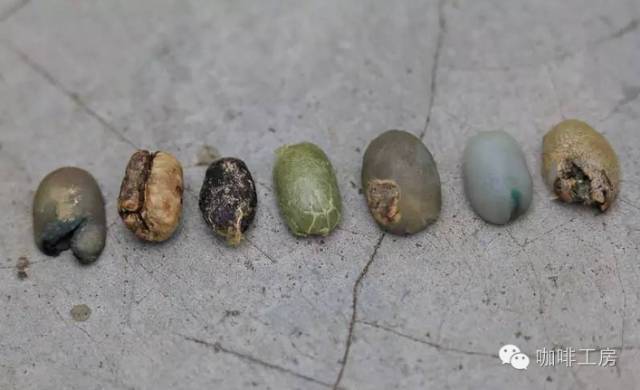
c. Defects and kuku kambing (goat-hoof beans)
When the parchment is hulled off, wet-hulled coffee still holds 20–24% moisture, whereas conventionally processed coffee is dried to 10–12% before hulling. In this "semi-dry" state the parchment clings to the bean, so hulling takes more friction and more force than it would with fully dried beans.
But semi-dry beans are also fragile—their hardness is far below that of fully dried beans—so they crack and crush more easily, forming the small splits we call horse-hoof or goat-hoof beans (kuku kambing, locally).
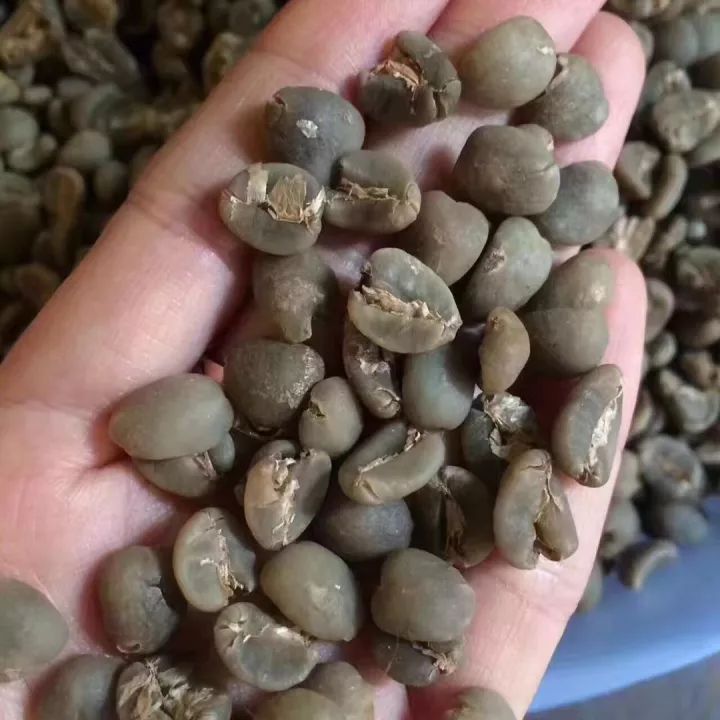
Wet hulling's breakneck speed also leaves Mandheling with a higher defect rate, so processing stations put staff to work sorting defects by hand—typically graded as DP (double picking) and TP (triple picking). Triple-picked Mandheling comes out cleaner than double-picked.
Flavor-wise, wet-hulled coffee is generally credited with earthy, smoky, and chocolate notes and acidity described as "low"—thick, if somewhat muted.
The low acidity traces back to the shorter, gentler fermentation and the longer drying. As for the famous "earthy" character, opinions differ wildly: some blame the varieties common in wet-hulled regions (Timor and Catimor lines, both carrying robusta blood), some say it's the interaction between the beans and their environment, and some insist it's simply the defects talking—of which, admittedly, there are quite a few.
FrontStreet Coffee's Green Bean Analysis
Golden Mandheling Green Beans
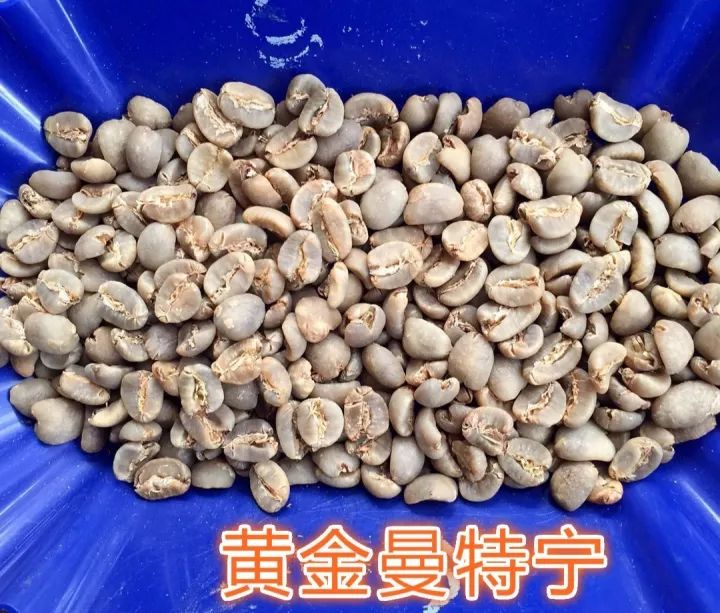
Golden Mandheling
Origin: Sumatra, Indonesia
Processing: Wet hulled
Variety: Typica
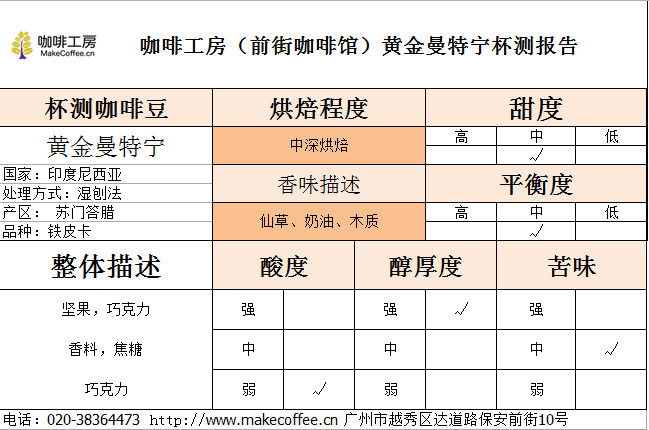
Roast Level: Medium-dark
FrontStreet Coffee drops the beans just before second crack to preserve a touch of soft acidity. The cup is very sweet, deeply aromatic, and mellow: toasted bread, pine, caramel, and cocoa, with a faint earthy edge.
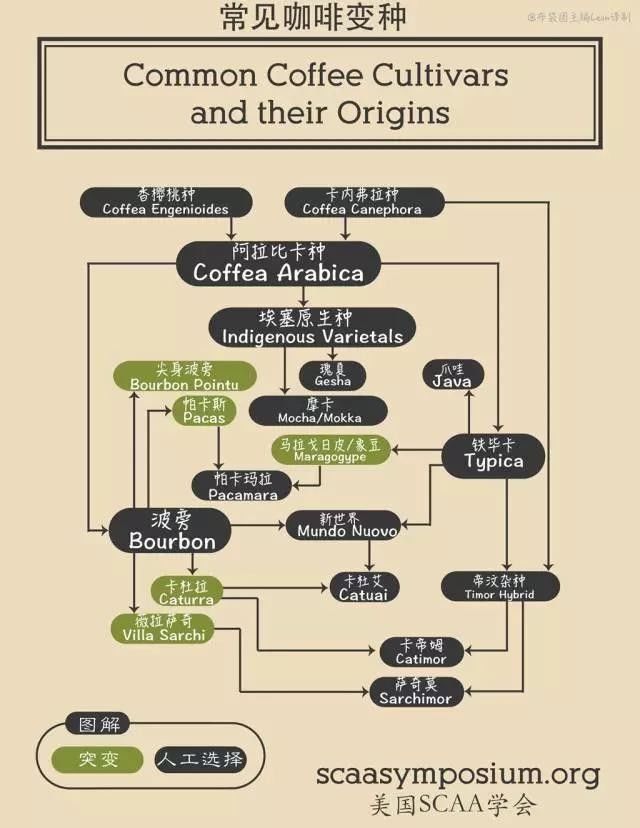
Within the specialty coffee world, Sumatra is a fascinating puzzle. After all, the famous "Mandheling" is not a region, not a variety, and its varietal makeup is honestly a mess. A few names to know:
Ateng
An arabica × robusta hybrid with several subtypes, planted widely across Sumatra and other Indonesian islands. In short, it's a branch of the Catimor family—"Ateng" is simply the local name.
Djember
Search "Djember" and you'll find it's a place name in Sumatra, which makes the variety seem mysterious. In fact, Djember is S-795; because this coffee was distributed on the island by the Jember Coffee Research Center, locals adopted the name.
What is S-795? A cross made by Indian botanists between the Typica mutation Kent and S-288.
What is S-288? A natural hybrid of arabica and liberica.
TimTim
Short for Timor Hybrid, an arabica × robusta cross—and the parent that, hybridized again, produced the Catimor we know.
Tim Tim — Longberry Mandheling
TimTim is an Indonesian bean whose elongated shape has earned it the nicknames "horse-face bean" and "long Mandheling." It isn't a pure variety but a natural arabica–robusta hybrid, discovered on Timor Island in the 1940s and cultivated for its natural disease resistance. In the Americas it's called Hibrido de Timor—abbreviated TimTim—while in Indonesia it's also known as Bor Bor.
FrontStreet Coffee's Roasting Analysis
Golden Mandheling is a higher-moisture green bean, with a moisture deviation notably above natural-processed coffees, so FrontStreet Coffee pays special attention to the drying phase. For high-moisture beans, close the air damper right after charging, steam for 30 seconds, then open to level 3 until the beans turn pale green or white; open the damper to level 4, then to level 5 (maximum) after first crack.
We also recommend logging detailed data before every roast—bean moisture, density, origin, processing method, ambient temperature and humidity in the roastery—and planning the curve in advance. Record the chemical and physical changes as you roast; that's how you learn to read the final result and keep improving the curve.
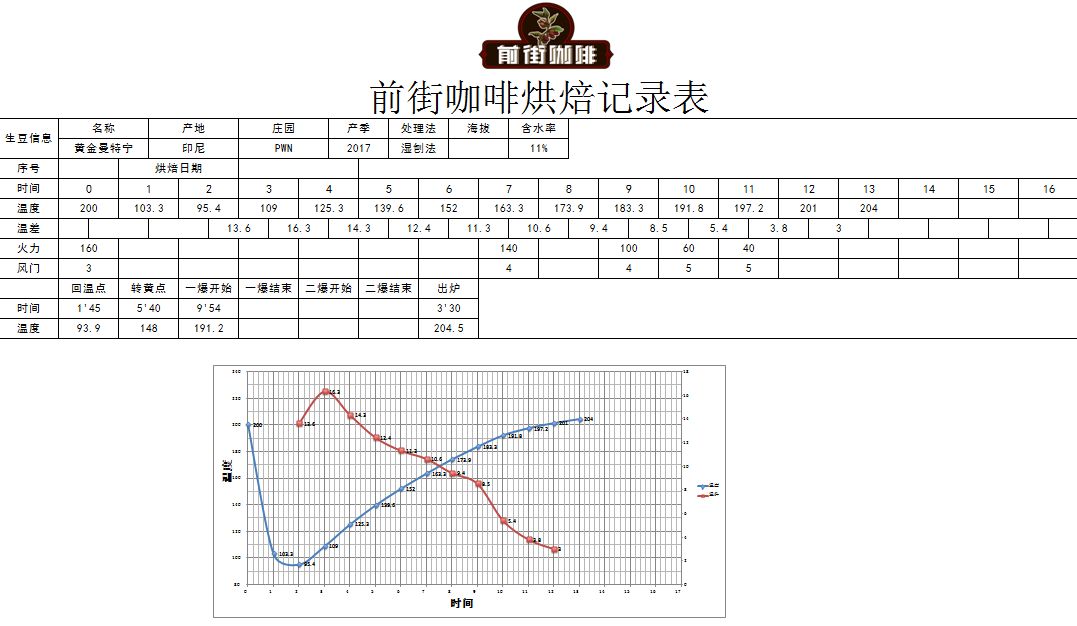
Roasting Curve
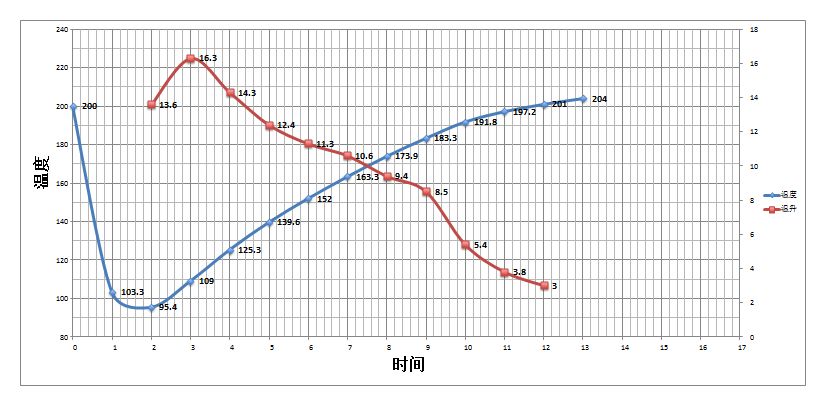
Charge the roaster at 200°C with the air damper at 3. After 1 minute, turn the heat down to 160°C, damper unchanged. At 5'40" (148°C) the bean surface yellows, the grassy smell disappears entirely, and drying is complete—turn the heat to 140°C and the damper to 4.
At 9'40", mottling and black spots appear on the surface and the toast aroma clearly shifts into coffee aroma—the prelude to first crack. Listen carefully. First crack begins at 9'54"; drop the heat to low (60°C) and open the damper fully (ease the heat down gently—don't kill the cracking sound). Drop the beans at 204.5°C.
FrontStreet Coffee's Cupping Report
Golden Mandheling cups noticeably cleaner than Lintong Mandheling. The herbal, earthy, woody notes typical of Mandheling have almost vanished, while caramel sweetness is more intense and the fruit acidity brighter and more elegant. Lintong Mandheling usually needs a roast taken past second crack to tame its muddled flavors, but Golden Mandheling dropped right around second crack shows good clarity and sweetness—giving the roaster much more room to interpret.
FrontStreet Coffee's Brewing Analysis
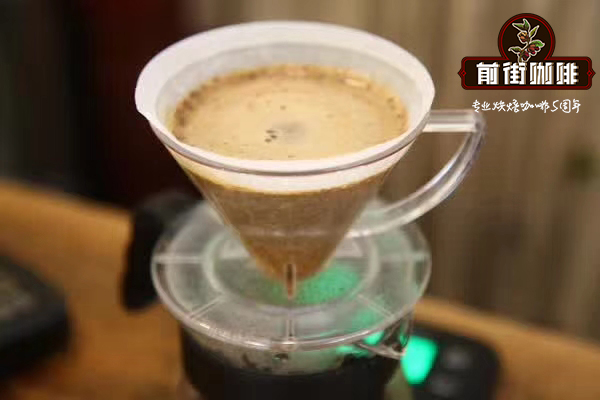
Medium-dark roasts lose more water, so they weigh less, and the grounds don't sink completely. On the first pour the water is absorbed instantly, and vigorous degassing wraps the grounds in bubbles that open up channeling—the fresher the beans, the longer those channels last and the faster the water level falls. FrontStreet Coffee recommends a bold, coarse water flow with slow circular pours.
1. Dripper: KONO
2. Water Temperature: 88°C
3. Grind Size: Setting 4 on the Fuji Royal grinder
4. Roast Level: Medium-dark
5. Bloom Time: 25 seconds
Flavor: Layered, clean, and balanced, with a persistent caramel sweetness in the finish
FrontStreet Coffee's exact technique: 15g of coffee, Fuji Royal ghost-tooth burr grinder at setting 4, Kono dripper, 88–89°C water. Bloom with 30g of water for 25 seconds, pour to 104g and stop. Once the bed has dropped to half, resume pouring slowly to 220g, avoiding the final 5g. Coffee-to-water ratio 1:15, total extraction around 2:00.
FrontStreet Indonesia PWN Golden Mandheling Black Coffee Beans G1 Washed Imported Single Origin Specialty Fresh Deep Roast
Purchase link: https://item.taobao.com/item.htm?spm=a1z10.5-c-s.w4002-15673140460.18.14226b5fo2Tf9i&id=540335271875
FrontStreet Coffee Recommendation
Golden Mandheling is the flagship of top-tier Mandheling, and among Mandheling lovers it's the bean that satisfies the perfectionists. FrontStreet Coffee's Golden Mandheling comes from Indonesia's PWN company, which applies exceptionally strict standards: starting from beans above size 18 mesh, it requires fewer than 3 defective beans per 300g green sample to meet the top G1 grade, then runs three rounds of hand-sorting to eliminate every remaining defect—raising both the cleanliness of the cup and the intensity of its sweetness. Standards this strict mean limited supply, which is exactly why PWN Golden Mandheling sits at the very top of its class. Its fame is such that production flows mainly to the Japanese and American markets, so genuine PWN Golden Mandheling is scarce elsewhere—FrontStreet Coffee's offering comes with certificates and the PWN-stamped bags that distinguish the real article.
Pour-over shows this coffee at its best. Use 87–88°C water, 15g of coffee at a 1:15 ratio, a grind like coarse granulated sugar, and a three-pour structure: first pour 30g to wet all the grounds and let them degas; second, about 100g to lift the golden foam and raise the bed; finally a gentle center pour of 95g to boost sweetness. The result is a thick, full body with caramel sweetness and notes of chocolate and nuts—and, with the classic herbal wildness of wet-hulled Sumatra, it's ideal for anyone who dislikes sour coffee. If you want the rawer, more traditional face of the origin, FrontStreet Coffee's Lintong Mandheling delivers clove and wood aromatics, low acidity, spice and mint notes, and a powerful, lasting sweetness.
Mandheling also shines under pressure. Its creamy richness is precisely why it long anchored espresso, and FrontStreet Coffee's most-repurchased Classic Espresso Blend builds on Brazil's creamy nut character with medium-dark Mandheling—butter, roasted chestnut, and caramel front and center—plus a touch of robusta for crema. Mandheling thickens the body and lends sandalwood, herb, and spice aromatics, making the blend effortless for latte art, a layered Dirty, or any milk drink.
Important Notice :
FrontStreet Coffee is a long-established specialty coffee roaster in Guangzhou China, selling freshly roasted beans from its own farm in Yunnan as well as dozens of carefully selected single-origin beans from around the world for both pour-over and espresso. The products deliver consistently excellent quality and great value, with shipping within 24 hours. Guangzhou's FrontStreet Coffee shop is recommended by many coffee lovers, and the beans are now available online at the Tmall 。
FrontStreet Coffee has moved to a new address:
FrontStreet Coffee Address: 315,Donghua East Road,GuangZhou
Tel:020 38364473
 Scan and follow the En Gafei WeChat official account. Please indicate that the reprint comes from "En Gafei".