Kenyan Single-Origin Coffee Beans: Differences, Distinctions, and Award Recognition - How Much Does a Cup of Kenyan Coffee Cost?
Differences, Distinctions, and Awards of Kenyan Single-Origin Coffee Beans
The Mau Mau Uprising (1956-1960) returned control of most cultivated land to local residents. Coffee farms are mostly small operations producing a few hundred kilograms a year. Growers decide which nearby processing factory to sell their cherries to based on transport distance and purchase price. The famous Karagoto coffee, for instance, is really a processing facility near the town of Karatina. It collects cherries from nearby farmers, processes and exports them, and provides technical support for cultivation. Karagoto has joined with the Tegu and Ngunguru factories to form a cooperative, the Tekangu Farmers Cooperative Society (FCS). Most of Kenya's famous coffee regions lie in the center of the country, including Nyeri, Kiambu, and Kirinyaga, as well as the western highlands near Uganda (Nakuru, Bungoma, Kitale, and others).
Coffee Auctions Ensure Farmer Benefits
Every Tuesday during the harvest months, the Coffee Exchange in the capital, Nairobi, holds an auction. Roughly 50 government-licensed exporters classify and grade the lots, send samples to prospective foreign buyers for cupping and evaluation, and then invite bids. Foreign companies can also commission licensed marketing agents for direct trade. Every step is clear and transparent, regulated by the Coffee Board of Kenya, ensuring that after costs are deducted, all proceeds reach the farmers.
The trade typically describes Kenyan coffee as "blackcurrant juice": a rich body, a wine-like aroma, and bright fruit acidity. These characteristics are hard to find in other producing regions. Unfortunately, coffee accounts for only 10% of Kenya's total economic income. As demand for land rises, coffee farmers may lose the incentive to keep growing coffee and abandon it altogether, likely a common consequence of urbanization.
Grading of Kenyan Coffee Beans
Coffee comes in many varieties, each with different grades. To enjoy a cup, there are plenty of choices, and beans from a single producing region can be split into several grades, which confuses consumers who are not familiar with the system. I have therefore gathered information on Kenyan coffee bean grading to share.
Kenya keeps strict control over coffee quality, classifying beans by size and shape into AA, AB, C, E, PB, TT, T, ML, and MH. These grades mainly distinguish bean shape and size, and do not necessarily represent quality. Many people believe larger beans hold more aromatic oils and thus more fragrance, which is why larger beans tend to fetch higher prices.
Take Kenyan AA: within the same grade, estate beans rank highest, followed by "+", then regular AA. AB follows the same pattern as AA. C grade covers smaller beans, E grade is extra-large (elephant beans), while TT, T, ML, and MH are inferior grades seen only locally.
PB (Peaberry)
Peaberry (PB) is quite special, usually formed at the ends of trees that flowered too late or too early. Because production is scarce, at only about 10% of the crop, peaberries from the same tree generally cost more than flat beans. When collected together, most defects are removed, which lowers the defect ratio and makes the beans more uniform in size, giving a more even roast and improved flavor.
For quality distinctions, Kenya also uses a numerical grading system, though it has never been widely promoted, so relatively few people know of it. Grading therefore still favors larger beans, while PB beans, being a different shape, are roughly equivalent to AA. If they are estate grade or "+" grade, they move up two or one level respectively: AB estate beans, for example, are roughly equivalent to AA+ and PB+.
Because production conditions vary from year to year, bean quality is directly affected. Grading is for reference only.
Flavor characteristics: rich aroma, balanced acidity.
Coffee is part of African life. Whether deep in the remote Great Rift Valley of East Africa, or on the Masai Mara plains where Masai nomads roam, whether in cities or villages, you can always catch the fragrance of coffee. Follow the aroma, pause, savor, and carve out those endless African moments with a cup of coffee.
Kenya lies between Ethiopia and southern Yemen, only a few hundred kilometers from these two world-famous coffee countries, yet its coffee-growing history lags far behind theirs. Coffee seeds did not reach this land until missionaries brought them in the late 19th century.
Kenyan AA is one of the world's rare excellent coffees, famous for its rich aroma and balanced acidity and loved by many connoisseurs. Its taste is perfectly balanced, with wonderful, intense flavors that are fresh yet never overpowering: a complete but not heavy experience. Kenyan AA is the most popular coffee in Europe. Take one sip and you feel it flood your entire tongue at once, fresh without being heavy, a truly complete yet light experience.
Most of Kenya's coffee trees grow in the mountains north and west of the capital, Nairobi. There are two main producing regions. One stretches south from the southern slope of Kenya's highest peak, Mount Kirinyaga, down toward Nairobi; close to the equator, it is Kenya's largest coffee area. The other, smaller region lies on the eastern slope of Mount Elgon. Kenya grows high-quality Arabica, and the beans absorb nearly the whole essence of the tree, with slightly acidic, rich aromas and bright, complex fruit flavors and grapefruit undertones, suited to both hot and cold drinking. This is why Europeans love Kenyan coffee, especially in Britain, where it has even overtaken Costa Rican coffee to become the most popular.
Kenya's coffee trees can flower twice a year. Most flower in March and April, after the long rains, and in most regions the harvest lasts from October until the end of the year. Some trees also flower in October or November and are harvested the following July. Kenyan coffee has always been hand-picked, with farmers taking only ripe red cherries, and each tree needs a new round of picking roughly every ten days.
"Let farmers earn what they deserve" is the fundamental belief of the specialty coffee movement. Although the Cup of Excellence is today the industry's most representative and transparent competition, many of its details in fact emulate Kenya's world-famous coffee auction system, renowned since the 1930s.
Kenya sits in eastern Africa, neighboring Ethiopia, the "source of coffee." Although its soil is fertile, the country's first coffee cultivation was introduced from Brazil in 1893: Bourbon, also known as French Mission, in honor of the French missionaries who brought it. In a "turn left, turn right" twist, coffee did not move south inland but crossed the Red Sea northward, and after centuries of spreading, settling, and mutating around the world, it finally returned to its homeland, the Great Rift Valley.
As a British colony, it was natural that export profits favored the colonial power. Until 1954, Kenyans owned only 5,000 acres of cultivated land, with most of the rest controlled by the British and sent to London for auction. Exploited as the colony seemed, Kenyan coffee would not be where it is today without the British laboratory Scott Laboratories, since its flagship varieties SL-28 and SL-34 were two of the 40 varieties cultivated there. Popular Kenyan varieties today also include Ruiru 11 (highly disease-resistant but slightly inferior in flavor), Batian (drought-tolerant), K7, and Kent.
Recommended Kenyan Coffee Bean Brands
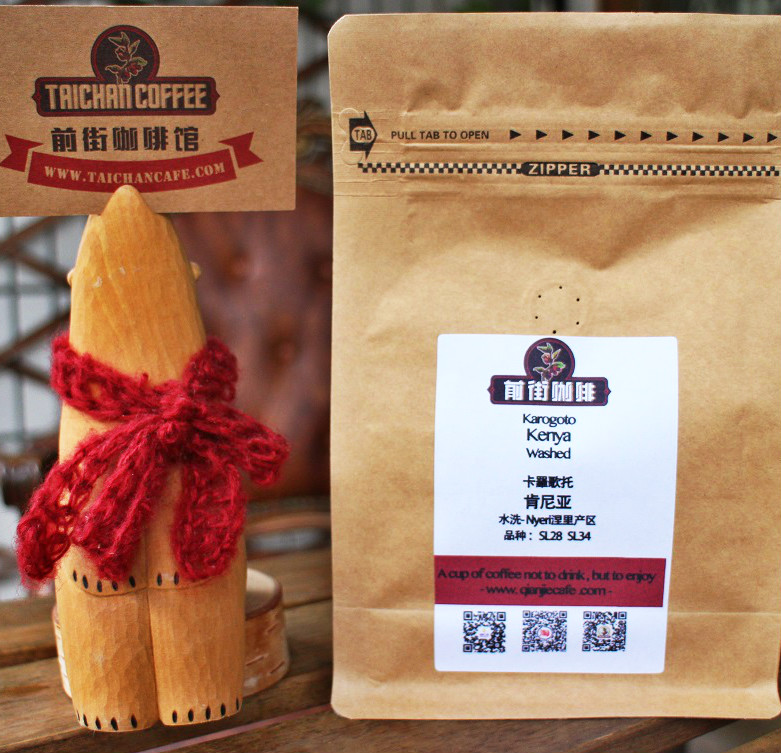
FrontStreet Coffee's roasted Kenyan beans guarantee both brand and quality, and, more importantly, outstanding value: a 227-gram box costs only 95 yuan. At 15 grams per cup, one package makes 15 cups, putting each cup at only about 6 yuan. Compared with cafes selling coffee at tens of yuan a cup, that is a genuinely conscientious recommendation.
Kenya Washed AA Grade Karogoto Fresh Specialty Beans from Nyeri Region
FrontStreet Coffee Recommendation
To taste Kenya's signature bright fruit acidity for yourself, FrontStreet Kenya Small Tomato is a standout starting point. It is a Kenyan specialty washed bean built around vivid cherry tomato and smoked plum acidity with a full, juicy body, and it comes from Kenya's Thika region at 1550-1750 meters, planted with the classic SL28 and SL34 varieties. The beans are plump and rounded, and the coffee undergoes Kenya's characteristic 72-hour double washed fermentation, which draws out the fruit notes while keeping the cup clean and pure. FrontStreet roasts it light to preserve that lively acidity and layered fruit.
From the dry aroma you already catch intense dried cherry tomato and florals; on the palate come clear cherry tomato and smoked plum notes, bright and solid acidity like freshly squeezed juice, and a pronounced mid-palate sweetness threaded with crisp pear and black plum. The finish is clean and long, carrying yellow-sugar sweetness and a faint green tea note, for a cup that is balanced sweet-and-sour and instantly recognizable.
If you prefer a rounder, fruit-forward Ethiopian profile, FrontStreet Yirgacheffe Gutinguting, often the first stop for newcomers to specialty coffee, brings vivid citrus, berry, and floral notes with a green-tea-like sweetness. Unlike the "sour coffee" many people imagine, a good Yirgacheffe's acidity is soft and bright, closer to the natural sweet-tart of fruit than to anything sharp, making it a very approachable choice for those just getting into pour-over.
Important Notice :
FrontStreet Coffee is a long-established specialty coffee roaster in Guangzhou China, selling freshly roasted beans from its own farm in Yunnan as well as dozens of carefully selected single-origin beans from around the world for both pour-over and espresso. The products deliver consistently excellent quality and great value, with shipping within 24 hours. Guangzhou's FrontStreet Coffee shop is recommended by many coffee lovers, and the beans are now available online at the Tmall 。
FrontStreet Coffee has moved to a new address:
FrontStreet Coffee Address: 315,Donghua East Road,GuangZhou
Tel:020 38364473
 Scan and follow the En Gafei WeChat official account. Please indicate that the reprint comes from "En Gafei".