Golden Mandheling Coffee Bean Characteristics Flavor Differences Between Indonesian and Colombian Coffee Varieties

Both in FrontStreet Coffee's physical shop and on its Tmall flagship store, one question comes up constantly: how do I choose coffee beans? Some customers are newcomers to specialty coffee who haven't yet mapped out the flavor profiles of different origins. Others simply freeze in front of the shelves—FrontStreet Coffee currently stocks more than 40 bean varieties from growing regions around the world, each with its own personality, and the lineup keeps expanding with new arrivals.
Among all of them, Mandheling is probably the name most familiar to Chinese consumers. But how much do you know about the history and stories behind the name? And when guests at FrontStreet Coffee ask about Colombian coffee—as they often do—can you say what sets that origin apart? Colombia is, after all, the world's largest exporter of washed coffee. If either origin still feels like a blur, this article from FrontStreet Coffee walks you through everything worth knowing about Mandheling and Colombian coffee.

People don't come to FrontStreet Coffee just for a cup of coffee, and FrontStreet Coffee doesn't just pour coffee—we share the stories behind it. So here are the stories of Mandheling and Colombian coffee!
Where the Mandheling Story Began
In the 17th century, the Dutch brought the first Arabica seedlings to Ceylon (today's Sri Lanka) and to Indonesia. Then, in 1877, disaster struck the Indonesian islands: coffee leaf rust wiped out nearly every coffee tree, forcing growers to abandon the Arabica they had tended for generations and replant with rust-resistant Robusta brought in from Africa. Indonesia remains a major producer today, with coffee grown mainly on Java, Sumatra, and Sulawesi—Robusta accounts for roughly 90% of total output. Sumatran Mandheling, though, is that rare Arabica exception. The trees grow on hillside slopes between 750 and 1,500 meters above sea level, and Sumatra's distinctive conditions give Mandheling its rich aroma, full body, intense flavor, and whispers of chocolate and caramel.

Mandheling beans run large and hard, which makes them prone to defects in cultivation, so harvested lots go through strict manual sorting. Skimp on that quality control and quality swings wildly from batch to batch—and since roast level also transforms the flavor, Mandheling has earned a reputation as one of the most divisive single origins around.

The name itself is an oddity among coffees. It isn't a region, a place, a port, or even a variety name the way Yirgacheffe or Sidamo are. The story goes back to World War II: after the Netherlands declared war on Japan, Japanese forces invaded the Dutch colony of Indonesia, landing on Sumatra in February 1942. The occupying soldiers—already avid coffee drinkers—discovered the charm of wet-hulled Mandheling in northern Sumatra and fell hard for it.
Even the name's origin supposedly involves a Japanese soldier and a pronunciation mix-up. During the occupation, a soldier drank a rich, mellow cup at a local café and was so struck by it that he asked what it was called. Through the language barrier, the owner thought he was being asked where the coffee came from and answered "Mandailing." After the war, the soldier had an Indonesian broker ship 15 tons of that remembered "Mandheling coffee" to Japan, where it sold astonishingly well. The broker, as it happened, went on to found today's famous PWN Coffee Company—and Mandheling's fame spread with him.
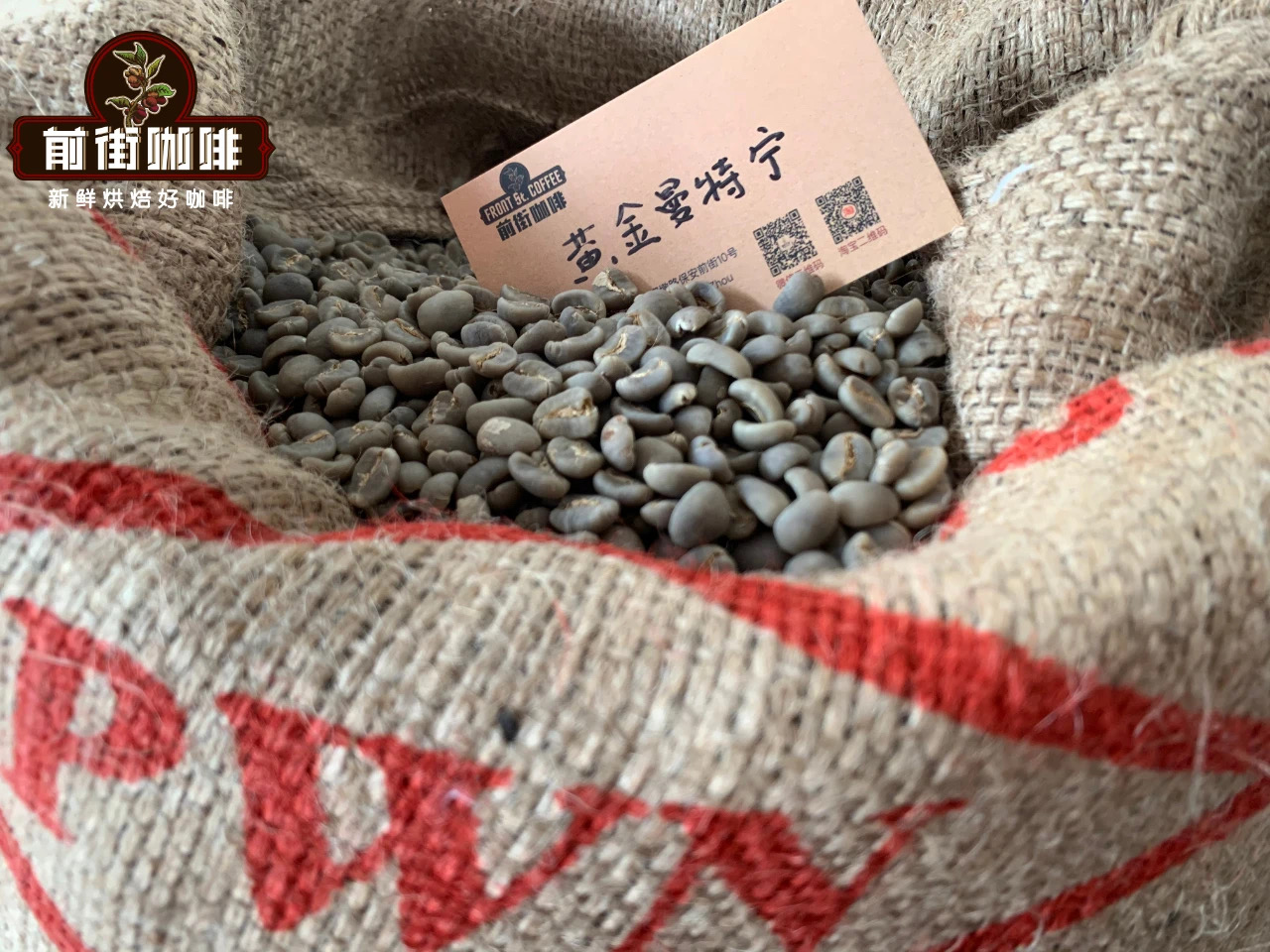
That Indonesian coffee merchant is the Pwani Coffee Company, better known as PWN—and it is also the trademark owner of Golden Mandheling.
Mandheling Coffee
Mandheling is often simply called "Sumatran coffee." Much of what northern Sumatra produces is Gayo, grown mostly from Ateng varieties; the Lake Tawar area in the far north is marketed as Aceh coffee or Lake Tawar coffee. The name Mandheling properly belongs to coffee from the Lintong area and the Lake Toba region in the south—Lintong being the true Mandheling district. The beans come from the mountains around Lake Toba, a high-altitude freshwater lake averaging about 900 meters, located north of Medan, Sumatra's capital. Sumatra's singular environment defines the cup: heavy body, intense flavor, and subtle notes of chocolate and herbs.
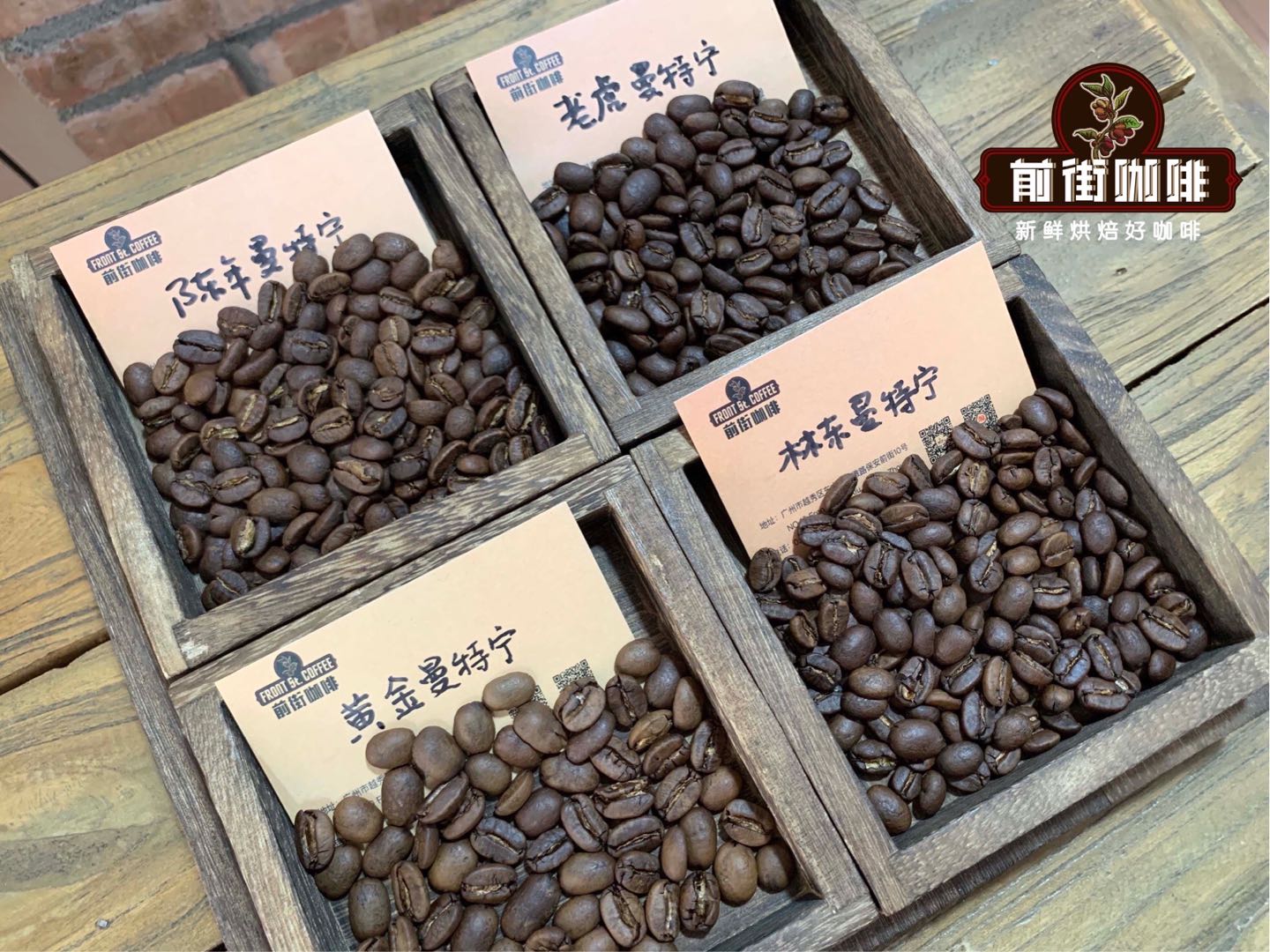
The beans are big and dense, which makes defects a constant risk in cultivation—hence the exacting hand-sorting after harvest, without which quality becomes a lottery. Roast level changes the cup dramatically too, which is why Mandheling remains such a contested single origin. Its appearance is honestly among the homeliest in the coffee world, but as the saying goes, never judge a book by its cover: these unglamorous beans are mellow, smooth, and finish with a distinct sweetness.
Characteristics of Mandheling Coffee
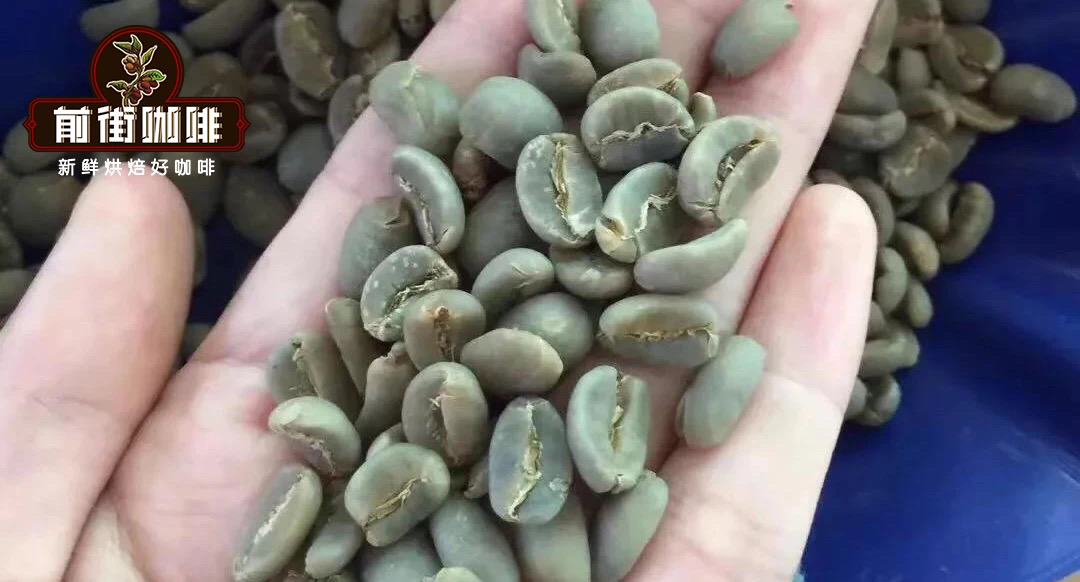
Mandheling is full-flavored and sweetly aromatic, with a clean bitterness and a mellow body threaded with sweetness. Because the beans carry little inherent acidity, the cup never turns sour or astringent—even after sitting on a warmer, or when brewed over ice. Roasted beans are on the larger side, with green beans that appear brown to dark green and a caramel-like aroma. The flavor is rich and deep. Most enthusiasts drink it straight as a single origin, but it is also an indispensable component of espresso blends.
What Are the Common Types of Mandheling?
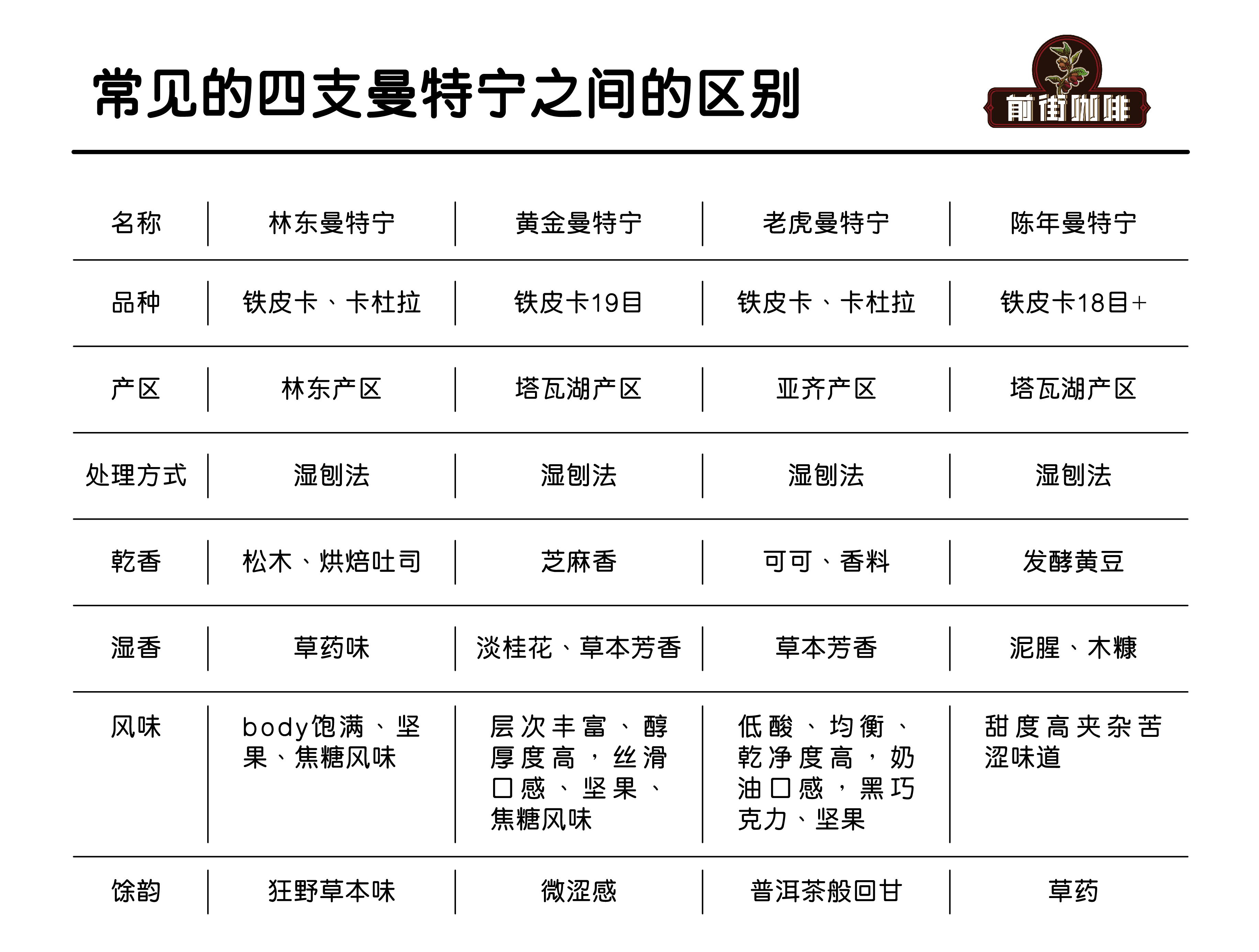
FrontStreet Coffee currently carries four: Lintong Mandheling, Golden Mandheling, Tiger Mandheling, and Aged Mandheling. The table below summarizes their details:
FrontStreet Coffee Lintong Mandheling
Region: Lintong area
Elevation: 1100-1600m
Variety: Typica, Caturra
Processing: Wet-hulled
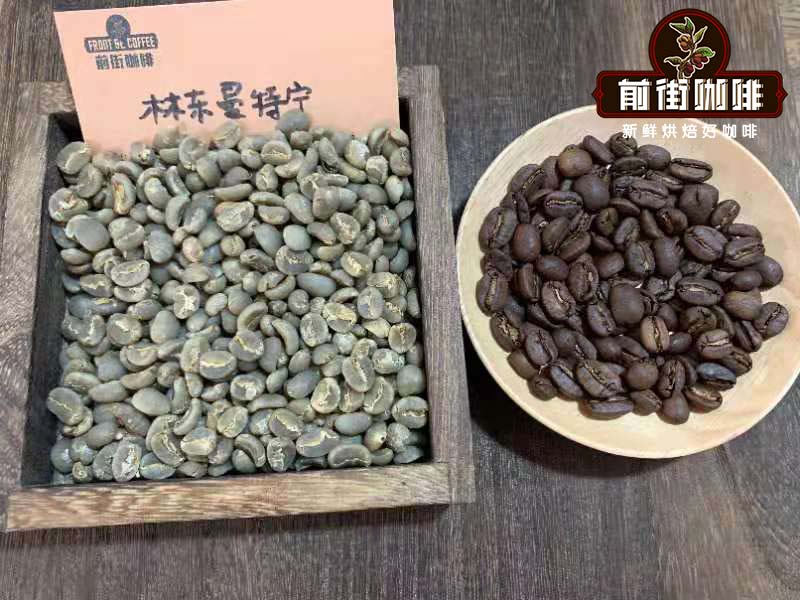
A premium Mandheling from the Lintong area, with large, hard beans. Indonesian coffee quality varies enormously, but what the world means by "Mandheling" is Typica and its kin grown in the mountains around Lake Toba. Connoisseurs have long said that Sumatran Mandheling has the best texture of any coffee on earth. Its higher defect rate demands rigorous sorting at the mill, but the reward is a cup of rich flavor, sweet aroma, pure bitterness, and mellow body with just a trace of sweetness and acidity—reasons enough for why it remains essential in blending.
FrontStreet Coffee Golden Mandheling
Region: Aceh, GAYO Mountain
Elevation: 1100-1600m
Variety: Ateng
Processing: Wet-hulled
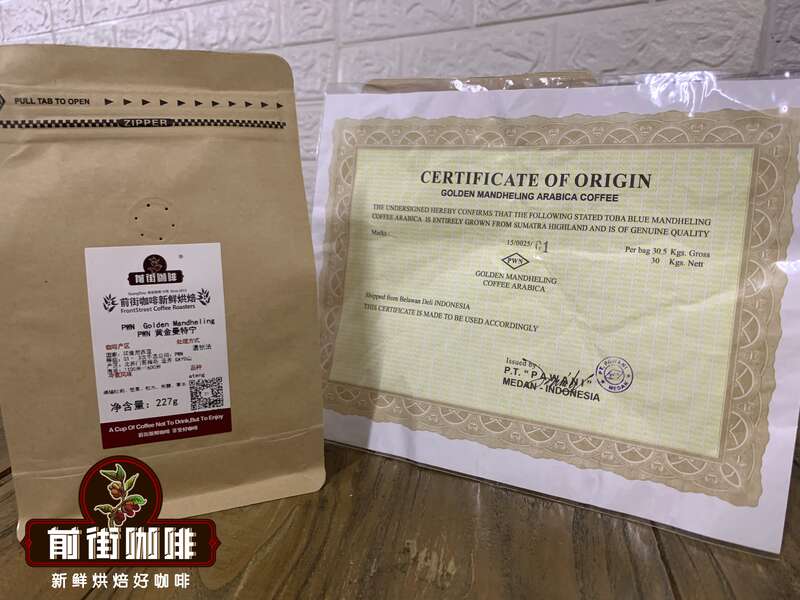
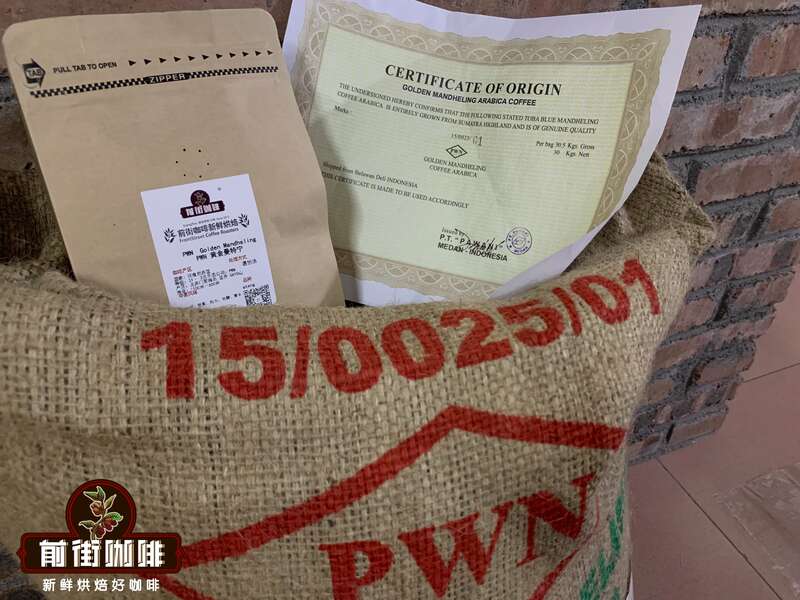
"Golden Mandheling" is a trademark of Indonesia's PWN company, so the name is exclusive to PWN—and most Golden Mandheling on the market is PWN's.
FrontStreet Coffee's current-harvest Golden Mandheling comes from the GAYO mountains of Aceh in northern Sumatra. The variety is Ateng, a cross between Arabica and Robusta that is planted widely across Sumatra and the other Indonesian islands—Ateng is in fact the local name for Catimor. Quality standards here are stricter still: first, bean size must hit 19 screen with plump, uniform particles; then the lot passes one machine sort and three rounds of hand-sorting to drive down the green-bean defect rate.
FrontStreet Coffee Tiger Mandheling
Region: Aceh
Elevation: 1500m
Variety: Typica, Caturra, Sidikalong
Processing: Wet-hulled
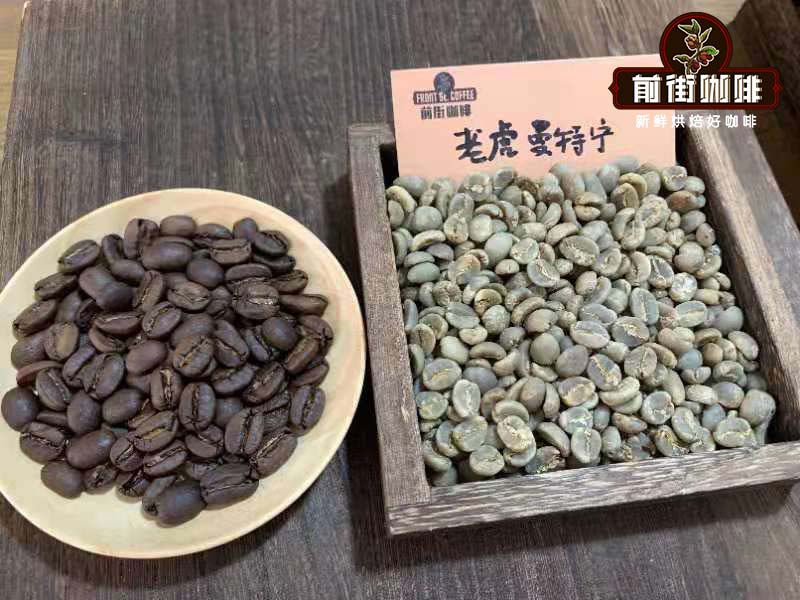
Tiger Mandheling is the label for Mandheling above 17 screen with a defect rate under 4%. Its dominant varieties, Caturra and Typica, each contribute something: Caturra brings citrus and lemon brightness, Typica a lingering sweet finish, giving Tiger Mandheling its balance and clarity. FrontStreet Coffee's lot shows an even profile with clear cream, dark chocolate, and nut notes.
FrontStreet Coffee Aged Mandheling
Region: Sumatra
Variety: Typica
Processing: Wet-hulled
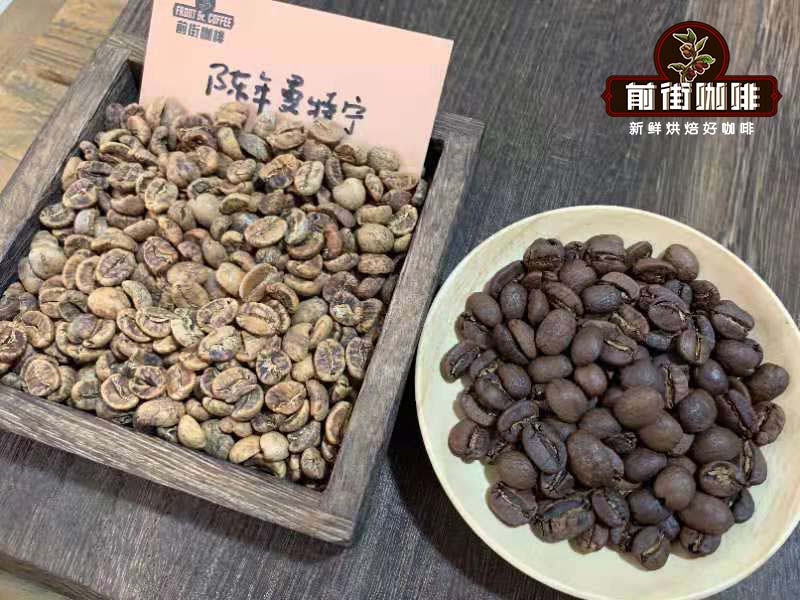
"Aged" doesn't just mean storing green beans for a long time—coffee held carelessly spoils, fading from fresh green to white to yellow, going flavorless, even attracting insects. Like fine wine, true aged coffee requires deliberate handling and long, controlled storage. Aged beans (aged bean) are green coffee allowed to mature naturally over an extended period, usually 2-3 years, in cool, well-ventilated conditions. Over that time acidity drops, the color shifts, and the beans' texture firms up. Because the environment is dim and the timeline long, aged coffee often develops complex notes reminiscent of burlap or leather.
Brewing Parameters
FrontStreet Coffee always recommends freshly roasted beans—freshness is the single biggest factor in flavor. Every order ships within 5 days of roasting, because FrontStreet Coffee's roasting philosophy is "Freshly Roasted Good Coffee." Rest the beans about 4-7 days and they land in your cup right at peak flavor.
Filter: Kono filter
Water temperature: 86℃
Coffee dose: 15 grams
Coffee-to-water ratio: 1:15
Grind size: Medium-fine
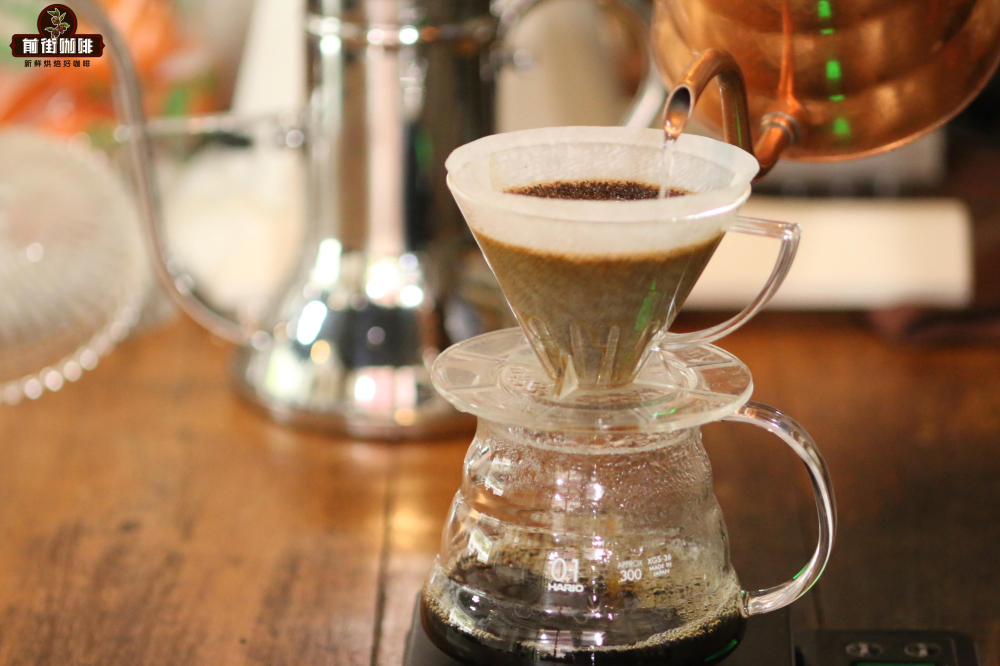
For everyday Mandheling, FrontStreet Coffee reaches for the KONO dripper, which rounds out the body and expresses flavor more directly. The KONO's only exhaust area sits in the lowest quarter of ribs: once the water level rises above them, drainage slows and the weight of the water builds gentle pressure. With such a restricted outlet, contact time between water and coffee stretches out, and the flowing water extracts soluble material more effectively. It's how FrontStreet Coffee consistently achieves the heavy body Mandheling drinkers expect.

Brewing Method: Segmented Pouring
Start with 30g of water for a 30-second bloom, then pour in small circles to 125g. When the level falls and the coffee bed is about to show, pour on to 225g and stop. When the bed is about to surface again, lift off the dripper. (Timing starts at the bloom.) Total extraction time: 2'00".
Colombian Coffee
Colombia's climate makes it a veritable "natural pasture" for coffee. The country is the world's second-largest producer after Brazil, the largest exporter of Arabica, and the largest exporter of washed coffee. Roughly 875,000 hectares of coffee stretch across 590 cities and 14 growing regions; on average the country exports 75% of its crop, which represents 10% to 16% of agricultural GDP.

What surprises many visitors is how small-scale it all is: 60% of Colombian coffee farms are smaller than one hectare, and only 0.5% of the coffee-growing area exceeds 20 hectares.
Colombian coffee is a benchmark Arabica and a traditional favorite for darker roasts, with a strong, memorable cup. The signature profile: a thick, rich aroma, bright high-quality acidity, excellent balance, sometimes a nutty streak, and an endlessly lingering finish. By both looks and cup quality, it sits firmly in the premium tier.
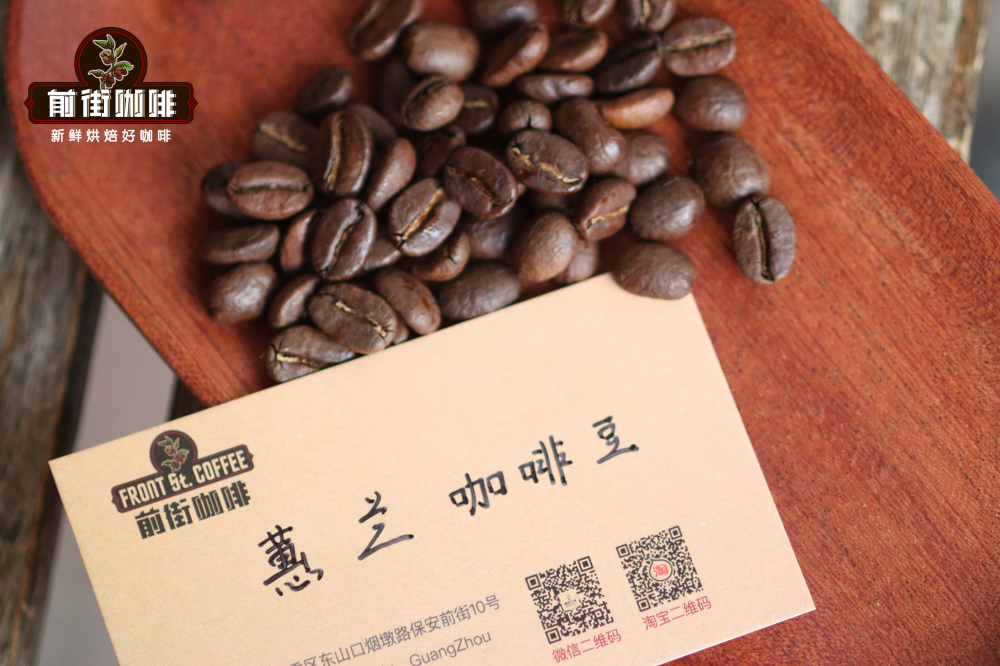
Volcanic Soil + Family Farms
Legend has it that missionaries carried coffee in from Venezuela in 1730 and planted it in the country's southeast; civil war and politics later pushed cultivation west into the mountains. Under ideal altitude and volcanic soils, Colombian coffee has charmed premium buyers in the United States and Japan since the 1940s. Growers husband their land carefully—from fertilizer choice to land management, everything is done in moderation to prevent soil exhaustion. Besides coffee, they interplant tall shade trees and bananas, and build shade structures over young seedlings to secure the cool, humid microclimate coffee needs. Because the coffee forests are humid with narrow day-night temperature swings, the beans ripen slowly. The other great advantage over Brazil is the family-farm model: without heavy harvesting or irrigation machinery, and without the budget to hire laborers, every cherry is picked by hand at full ripeness—which favors the accumulation of caffeine and aromatic compounds and yields the best possible quality.

Colombian Coffee Regions
Colombian coffee splits into commercial-grade and specialty-grade zones. The commercial zones cluster in the center and north, dominated by large corporate farms—foremost among them the famous "MAM" trio of Medellín, Armenia, and Manizales, whose cups show the familiar Central American style with punchy fruit acidity. Bucaramanga in the northeastern Santander province, however, is known for low acidity and a strong bitter aroma, something like an Indonesian Mandheling (possibly because the lower western altitudes mute the acidity).
The specialty zones lie mainly in the south, at elevations above 1,500 meters, in volcanic terrain—home to celebrated regions like Cauca, Huila, Meta, and Nariño. The flavor signature is caramel sweetness laced with delicate berry fragrance and acidity—sweetness you can't miss.

Colombian Coffee Varieties
With strong government backing for coffee cultivation, Colombia has diversified its varietal portfolio. Typica, as elsewhere, is the longest-planted variety—superb in the cup, but its low yields and heavy agronomic demands have pushed many farmers toward more productive options.
Bourbon is another old-timer, though now confined to a handful of areas. FrontStreet Coffee previously offered a Pink Bourbon from Finca Paraíso in Cauca—a Bourbon variety with a clean, fresh cup.
Caturra is the workhorse of Colombian coffee. A natural Bourbon mutation, it needs no shade, stays short for easy picking, branches generously, and out-yields its parent. FrontStreet Coffee's current "Hanayatsuki" and "Rose Valley" are both Caturras.
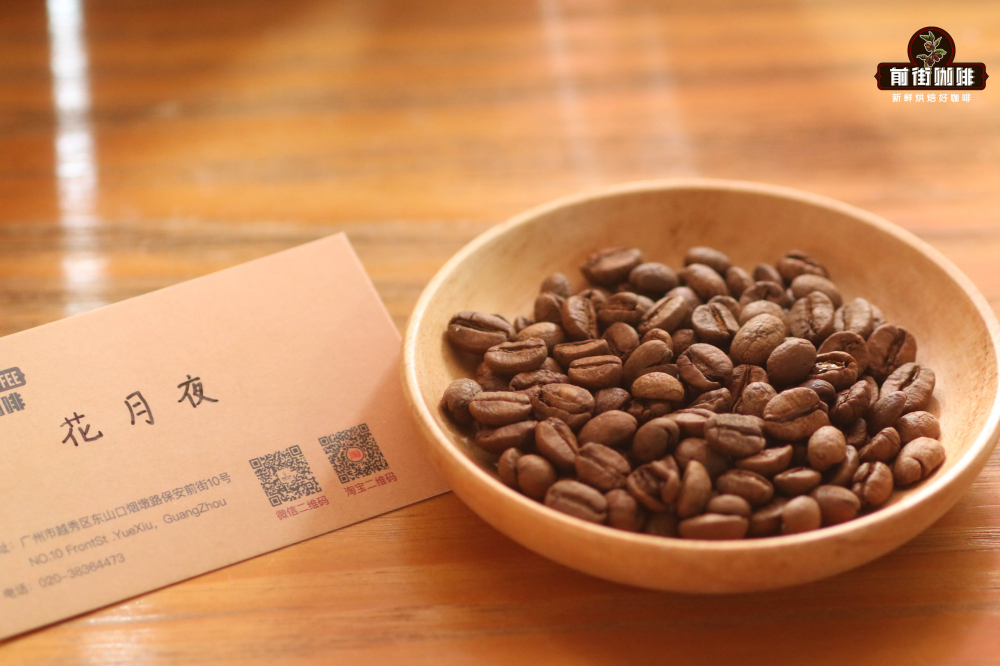
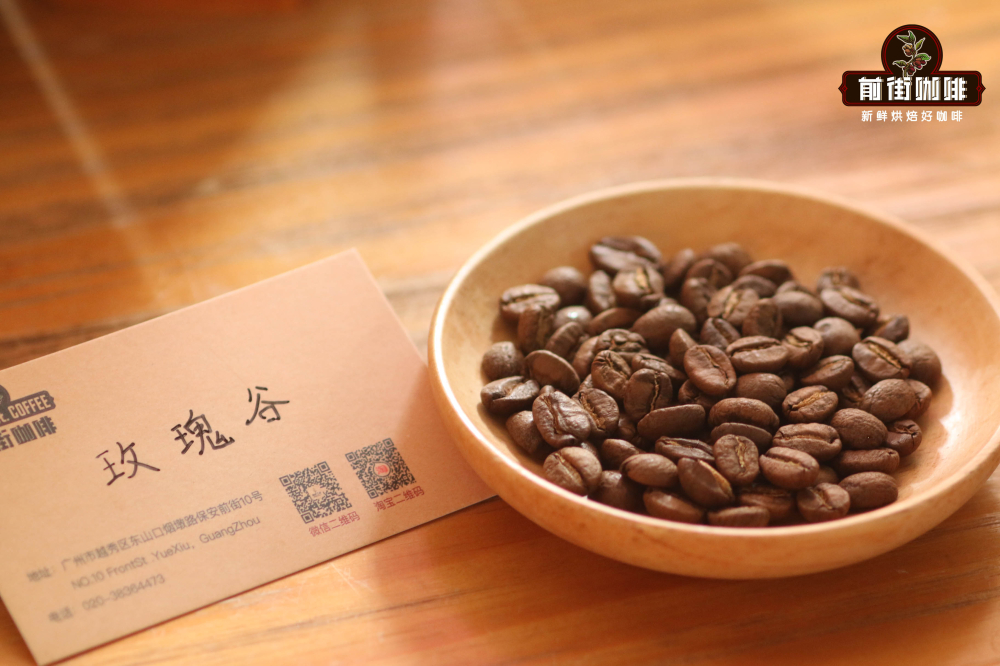
Castillo is the new-generation leaf-rust-resistant variety developed jointly by the Colombian Coffee Growers Federation (FNC) and the National Coffee Research Center Cenicafé, which continues refining it for higher yields, stronger resistance, and cup quality to match Caturra. FrontStreet Coffee's "Sakura" is a Castillo from Finca El Paraíso in Cauca.
Let's use Sakura as a window into Colombian Castillo.
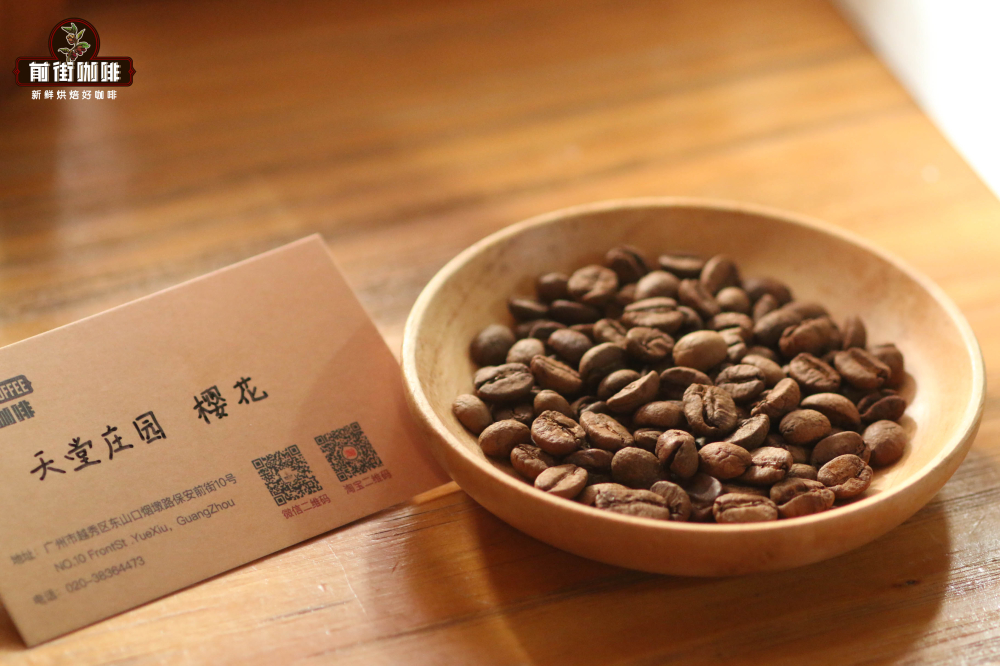
FrontStreet Coffee Colombian Sakura
Country: Colombia
Region: Cauca
Farm: Finca El Paraíso
Variety: Castillo
Processing: Double Anaerobic Washed
Elevation: 2050 meters
Brewing Recommendations
Recommended method: Pour-over
Filter: V60 filter
Water temperature: 90-92°C
Coffee dose: 15 grams
Coffee-to-water ratio: 1:15
Grind size: Medium-fine

As always, brew with freshly roasted beans to get everything the coffee has to give. FrontStreet Coffee ships every order within 5 days of roasting under its "Freshly Roasted Good Coffee" promise, and with a 4-7 day resting period the beans arrive right at their flavor peak.
Bloom with 30g of water for about 30 seconds. Pour in small circles at the center up to 125g; once the level drops and the bed is about to show, pour to 225g to finish. Lift the dripper when the bed is about to surface again. (Timing starts at the bloom.) Extraction time: 2'00".
The dry aroma carries an intense spiced-tea fragrance with clear florals, while the double anaerobic washed process adds mugwort, mint, and eucalyptus. In the cup: berry and strawberry-candy sweetness with a gentle fruit acidity.
Who Are Mandheling and Colombian Coffee For?
Mandheling Coffee
Choose Mandheling if you love body and intensity. Its flavor is bold and vibrant—neither astringent nor sour, with body and bitterness fully on display. By looks it may be the homeliest bean in the shop, but drinkers will tell you the uglier the Sumatran bean, the richer and smoother the cup. Mandheling is often called the most full-bodied coffee in the world: on the tongue you feel an unmistakable silkiness, with low but clearly present acidity—a lively micro-acidity dancing through the deep aroma that lets you catch the bright spark inside all that gentleness. There's also a faint earthiness underneath, which some describe as a herbal, plant-like fragrance.

Colombian Coffee
If you lean toward a lighter, brighter cup, reach for Colombian coffee. Roasted, the beans give off a sweet aroma, with acidity that turns to sweetness and a bitterness kept in check—the balance that makes it a staple of premium blends. The fragrance is light and elegant, neither as punchy as Brazilian coffee nor as tart as African coffee: a soft, sweet perfume, understated and refined.
For more professional coffee knowledge and coffee bean information, follow FrontStreet Coffee (WeChat official account: cafe_style).
And for more specialty coffee beans, add FrontStreet Coffee's private WeChat, ID: kaixinguoguo0925.
FrontStreet Coffee Recommendation
If this tour has you leaning toward Mandheling, the top pick at FrontStreet Coffee is its PWN Golden Mandheling. Sourced from Indonesia's PWN company, it is held to extraordinary standards: beans must be 18 screen or larger, each 300g green-bean sample may contain fewer than 3 defective beans to meet the top G1 grade, and three rounds of hand-sorting strip out remaining flaws. The result is a cup with exceptional cleanliness and sweetness—and one reason genuine Golden Mandheling, most of which is earmarked for the Japanese and American markets, is so hard to find elsewhere. FrontStreet Coffee's listing includes PWN's certification papers and the PWN-stamped bags that set the genuine article apart.
Prefer something wilder? FrontStreet Coffee's Lintong Mandheling, from the traditional Lake Toba district, is fragrant and intense, sweetly bitter, with clove and woody aromatics on entry. Roasted medium-dark, it stays low in acidity and layers spice and mint over a thick, lasting sweetness—that unmistakable earthy-herbal signature the wet-hulled process creates.
To brew either one as pour-over, FrontStreet Coffee suggests 15g of coffee at a coarse granulated-sugar grind, 87-88°C water, and a 1:15 ratio in three pours: 30g of water for the bloom to wet the bed and degas, about 100g in the second pour to lift the crust and raise the bed, then a gentle final center pour of 95g to draw out sweetness. Expect a dense, syrupy body with caramel sweetness and chocolate-nut flavors. And if you'd rather run it through an espresso machine, the FrontStreet Coffee classic blend—Brazilian cream-and-nuts enriched with medium-dark Mandheling, a touch of Robusta for crema—adds butter, roasted chestnut, caramel, and sandalwood-herbal spice, pulling gorgeous shots for lattes and Dirty alike.
Important Notice :
FrontStreet Coffee is a long-established specialty coffee roaster in Guangzhou China, selling freshly roasted beans from its own farm in Yunnan as well as dozens of carefully selected single-origin beans from around the world for both pour-over and espresso. The products deliver consistently excellent quality and great value, with shipping within 24 hours. Guangzhou's FrontStreet Coffee shop is recommended by many coffee lovers, and the beans are now available online at the Tmall 。
FrontStreet Coffee has moved to a new address:
FrontStreet Coffee Address: 315,Donghua East Road,GuangZhou
Tel:020 38364473
 Scan and follow the En Gafei WeChat official account. Please indicate that the reprint comes from "En Gafei".