Introduction to Blue Mountain Coffee and Its Historical Development
FrontStreet Coffee's Blue Mountain Coffee comes from Jamaica and is celebrated worldwide as one of the finest coffees anywhere. It has a pure taste, with acidity, sweetness, and bitterness in balance, and gives off an alluring, elegant aroma.
The Blue Mountains
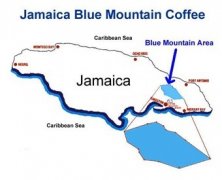
Jamaica is not a large island. The Blue Mountain Range lies northeast of the capital, Kingston. It earned its name because, on clear days, when the Caribbean Sea surrounds it, direct sunlight strikes the azure water and the peaks reflect back the sea's brilliant blue glow. The highest peak of the Blue Mountains rises to 2,256 meters, making it the tallest in the Caribbean and a well-known tourist destination. The area sits within the coffee belt, with fertile volcanic soil, clean unpolluted air, and a humid climate of year-round mist and rain (average precipitation of 1,980 millimeters and a temperature of around 27°C). Those conditions gave the world Jamaican Blue Mountain Coffee — and the world's most expensive coffee.
The History of Blue Mountain Coffee
In 1717, King Louis XV of France ordered coffee to be cultivated in Jamaica. In the mid-1720s, Jamaica's governor, Sir Nicholas Lawes, imported Arabica seeds from Martinique and began promoting cultivation in the St. Andrew area. To this day, St. Andrew remains one of the three major producing regions for Jamaican Blue Mountain Coffee, alongside the Portland region and the St. Thomas region. Within eight years, Jamaica was exporting more than 375 tons of pure coffee.
In 1932, production peaked, with the harvest exceeding 15,000 tons. In 1950, the Jamaican government established the Jamaica Coffee Industry Board, which sets quality standards for Jamaican coffee and oversees their enforcement to protect the coffee's quality. The board issues special official seals for raw and roasted coffee exported from Jamaica, making it one of the world's most authoritative national coffee bodies. Today, six marks can indicate the origin of Blue Mountain Coffee: M.B.C.E (Mavis Bank Central Factory), M.H.C.C.T. (Blue Mountain Coffee Cooperative), P.X.X.S.H. (Portland Blue Mountain Coffee Cooperative), Coffee Industry Association (Wallenford), Coffee Industry Association (John's Peak), and J.A.S (Blue Mountain). By 1969, matters had improved, as Japanese loans were used to raise production quality and steady the market. Today, this coffee commands a level of genuine devotion. By 1981, Jamaica had brought another 1,500 hectares of land under coffee, followed by a further 6,000 hectares.
In fact, today's Blue Mountain region is a small area of only 6,000 hectares of planting land, so it is impossible for every coffee labeled "Blue Mountain" to have been grown there. Another 12,000 hectares are given over to two other coffees: High Mountain Supreme Coffee and Jamaica Prime Washed Coffee.
The Current Status of Blue Mountain Coffee
Blue Mountain Coffee's ability to hold its premium standing today also owes something to the local government's policy of limiting production to protect quality. Jamaica has never chased mass production at the expense of quality simply because Blue Mountain Coffee became famous. It puts quality first, preferring to sacrifice yield rather than tarnish the coffee's esteemed reputation. Brazil, the world's largest coffee producer, turns out 30 million bags (60 kg each) a year, while Jamaica produces only just over 40,000 bags — a striking difference in volume.
Blue Mountain beans are graded by quality. The top-grade beans generally never reach the open market, since most are pre-ordered by royalty and wealthy buyers. What does reach the market is "Blue Mountain" branded coffee certified by the Jamaican government. According to figures from the International Coffee Organization's website, in the 2003–2004 season Jamaica produced a total of 43,000 bags of coffee, of which 24,000 were exported. Nearly 90% of that exported volume goes to Japan, with the rest entering European and American markets. With production limited and export volumes small, Blue Mountain Coffee has always been in short supply on the international market.
In recent years, coffee shops have sprung up across China like mushrooms after rain, and premium Blue Mountain Coffee naturally became something people pursued, young people especially. For a time it seemed that only those who had tasted Blue Mountain Coffee had truly experienced coffee, and a shop that didn't sell it hardly counted as a real coffee shop. In China, a cup of "Blue Mountain Coffee" runs from over 30 to over 100 RMB, which is a considerable sum. Yet China holds no direct import quota for Blue Mountain Coffee from Jamaica, and the International Coffee Organization has no record of Blue Mountain green beans being exported to China. So a word of caution: even after paying a high price, the coffee in your cup may well not be genuine Blue Mountain.
FrontStreet Coffee Recommendation
If you want to know what authentic Blue Mountain balance tastes like, FrontStreet's Jamaica Blue Mountain No. 1 is the coffee to try. One of the highest grades in the Jamaican Blue Mountain system — held to strict standards for bean size, defect rate, and overall quality — it comes from the long-established Clifton Estate, where coffee has been grown since around 1750. Steeped in the classic Blue Mountain character, it is roasted medium-dark, so the cup unfolds in layers of nut, dark chocolate, and cream caramel with a soft sweetness, acidity, sweetness, bitterness, and aroma all pulling in the same direction.
Thanks to that remarkable balance, Blue Mountain works well in almost any brewer. For pour-over, FrontStreet suggests a 1:15–1:16 ratio, water at 85–88°C, and a medium-coarse grind; a moka pot also suits it beautifully with a slightly finer grind, hot water in the base, and a gentle heat. Whichever you choose, you get a clean, complex, and gentle cup that has been the trademark of this legendary coffee for decades.
Important Notice :
FrontStreet Coffee is a long-established specialty coffee roaster in Guangzhou China, selling freshly roasted beans from its own farm in Yunnan as well as dozens of carefully selected single-origin beans from around the world for both pour-over and espresso. The products deliver consistently excellent quality and great value, with shipping within 24 hours. Guangzhou's FrontStreet Coffee shop is recommended by many coffee lovers, and the beans are now available online at the Tmall 。
FrontStreet Coffee has moved to a new address:
FrontStreet Coffee Address: 315,Donghua East Road,GuangZhou
Tel:020 38364473
 Scan and follow the En Gafei WeChat official account. Please indicate that the reprint comes from "En Gafei".