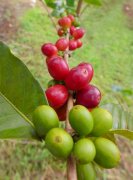
Characteristics of Guatemala La Tacita Coffee Beans & Brewing Methods from La Tacita Estate

Coffee first arrived in Guatemala in 1750, brought by Jesuit priests, and German colonists built the local coffee industry in the late 19th century. Today most production happens in the southern part of the country. Guatemala has seven main growing regions, Antigua, Cobán, Lake Atitlán, Huehuetenango, Fraijanes Plateau, Oriente, and San Marcos, each with its own climate and therefore its own cup character. Broadly speaking, Guatemalan coffee shows a smooth, rich texture with elegant aromatics and a pleasant, warm fruit-like acidity, truly the nobility among coffees.
Flavor Profile
Black tea, floral notes, rich caramel.
Fraijanes Plateau Region
Volcanic soil, high altitude, a humid and rainy climate, and active volcanism have shaped the Fraijanes Plateau's singular terroir. The Pacaya volcano here is the most active of Guatemala's three still-erupting volcanoes, frequently dusting the plateau with a thin layer of ash that feeds its soil with abundant minerals. The drying season for coffee coincides with the plateau's sunniest stretch, mornings are often cloudy and foggy, but the haze burns off quickly, guaranteeing plenty of sunshine.
La Tatisha Estate
Coffee cultivation at La Tatisha Estate in the Fraijanes Plateau began in 1920. The estate grows a diverse mix of varieties: Bourbon, Caturra, and Pacamara. Of the 205-acre farm (1 acre = 4,046.8 square meters), 173 acres are dedicated to coffee, while the remaining 32 acres of native forest shelter local wildlife. Several natural springs on the property supply ample, high-quality irrigation through the dry season and also power the mill (the water used for washed processing).
Brewing Method
Pour-over for Guatemalan La Tatisha: 15g of coffee at a medium grind (Fuji grinding burr, #4), V60 dripper, water at 88-89°C. First pour 30g of water and bloom for 27 seconds. Continue to 105g, then pause. Once the bed level drops to halfway, pour slowly up to 225g and skip the tail. Water-to-coffee ratio 1:15, extraction time 2:00.
Coffee Varieties
Bourbon coffee (French: Café Bourbon) is produced from Arabica trees of the Bourbon cultivar. It was first cultivated on Réunion Island, then known as Bourbon Island (Île Bourbon) before 1789, and later spread by France to Africa and Latin America; it now grows in two of the world's most popular Arabica production zones. Bourbon is typically grown at elevations between 3,500 and 6,500 feet (1,062–1,972 meters).
Caturra: a single-gene mutation of Bourbon, discovered in Brazil in the 1950s. Both yield and disease resistance outstrip Bourbon's, with comparable flavor. It grows well from 700 to 1,700 meters and adapts readily to altitude, though yields taper off at the higher end.
Coffee Grading Systems
Grading systems worldwide remain unharmonized, each producing country keeps its own scheme and names, which is why you'll see terms like "SHB," "AA+," "Supremo," "Extra-Fancy," or "Peaberry" on packaging. Marketed roasted beans sometimes list the single-origin grade; the more detailed the grade information, the better the coffee usually is. Most everyday coffees, however, don't display it at all.
Product Information
Roaster: FrontStreet Coffee
Ingredients: In-house roasted
Shelf life: 90 days
Net weight: 227g
Packaging: Bulk
Taste: Aromatic coffee beans
Roast level: Medium roast
Sugar content: Sugar-free
Origin: Guatemala
Coffee type: Other
Coffee Details
Guatemala Finca Las Delicias
Country: Guatemala
Grade: SHB
Region: Fraijanes, Guatemala City
Altitude: 1,675 meters
Harvest period: October to February of the following year
Processing method: Washed
Varieties: Bourbon, Caturra
Processing mill: La Tatisha Estate
FrontStreet Coffee Recommendation
Coffee with Floral Character
FrontStreet Yirgacheffe Worka (Guodingding) Cooperative
Few origins are as famous as Yirgacheffe. FrontStreet's Worka Cooperative lot carries the classic washed-Yirgacheffe profile the area is known for worldwide: white-floral sweetness and bright citrus acidity, with florals remarkably close to jasmine and a green-tea finish. Poured over, it shows clear floral-fruit tones, an uplifting lemony acidity, and honeyed sweetness. It also shines as a cold brew, low-temperature steeping draws out more of the coffee's light, small-molecule compounds, yielding an iced coffee as refreshing as fruit tea.
FrontStreet Natural Flower Queen (Huakui)
Part of what makes Flower Queen one of the most celebrated specialty coffees is its creamy strawberry flavor, a gift of the natural process, where fully ripe cherries develop rich, sweet aromatics during drying. The silky entry evokes light orange blossom, and the juicy sweet-tart lift of tropical fruit like guava and mango adds another layer of depth.
FrontStreet Strawberry Candy Coffee
If single origins are about tasting one place's distinct character, blends are about richness and layers. The Strawberry Candy Geisha Blend marries Costa Rican honey processing with washed Panama Geisha, so the brewed cup takes the best of both: aromas of raisin, orange, and ripe blueberry, a rose-like heady fragrance, and a whisper of almond on the finish. Incredibly expressive, great for pour-over, cold brew, home espresso machines, moka pot, or a Clever dripper.
FrontStreet Mozart Coffee
Mozart comes from Costa Rica, a country famous for honey processing, and uses a distinctive raisin-honey process: the de-pulped fruit is briefly fermented before drying. The finished beans carry layered notes of dried fruit, ripe pineapple, and sweet orange, and as hot water hits the grounds they release an enchanting osmanthus fragrance, richly aromatic yet cleanly sweet. Ideal for cold brew and iced pour-over.
FrontStreet Boquete Geisha
FrontStreet's Boquete Geisha comes from the small Panamanian town that produced legendary estates, Hacienda La Esmeralda among them, proof of just how privileged the terroir is. This Geisha shows the classic orange-blossom honey character: a white, coffee-flower fragrance as it brews, then citrus, sweet melon, and honey in the cup with a caramel undertone that keeps you coming back. Works across pour-over, drip bags, cold brew, Clever dripper, and French press.
Important Notice :
FrontStreet Coffee is a long-established specialty coffee roaster in Guangzhou China, selling freshly roasted beans from its own farm in Yunnan as well as dozens of carefully selected single-origin beans from around the world for both pour-over and espresso. The products deliver consistently excellent quality and great value, with shipping within 24 hours. Guangzhou's FrontStreet Coffee shop is recommended by many coffee lovers, and the beans are now available online at the Tmall 。
FrontStreet Coffee has moved to a new address:
FrontStreet Coffee Address: 315,Donghua East Road,GuangZhou
Tel:020 38364473
 Scan and follow the En Gafei WeChat official account. Please indicate that the reprint comes from "En Gafei".