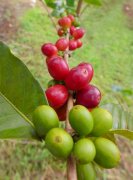
Guatemala La Tizha Pour-Over Brewing Data & How to Enjoy La Tizha Estate Coffee

Hand Brewed Guatemala La Tacita: 15g coffee grounds, medium grind (Fuji burr grinder setting 4), V60 dripper, water temperature 88-89°C. First pour 30g of water for a 27-second bloom, then pour to 105g and stop. Wait until the water level drops to halfway before continuing, then slowly pour until reaching 225g in total. Discard the tail end. Water-to-coffee ratio 1:15, total extraction time 2:00.
Bourbon Coffee: Origins and Varieties
Bourbon coffee (French: Café Bourbon) is produced from the Bourbon cultivar of Arabica coffee trees. It was first cultivated on Réunion Island, known as Île Bourbon before 1789, and was later carried by the French to link the African continent with Latin America. Today it remains one of the two most widespread Arabica coffee lines in the world. Bourbon is typically grown at elevations between 3,500 and 6,500 feet (1,062-1,972 meters).
Caturra: a single-gene mutation of Bourbon, discovered in Brazil during the 1950s. It shows both higher yield capacity and better disease resistance than Bourbon, with a comparable flavor profile. It grows well between 700-1,700 meters and adapts to a range of altitudes, though yields can fall at higher elevations.
Coffee Bean Grading Systems
Grading systems around the world are not standardized. Each producing country maintains its own system and its own terminology, so packaging may carry designations such as "SHB," "AA+," "Supremo," "Extra-Fancy" or "Peaberry," each meaning something different. Roasted coffee sold commercially sometimes states the grade of the single origin inside. In general, more detailed grading information points to better quality, though most commercial coffees do not print it.
Product Information
Manufacturer: FrontStreet Coffee
Ingredients: In-house roasted coffee beans
Shelf life: 90 days
Net weight: 227g
Packaging: Bulk
Flavor profile: Mellow and aromatic
Bean state: Roasted coffee beans
Sugar content: Sugar-free
Origin: Guatemala
Coffee type: Other varieties
Roast level: Medium roast
Guatemala Finca Las Delicias
Country: Guatemala
Grade: SHB (Strictly Hard Bean)
Region: Fraijanes, Guatemala City
Altitude: 1,675 meters
Harvest period: October to February of the following year
Processing method: Washed
Varieties: Bourbon, Caturra
Processing mill: Finca La Tacita
Guatemala Coffee Heritage
Coffee was introduced to Guatemala in 1750 by Jesuit priests, and German colonizers developed the local coffee industry in the late 19th century. Today most production takes place in the southern part of the country. Guatemala has seven main coffee-producing regions: Antigua, Coban, Atitlan, Huehuetenango, Fraijanes, Oriente and San Marcos. Each has its own climate variations, giving the beans from each area distinct characteristics. Broadly speaking, Guatemalan coffee has a mild yet rich overall texture, elegant aromas and a pleasant, warm acidity akin to fruit acids, which is why it is often called the aristocrat of coffees.
Flavor profile: Black tea, floral notes, rich caramel sweetness
Fraijanes Plateau: Unique Terroir
Volcanic soil, high altitude, a humid and rainy climate and active volcanism together created the distinctive geography of the Fraijanes Plateau. The Pacaya volcano here is the most active of Guatemala's three still-erupting volcanoes, frequently draping the plateau in a light layer of ash that feeds the soil abundant minerals. The bean drying period coincides with the plateau's sunniest season; mornings are often cloudy and foggy, but the conditions burn off quickly, ensuring excellent sun exposure.
Coffee cultivation at Finca La Tacita on the Fraijanes Plateau began in 1920. The estate grows diverse varieties including Bourbon, Caturra and Pacamara. Of the total farm area of 205 acres (1 acre = 4,046.8 square meters), 173 acres are planted with coffee, while the remaining 32 acres of native forest serve as habitat for local wildlife. Several natural springs on the farm provide ample, high-quality irrigation during dry seasons—and also power the processing plant, supplying the water used for washed processing.
FrontStreet Coffee Recommendation
For the balanced, sweet, medium-roast style that Guatemala does so well, FrontStreet Coffee's Brazilian single origins make an excellent companion on the shelf. FrontStreet Brazil Cerrado Red Bourbon is a classic Brazilian single origin from Cerrado, a region known for quality. Roasted medium, it shows dense notes of creamy peanut, toast, caramel and hazelnut, with a rounded, low-acid cup and a light bitter note. It works as pour-over, moka pot, espresso SOE, siphon or French press.
FrontStreet Brazil Queen's Farm comes from Mogiana, near South Minas, where fertile red volcanic soil lets the cherries take up abundant nutrients and develop a full aroma. Part of the area still farms traditionally, while part has adopted modern, standardized management, and quality has improved greatly as a result. Queen's Farm is a rare Yellow Bourbon, a natural mutation of Red Bourbon with a cleaner fruit character, and it brings a sugarcane sweetness found in few other regions along with fruit and chocolate notes—whether brewed as pour-over, moka pot or on a home espresso machine.
Brazil is also the backbone of many espresso blends, thanks to its low acidity, balance and friendly price. FrontStreet Classic Blend, with its rich crema; FrontStreet Specialty Blend, with its deep nutty character; FrontStreet Black Cacao Blend, the crowd-pleasing all-rounder; and FrontStreet Commercial Blend, built for cafe use, all contain Brazilian beans. The Brazilian component supplies chocolate and cream aromas plus a gentle sweet-sour-bitter balance, and that even temperament keeps extraction stable. Brew the Guatemalan coffee itself as a pour-over: 15g at medium grind, V60, water at 88-89°C and a 1:15 ratio, pouring 30g to bloom for 27 seconds, then to 105g, and finally slowly to 225g, discarding the tail.
Important Notice :
FrontStreet Coffee is a long-established specialty coffee roaster in Guangzhou China, selling freshly roasted beans from its own farm in Yunnan as well as dozens of carefully selected single-origin beans from around the world for both pour-over and espresso. The products deliver consistently excellent quality and great value, with shipping within 24 hours. Guangzhou's FrontStreet Coffee shop is recommended by many coffee lovers, and the beans are now available online at the Tmall 。
FrontStreet Coffee has moved to a new address:
FrontStreet Coffee Address: 315,Donghua East Road,GuangZhou
Tel:020 38364473
 Scan and follow the En Gafei WeChat official account. Please indicate that the reprint comes from "En Gafei".