The Origin of World Coffee: An Introduction to Ethiopian Coffee Bean Regions
Ethiopia: The Birthplace of Arabica Coffee
Ethiopia is the homeland of Arabica coffee, and it is in the forests of the Kaffa region that wild Arabica still grows. In the Ethiopian language, coffee is called "Bun" or "Buna," and the term "coffee bean" likely derives from "Kaffa Bun." Harar was among the first places where Arabica coffee was discovered, probably having spread from the Kaffa forest.
Ethiopian coffee is processed by both natural (dry) and washed methods, and the two produce markedly different cups. Generally speaking, washed Sidamo, Yirgacheffe, and Limmu show slightly lighter body and earthier flavors, while natural coffees offer wilder, fruitier profiles. Every batch varies in taste, though, so extensive cupping is required to find truly exceptional coffee.

FrontStreet Coffee · Ethiopia Harar / Sundried / Dry-Processed
Harar grows in the eastern highlands (Harerge province) at altitudes of 5,000-7,000 feet. A century ago it still grew wild on the mountainsides. The green beans are mostly medium-sized with pointed ends, greenish-yellow or golden in color, and they throw off a strong chocolate aroma during roasting. The flavor is wild, with moderate acidity and rich texture — a very typical mocha character. Good Harar carries jasmine fragrance and a fermented, wine-like aftertaste, to some extent resembling the Mattari from Yemen's Bani Matar region, perhaps even surpassing it.
Today's Harar is still processed by traditional natural methods and is typically exported through the nearby town of Dire Dawa. Annual production runs about 185,000 bags of 60kg, with exports commonly featuring Longberry beans (evolved from early Arabica cultivars), mostly in G4 or G5 specifications. Unfortunately, fine Harar is often smuggled into Yemen and resold at higher prices as mocha beans — a practice that continues unabated.
Besides being enjoyed as a single origin, its rich flavor and wine-like acidity also make it an excellent espresso base.
FrontStreet Coffee · Ethiopia Djimmah / Sundried
Djimmah, whose annual output accounts for about 50% of Ethiopia's total (1,000,000 bags of 60kg), grows in the southwestern highlands (bordering Kaffa and Illubabor) at altitudes of 4,400-6,000 feet. It is typically exported as G4/G5.
In recent years about 10-20% of Djimmah has been used to prop up the flavor of blends, and its quality has slipped below where it should be. Buyers' evaluations are polarized (a friend of mine uses Djimmah exclusively as the espresso base in his shop, and its intensity genuinely surprised me). Like Harar, it follows ancient natural processing and carries some wine-like acidity, slightly less pronounced than Harar's. It has medium body, a certain roughness, and earthy flavors.
FrontStreet Coffee · Ethiopia Ghimbi/Lekempti / Sundried, Natural Dry-Processed and Washed
Grown in the western highlands (Wollega province), north of Djimmah, at altitudes of 4,900-5,900 feet, most of these trees are wild varieties. Annual production is about 500,000 bags of 60kg, exported mostly as G4/G5. The beans are larger and longer than Longberry and greenish-brown in color. The flavor recalls jasmine tea but with more bitterness and less brightness than Harar; there is slight acidity with faint fruit and wine aromas — again a touch below Harar — but the texture and viscosity are excellent, which is why Ghimbi beans are nicknamed "poor man's Harar."
The flavor is complex yet balanced, coating the throat well with a long aftertaste when dark roasted. Many roasters prize it as a blending component, but it can also stand as a fine single origin, suited to after-dinner drinking.
FrontStreet Coffee · Ethiopia Limu / Washed
Grown in the southwestern highlands (bordering Shewa and Sidamo), east of Djimmah and north of Sidamo, at altitudes of 3,600-6,200 feet, Limu is a favorite of most European and American buyers. Most is washed, with annual production of about 110,000 bags of 60kg. The beans are medium-sized, mostly round (about 15/16 screen), and bluish-green, mostly exported as G2. The flavor recalls Yirgacheffe but with thinner viscosity and more prominent floral and fruit notes; the acidity is smoother than Yirgacheffe's, with more stimulating acidity and a wine-like aftertaste. It is an excellent, well-balanced coffee — a noteworthy Ethiopian specialty after Yirgacheffe. However, almost all Limu is vertically integrated and exported by the Ethiopian Coffee Organization, making it nearly impossible to find domestically.
It is said the variety suits medium roasting in fluidized-bed roasters rather than deep roasting, and peaks two to three days after roasting. In truth, good Limu and good Yirgacheffe are comparable — a matter of personal taste.
FrontStreet Coffee · Ethiopia Sidamo / Sundried, Natural Dry-Processed and Washed
Grown in the southernmost highlands (Sidamo province), southeast of Djimmah and directly south of the capital, at altitudes of 4,600-7,200 feet, Sidamo typically shows pronounced sweetness and is preferred by many drinkers. Annual production is about 225,000 bags of 60kg. The beans are smaller than Longberry and greenish-gray. On Sidamo's natural drying fields, coffee is laid on wooden racks with jute netting, where workers take turns stirring it by hand under the sun. Natural Sidamo is mostly exported as G4, while washed Sidamo, being more carefully processed, is mostly exported as G2.
Natural lots lean floral with some earthy notes; washed lots carry nutty, fruity aromas with a hint of cocoa. Both share a smooth mouthfeel and viscosity with comfortable, pleasant acidity. A medium roast suits single-origin brewing, while a dark roast works for blends and as an excellent espresso base.
FrontStreet Coffee · Ethiopia Yirgacheffe / Washed
The name comes from two parts: Yirga is a town name in Sidamo meaning "stable," and Cheffe means "municipality."
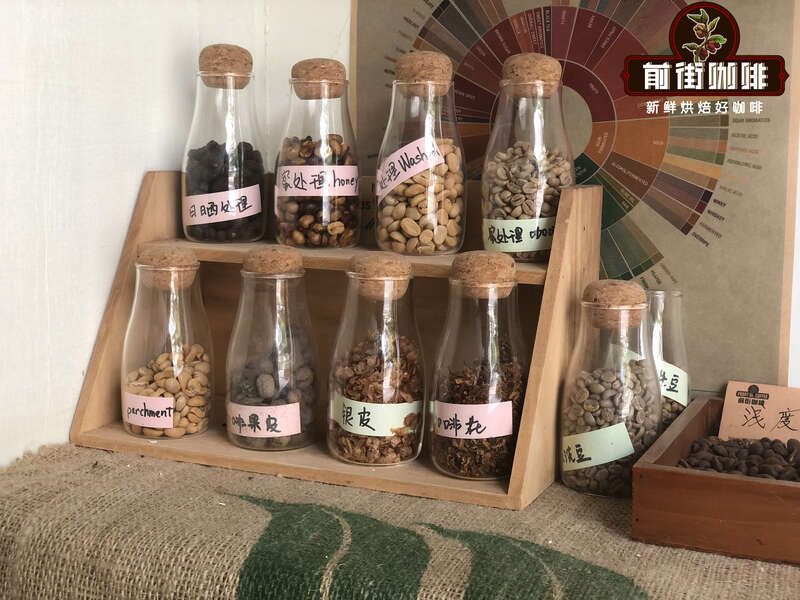
It grows in the southern highlands at altitudes of 5,700-7,800 feet, in the northwestern part of Sidamo province around Lake Abaya, and typically shows pronounced sweetness. Annual production is about 225,000 bags of 60kg. The beans are smaller than Longberry and greenish-gray, mostly washed. At the washing stations, harvested cherries ferment in water-filled tanks, stirred with simple wooden rakes to ease cleaning. The stations always carry a pungent fermented-fruit acidity and the sound of cherries knocking in the tanks. Once the cherries turn soft and sticky they are hulled and washed, leaving parchment-covered beans, which after a final rinse are dried outdoors beside the station.
The flavor combines lemon and citrus with excellent viscosity and complexity (though I personally feel its fame sometimes leads people to over-praise it, even though I enjoy it myself). Most is exported as G2 and suits a medium roast as a single origin.
Also worth mentioning are the coffees of Teppi and Bebeka, mostly produced by state-owned institutions in smaller quantities and little known abroad. Teppi grows at altitudes of 3,600-6,200 feet with annual production of about 50,000 bags of 60kg; Bebeka grows at 3,000-3,900 feet with about 30,000 bags of 60kg. Both are planted in the lower-lying southwest and used almost exclusively for blending.
Ethiopian Coffee Grades
FrontStreet Coffee's Ethiopian washed Yirgacheffe comes in G1 and G2.
The highest grades for Sidamo-area coffees (Yirgacheffe, Sidamo) are Grade 2 and Grade 3 (G2, G3).
Coffees from Ethiopia's eastern regions processed by natural methods are mostly Grade 4 or Grade 5 (G4, G5).
In many cases Grade 4 coffee is marked as Grade 5 to reduce taxation. Current grading is not fully unified and somewhat chaotic — natural Yirgacheffe can also be found as Grade 1 and Grade 2 — while Harar's highest grade is Grade 4 (G4).
Ethiopia's main coffee regions are Sidamo, Harrar, and Yirgacheffe. Sidamo and Harrar are provinces: Sidamo lies in the south, bordering Kenya; Harrar in the east, bordering Somalia. Although Yirgacheffe is a small area within the larger Sidamo region, thanks to its soil composition and water the coffee it produces is considered Ethiopia's finest.
In Western markets, Ethiopian coffee is generally sold and labeled as Yirgacheffe, Sidamo, and Harrar.
In the specialty sector, there are also coffees from five smaller regions: Limmu, Djimmah, Lekempti, Bebeka, and Wolega. The most commonly seen are Ethiopian Sidamo and Harrar.
Regional Coffee Profiles
FrontStreet Coffee · Harrar: from the eastern highlands, with medium-sized beans, greenish-yellow color, moderate acidity, full body, and a typical mocha flavor — one of the world's most famous coffees.
FrontStreet Coffee · Wollega (Nekempte): from western Ethiopia, with medium to large beans, famous for rich fruit flavors, greenish-brown color, good acidity and body. Suited to both blending and single-origin.
Limu: famous for its aromatic, wine-like flavors and popular in Europe and America. Good acidity and body; washed Limu is a specialty favorite. The beans are medium-sized, bluish-green, and mostly round.
FrontStreet Coffee · Sidama: medium-sized beans, greenish-gray color. Washed Sidamo is characterized by balanced mouthfeel and flavor — hailed as "sweet coffee" — with fine acidity and good body. From southern Ethiopia, suited to both blending and specialty single-origin.
FrontStreet Coffee · Yirgacheffe: strongly floral. The washed variety is among the world's best high-altitude coffees, with gentle acidity and rich body. Teppi and Bebeka coffees have low acidity but high body, making them indispensable blending components.
FrontStreet Coffee Recommendation: Start Your Ethiopian Journey with Washed Yirgacheffe
For a first taste of Ethiopia's specialty coffee, start with FrontStreet's Washed Yirgacheffe: white jasmine florals with bright citrus and lemon acidity over a clean, tea-like body — an approachable daily brew at a friendly price. To hear how processing changes the cup, try the FrontStreet Natural Red Cherry Yirgacheffe: only fully ripe cherries are sun-dried, turned every 2-3 hours at first, for three to five weeks, yielding citrus acidity, a berry-juice juiciness, honeyed sweetness, and a creamy smoothness. And for a single-village lot, seek out the FrontStreet Guodingding Cooperative from the Worka area: classic washed processing, no traditional bitterness, just fresh citrus, lemon brightness, and the fragrance of jasmine.
Brew it on a V60: 15g of coffee, 90-91°C water, a 1:15 ratio, ground to the texture of fine granulated sugar (about 80% passing a #20 sieve).
Important Notice :
FrontStreet Coffee is a long-established specialty coffee roaster in Guangzhou China, selling freshly roasted beans from its own farm in Yunnan as well as dozens of carefully selected single-origin beans from around the world for both pour-over and espresso. The products deliver consistently excellent quality and great value, with shipping within 24 hours. Guangzhou's FrontStreet Coffee shop is recommended by many coffee lovers, and the beans are now available online at the Tmall 。
FrontStreet Coffee has moved to a new address:
FrontStreet Coffee Address: 315,Donghua East Road,GuangZhou
Tel:020 38364473
 Scan and follow the En Gafei WeChat official account. Please indicate that the reprint comes from "En Gafei".