How to Adjust Hario Coffee Grinder Settings - Mazzer Grinder Coarseness Adjustment Guide
Hario Grinder Adjustment Guide
Forty percent of visitors to our site come looking for information about Hario grinders, and most of them want to know one thing: how to adjust the settings. I've put together this simple comparison to help anyone considering this grinder understand what to expect.
Test Subject
Today's test beans: FrontStreet Coffee's specialty espresso blend.
The Adjustment Process
First, remove the grinder handle, leaving only the bottom gear.
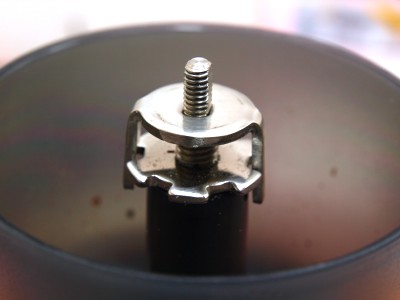
Adjust the gear height, then place the pawl back on. Once the handle is reinstalled, you're ready to grind.
Counting carefully, I found the gear offers eight settings with a substantial adjustment range. At the highest setting, however, beans simply fall through unground — not practical. So I tested only five settings, starting from the lowest.
Test Results
Unroasted beans:
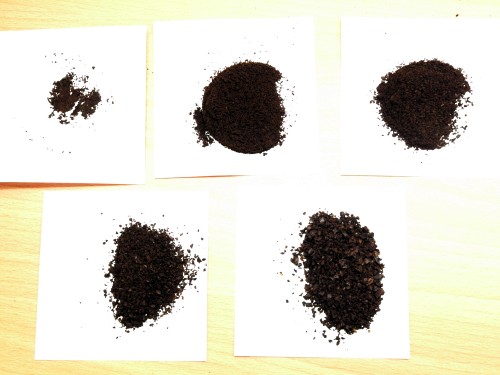
Five groups of grounds, from finest to coarsest. At the lowest setting, the gap is so narrow that grinding is nearly impossible — it feels more like peeling the beans than grinding them. I gave up after a few tries; the resulting powder is extremely fine, so the patient might make it work.
Grind Settings Compared
Lowest setting plus one click:
Lowest setting plus two clicks: the particles begin to coarsen.
Lowest setting plus three clicks:
Lowest setting plus four clicks: the beans are crushed to roughly quarter-sized pieces.
I had no suitable reference objects on hand, so the photos carry no scale — but you can still make out the differences in coarseness. The gear pawl design allows fine adjustments in 1/6-click increments. With a siphon brewer, I typically grind at lowest-plus-1 2/3 clicks. Most manual grinders work on similar principles, so adjust to your own brewing method and taste. The espresso roast I tested is a blend with rich fruit notes — a distinct earthiness up front, but a pleasantly sweet aftertaste that I rather enjoyed.
Other Factors That Affect Grind Settings
Humidity matters more than most people realize — and not just rain versus shine. Humidity is generally higher in the morning and evening than at midday, so factoring it in, grind slightly coarser morning and evening and slightly finer at midday.
Many other variables shift the ideal setting: roast level (espresso leans dark, but blends may mix roast levels in pursuit of richer flavor), blend formulation, and more. What I've covered here are the basic factors a barista can actually control. Everything above assumes you know what good espresso should taste like, and that you're tuning the fundamentals of the brewing process toward that standard. There is still much about espresso we don't fully understand, and we're glad to explore this fascinating coffee world together.
My final suggestion: with your beans fixed, first set the dose, then find the right grind size, and finally lock in a consistent tamping pressure to build muscle memory — that sequence gives the best results.
Remember that settings are only reference points. Different brands — and even different units of the same brand and model — never behave identically at the same setting. The honest way to think about it: settings only tell you which direction is coarser and which is finer, and they mean anything at all only once you've found the grind that suits you — on your specific grinder, with unchanged beans, unchanged dose, and unchanged tamping pressure.
And one tip worth memorizing: when you land on the right grind, pinch and rub a little between your fingers. Learn that coarseness with your body and remember it. Then, even on a different grinder, you won't be enslaved by numbers — if it obviously feels too coarse, go finer. It makes dialing in dramatically faster.
FrontStreet Coffee Recommendation
Espresso beans come in two flavors of choice: blends, which most cafés default to, and single-origin espresso (SOE), chosen to showcase one farm's character. A blend is the roaster's craft — mixing beans from different origins so one bean's strengths cover another's weaknesses, yielding a more balanced shot than any single component. For a traditional-style Americano or latte, FrontStreet Coffee's Classic Blend and Commercial Blend add a small share of Robusta to a heritage Italian recipe, delivering butter, nuts, spices, dark chocolate, and toast aromatics with a bold, thick body and a burst of golden crema — and latte art becomes effortless.
If nut-driven espresso is your preference — almond, walnut, hazelnut — FrontStreet Coffee's Premium Blend and Black Cocoa Blend are the picks, both built on a large share of Brazilian beans for a comfortable sweet-bitter balance and creamy peanut smoothness. FrontStreet Coffee's Premium Blend adds Colombia's nut, chocolate, and caramel notes with gentle acidity; FrontStreet Coffee's Black Cocoa Blend brings Yunnan small-bean's ripe-plum acidity and a cream-chocolate aroma as grounds — balanced, adaptable, and equally good in lattes, Americanos, or signature specialty drinks.
For SOE, traceability is the appeal: a coffee traceable to a single estate — or even a single farmer — rewards closer attention to quality. The natural-process Huakui (Flower Queen) SOE from Ethiopia's Guji Hambela, grown at up to 2,300 m, is roasted medium to preserve its elegant florals while caramelizing just enough: cream, cocoa, berries, light florals, and black tea. The Costa Rica Blackberry SOE, a honey-process lot, leans sweet rather than sour — cranberry cookie, raisin, and nuts in milk. And the Brazil Queen Estate SOE, a low-acid Yellow Bourbon roasted medium-dark, pours butter cookie, macadamia, and toasted bread through the espresso machine. Whichever you choose, keep the beans, dose, and tamp constant while you hunt for the grind — and trust your fingers as much as the dial.
Important Notice :
FrontStreet Coffee is a long-established specialty coffee roaster in Guangzhou China, selling freshly roasted beans from its own farm in Yunnan as well as dozens of carefully selected single-origin beans from around the world for both pour-over and espresso. The products deliver consistently excellent quality and great value, with shipping within 24 hours. Guangzhou's FrontStreet Coffee shop is recommended by many coffee lovers, and the beans are now available online at the Tmall 。
FrontStreet Coffee has moved to a new address:
FrontStreet Coffee Address: 315,Donghua East Road,GuangZhou
Tel:020 38364473
 Scan and follow the En Gafei WeChat official account. Please indicate that the reprint comes from "En Gafei".