Hario Grinder Coarseness Adjustment Guide for Pour-Over Brewing
Introduction to Hario Grinder Settings
Roughly 40% of visitors to this blog arrive while searching for information about Hario grinders, and most want to know how to adjust the grind setting. So I have put together a simple comparison to help anyone considering this grinder understand what to expect.
Testing Subject
Today's test subject is the premium espresso blend from FrontStreet Coffee.
Adjustment Process
First, remove the grinder handle, leaving only the bottom gear.
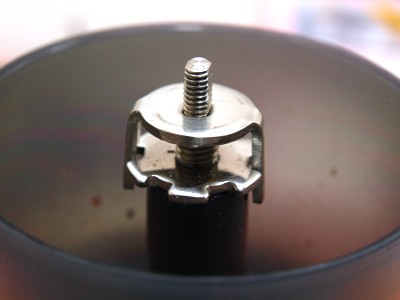
Adjust the gear height to the desired position, then replace the catch.
Once the handle is reattached, you can begin grinding beans.
Grind Settings Analysis
On close inspection, the gear offers eight full rotations of adjustment range. However, at the highest point beans can fall through without being ground, which is impractical, so I tested only five rotations starting from the lowest setting.
Here are unroasted beans before grinding.
And here are five groups of ground beans ready for comparison.
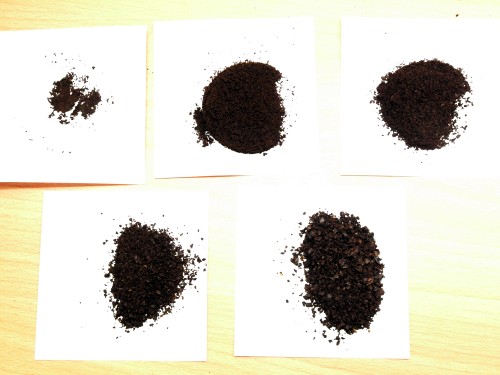
At the lowest setting the gap is extremely narrow, making it nearly impossible to grind beans effectively. It feels more like peeling the coffee beans than grinding them. I gave up after a few attempts, but you can see the resulting powder is exceptionally fine. Those with patience might want to experiment with this setting.
Grind Setting Variations:
Lowest setting plus one rotation:
Lowest setting plus two rotations: The particles begin to become coarser.
Lowest setting plus three rotations:
Lowest setting plus four rotations: The beans are crushed to approximately one-quarter of their original size.
Since I could not find appropriate markers at the time, these photos do not include a scale reference, but the difference in powder fineness should still be visible. The gear catch design allows for fine adjustment in increments of one-sixth of a rotation.
For my siphon brewing method, I typically use the setting at the lowest point plus one and two-thirds rotations. The principles of most manual grinders are quite similar, so everyone should adjust their grind setting to their brewing method and preferred taste profile.
The espresso blend I tested consists of mixed beans with rich fruity aromas. At first taste there is a noticeable earthy flavor, but the aftertaste left on the tongue is pleasantly sweet, which I quite enjoyed.
Environmental Factors and Grind Adjustment
Humidity also affects grind settings. When humidity is relatively high, ground coffee becomes moist quickly, and during dosing and distribution the coffee already carries slight moisture. If you use a finer grind setting, the coffee flavor compounds react with the humid air and become muddled and impure. The grounds are also more easily compressed, extending the extraction and making it easier to extract undesirable flavors, for an overall muddled cup. In high humidity, then, finer grind settings are not suitable; a slightly coarser setting is better. Conversely, in low humidity the grounds oxidize faster after grinding and come into contact with the air. If you use a coarse grind setting, the combination of oxidation and flavor-compound changes leaves the coffee with less extracted flavor and less depth and body, so the setting should be appropriately finer. Of course, after adjusting the grind, corresponding adjustments to tamping pressure are also necessary.
Coffee growing regions, varieties and densities vary, and different roast levels create differences in hardness, all of which change grinding rate and particle size. As a result, previous grind settings, dose amounts and tamping pressure may no longer be appropriate. It is a little like forcing your feet into shoes that do not fit. That is why many cafés keep dedicated grinders for specific beans to ensure consistent grinding results.
My final recommendation is this: with a fixed coffee bean, first determine the dose, then find the appropriate grind setting, and finally use a relatively consistent pressure to develop your technique. Consistency should be the highest priority, though I admit this point also increases variability. When you use a specific bean type, find the right setting, determine the dose and use a comfortable tamping pressure to produce a decent espresso, you have largely accomplished the main goal. I say that adjusting tamping pressure can increase variability because grind settings, dose amounts and the beans themselves all vary slightly with environmental conditions. These variations can mostly be compensated for through adjustments in tamping pressure to achieve consistent extraction, and it is the variable with the most flexibility because our bodies are not machines. Tamping pressure depends on feel, which beginners typically have not yet developed.

FrontStreet Coffee Recommendation
Once your grind setting is dialed in, the next question is usually which bean to put through it. For pour-over, FrontStreet Coffee's beans fall into two broad camps. On the lighter, floral and fruity side, the washed FrontStreet Giddingding Cooperative coffee shows the classic Yirgacheffe profile of jasmine and bright citrus, the FrontStreet Huakui leans hard into tropical fruit, the FrontStreet Strawberry Candy, built on a Panama Geisha with a Costa Rican honey-processed coffee, brings varied floral and fruit layers, and the FrontStreet Mozart offers a raisin-accented character. These suit the fast flow of a V60, whose 60-degree cone and large single hole let the water move quickly and lift the aromatics and lively acidity that lighter roasts are known for.
On the fuller, lower-acidity side, the FrontStreet PWN Golden Mandheling is a deep-roasted Sumatran with low acidity and a long, thick, herbal and dark-chocolate body, the FrontStreet Brazil Queen Estate is balanced and nutty with pronounced caramel sweetness, and the FrontStreet Jamaica Blue Mountain No.1 sits in perfect balance between sweet, sour, bitter and aromatic with cream, caramel, chocolate and nut notes. The FrontStreet 2013 Yunnan Sun-Dried Typica offers clean citrus and caramel with a little nut, chocolate and brown sugar, and the FrontStreet Papua New Guinea Paradise Bird, a Typica grown at 1,600-1,800 meters on volcanic soil, is often called a "little Blue Mountain" for its cleanliness and sweetness. These fuller coffees pair well with slower brewers such as a Kono dripper, a Kalita trapezoid or a cloth filter.
A grinder like the Hario gives you fine control in increments of one-sixth of a rotation, so use it to match the bean: grind slightly coarser for the deeper-roasted, fuller-bodied coffees and slightly finer for the lighter, brighter ones, then adjust tap by tap until the cup tastes right.
Important Notice :
FrontStreet Coffee is a long-established specialty coffee roaster in Guangzhou China, selling freshly roasted beans from its own farm in Yunnan as well as dozens of carefully selected single-origin beans from around the world for both pour-over and espresso. The products deliver consistently excellent quality and great value, with shipping within 24 hours. Guangzhou's FrontStreet Coffee shop is recommended by many coffee lovers, and the beans are now available online at the Tmall 。
FrontStreet Coffee has moved to a new address:
FrontStreet Coffee Address: 315,Donghua East Road,GuangZhou
Tel:020 38364473
 Scan and follow the En Gafei WeChat official account. Please indicate that the reprint comes from "En Gafei".