Yirgacheffe Coffee: Characteristics, Flavor Profile, Origin Estates, Regions, and Varieties

FrontStreet Coffee has noticed that many friends take their first step into light-roasted coffee through Yirgacheffe. With its bright citrus-and-lemon acidity and fresh jasmine florals, Yirgacheffe has become one of the most emblematic specialty coffees, long held in high regard by coffee connoisseurs around the world. To understand what makes Yirgacheffe taste the way it does, join FrontStreet Coffee as we trace the factors that shape its flavor.
For FrontStreet Coffee's natural-processed Yirgacheffe, the goal is to bring the bean's floral aroma and lively acidity to the fore, so we roast light, stopping at the end of the first crack to make the acidity more pronounced. Roasting all the way to the end of the first crack, however, can leave the bean short on caramelized sweetness, with a somewhat weaker sweetness and finish. To strike a proper overall balance, FrontStreet Coffee ultimately settled on a medium-light roast profile for Yirgacheffe.

Yirgacheffe: From the Homeland of Coffee
Yirgacheffe sits in Ethiopia, the birthplace of coffee. The region enjoys very high altitude, comfortable, cool temperatures, and just the right rainfall without excessive humidity — ideal conditions for coffee trees, which are delicate plants. Here, farmers plant their trees on misty rural hillsides, mostly in garden-style plots mixed with other harvestable crops; many are planted under banana trees.

The high altitude produces a wide day-night temperature swing. Coffee trees planted here grow slowly, and their fruit ripens over a longer period, accumulating more aromatic compounds along the way. As a result, the harvest also comes relatively late: generally from October through January of the following year, we see farmers busy picking cherries in the hills and their home gardens, gradually building the Yirgacheffe lots that will represent the next year's crop.
Washed Processing Elevates Yirgacheffe's Flavor
What made Yirgacheffe famous worldwide was the way washed processing restores the bean's natural aroma. Traditionally, Yirgacheffe used sun-drying, with rather rudimentary techniques and inadequate quality control, so defect rates were high. The resulting beans often carried earthy and rotten-fruit flavors. Such lots could only be sold cheaply and brought growers little income. To raise quality, the Ethiopian government introduced more advanced washed-processing technology and equipment from Central and South America in 1972.

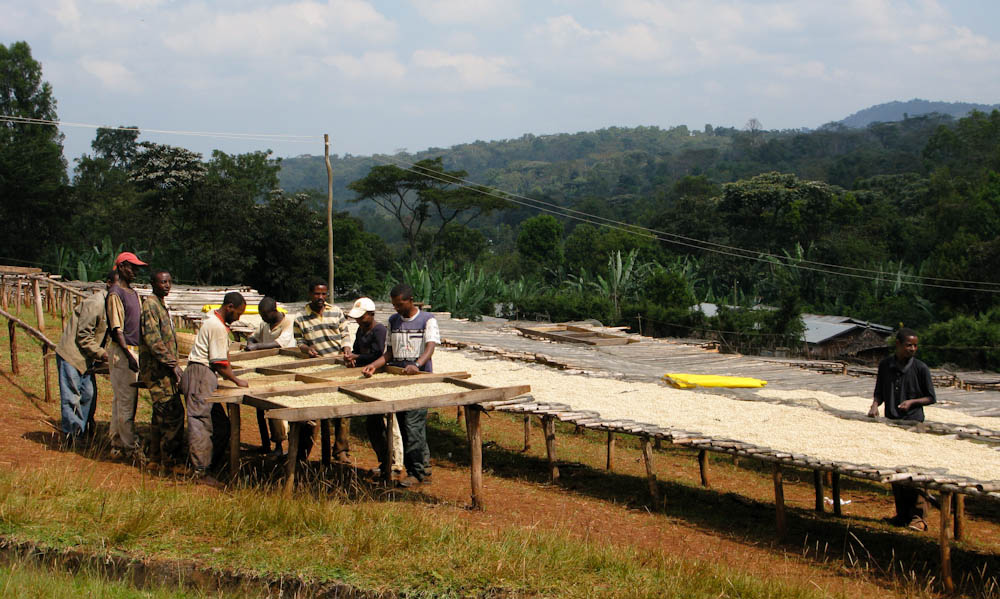
The biggest difference from traditional natural processing is that washing uses several steps to remove defective beans. After the cherries are picked, they go into water, where buoyancy lifts out any floaters that fail the density standard. A pulper then strips away the skin and pulp, after which the beans rest in fermentation tanks for 18-36 hours until the mucilage layer breaks down (the exact time depends on local temperature and humidity). Next, the parchment beans pass through washing channels for 30-60 minutes of brushing; the channels are specially designed so that, with the current, low-density and poor-quality beans are carried away. The high-quality parchment that remains is drained and spread on African-style raised drying racks for about 14 days, until it reaches the target moisture content, at which point it can be bagged and stored.
Washed processing presents Yirgacheffe with fresh citrus notes and elegant white floral aromas; the overall cup is bright and delicate and shines on the cupping table. This is precisely why Yirgacheffe was split off from the Sidamo region to become the celebrated Yirgacheffe coffee region it is today.
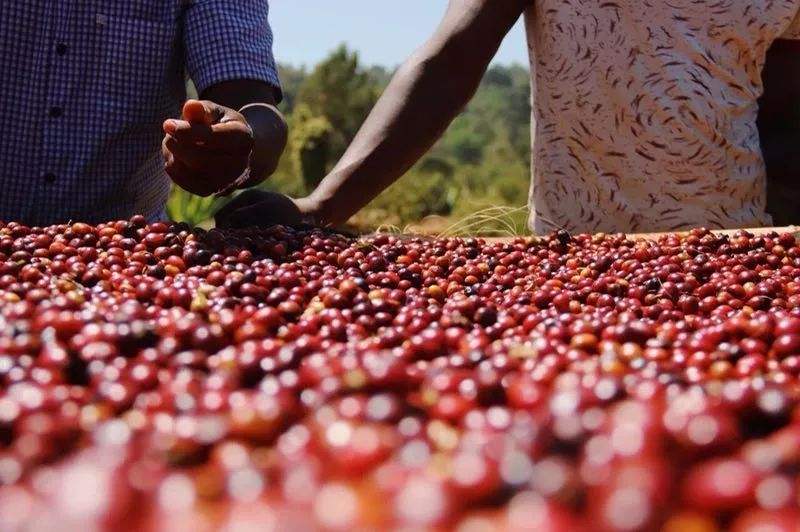
Yirgacheffe also produces excellent natural-processed lots, such as the Natural Red Cherry on FrontStreet Coffee's menu. Dried with its pulp and skin under the sun, it needs regular turning by hand to keep the cherries from over-fermenting and developing off-flavors. Natural processing lends Yirgacheffe beans their fermented fruit aroma and deep sweetness.
Light Roasting Preserves More Bright Acidity
Unlike the era when "coffee is supposed to be bitter," light-roasted Yirgacheffe can be said to have opened the age of fruity coffee. Coffee tastes aggressively bitter mainly because roasters take it dark, steering the flavor toward nuts and dark chocolate. As the concept of specialty coffee took hold, roasters began stopping Yirgacheffe at an appropriately light degree to preserve more acidity, letting it express pleasant fruit sweetness and acidity alongside its white floral aromas.

A taste for sweetness over bitterness happens to match broad public preferences, which is one reason Yirgacheffe is so popular worldwide. For a coffee this beloved, FrontStreet Coffee naturally includes it in the introductory daily-bean series. FrontStreet Coffee's daily beans let newcomers taste the region's basic flavors at a very low price, and the small packaging avoids the waste of coffee left unfinished.
How to Brew Yirgacheffe for Great Taste
Whichever flavor type you are brewing, FrontStreet Coffee recommends fresh-roasted beans so you can experience the complete profile. Beans reach their optimal tasting window 4-7 days after roasting, after which aroma fades ever faster. The beans FrontStreet Coffee sells are roasted within 5 days, so you can brew and drink as soon as they arrive.

Coffee grown at high altitude has a harder texture. Light-roasted Yirgacheffe beans have not been significantly altered by the roast, so FrontStreet Coffee's baristas use higher water temperatures to draw out more of the coffee's aromatic compounds. To avoid over-extraction while still achieving full flavor, FrontStreet Coffee uses a medium-fine grind size. To highlight Yirgacheffe's richer layered aromas, the baristas reach for a V60 dripper; its spiral ribs help the grounds degas more effectively, maximizing the volatilization and dissolution of acidic aromatic compounds.
Brewing Parameters:
Filter: V60
Water Temperature: 91-92°C
Dose: 15g
Ratio: 1:15
Grind Size: Medium-fine (78% through #20 sieve)

Use a three-stage extraction. Bloom with 30g of water for 30 seconds. Then pour in circles with a small stream to 125g and pause. When the water level drops and is about to expose the coffee bed, continue pouring to 225g and stop. Remove the dripper once all the coffee has finished dripping (timing begins at the bloom). Total extraction time is 2'00".
Once ground, FrontStreet Coffee's washed Yirgacheffe daily bean reveals delicate floral and fruit aromas. On the palate it shows bright, uplifting lemon and berry acidity with pronounced sugarcane sweetness. As the cup cools, it takes on a green-tea-like mouthfeel with a lingering finish.
FrontStreet Coffee Recommendation
If you want to understand the Yirgacheffe style, start with the FrontStreet washed Yirgacheffe daily bean. It is the classic introduction to the region's flavors — white jasmine, bright citrus-and-lemon acidity, and a clean tea-like body — and its modest price has made it the first specialty coffee for countless newcomers. Yirgacheffe is a small town in Ethiopia's Sidamo province in the south of the country, sitting at roughly 1700-2100 m, with the coffee trees planted above 1800 m, ranking among the highest-growing coffee regions on earth. Long famed for its unmistakable white florals and lemon-citrus acidity, the name became so influential that in 2010 the Ethiopian Commodity Exchange separated it from Sidamo, giving us the Yirgacheffe we know today.
For a more focused expression, FrontStreet Coffee offers the washed Godinding cooperative lot. Godinding sits at the southeastern edge of Yirgacheffe in the Worka area; it was once part of the Worka cooperative under the YCFCU alliance and was later carved out as its own single-origin as buyers pursued traceability. It follows the most traditional washed methods — often called the last clean spring of Yirgacheffe — and thanks to stripping the fruit before drying, its inherent aroma comes through clearly: fresh, bright citrus and lemon with jasmine fragrance and none of the traditional bitterness. Those who prefer a sweeter, fruitier Yirgacheffe can turn to the natural-processed Red Cherry, made from fully ripe cherries laid out whole to dry. The cherries are turned every 2-3 hours in the first days to prevent uneven fermentation, and after three to five weeks of sun-drying the dried fruit is hulled off. Because the fruit dries on the bean, it keeps the classic Yirgacheffe character while gaining tropical fruit aroma, with citrus acidity, berry-juice body, honeyed sweetness, and a creamy, smooth texture.
Brewing Yirgacheffe is straightforward. FrontStreet Coffee suggests a V60 dripper at 90-91°C, 15g of coffee at a 1:15 ratio, ground to fine-sugar size on an EK43s at setting 10 (about 80% passing a #20 sieve). Pour 30g of water for a 30-second bloom, then a further 95g (the scale reading about 125g) finished by roughly the one-minute mark; when the water drops to about two-thirds of the bed, add the remaining 100g (the scale reading about 225g), finished by about 1 minute 35 seconds. Total drawdown lands at 2:00-2:10, and the cup is ready.
Important Notice :
FrontStreet Coffee is a long-established specialty coffee roaster in Guangzhou China, selling freshly roasted beans from its own farm in Yunnan as well as dozens of carefully selected single-origin beans from around the world for both pour-over and espresso. The products deliver consistently excellent quality and great value, with shipping within 24 hours. Guangzhou's FrontStreet Coffee shop is recommended by many coffee lovers, and the beans are now available online at the Tmall 。
FrontStreet Coffee has moved to a new address:
FrontStreet Coffee Address: 315,Donghua East Road,GuangZhou
Tel:020 38364473
 Scan and follow the En Gafei WeChat official account. Please indicate that the reprint comes from "En Gafei".