The Impact of Blooming and Its Duration on Pour-Over Coffee (Part 2)
Last time, we used a Clever Dripper to gather objective data on whether to bloom at all, and for how long. What we learned: as bloom time increases, acidity drops while sweetness and body thicken, and the overall flavor profile shifts toward the back of the palate and grows more complex. TDS and extraction yield (EXT) both trended downward as bloom time lengthened. We also noted that the Clever Dripper behaves more like an immersion brewer, so this time we repeated the same experiment on a V60 - a true pour-over dripper - to see what flavor and data water-flow agitation produces there.
Experiment Design
The V60 experiment had two groups. Group 1 held total brew time fixed at 2 minutes 10 seconds, with bloom times of 0, 20, 40, and 60 seconds. The catch is that with a fixed total time, a 60-second bloom forces you to pour much faster afterward to still finish at 2:10 - and everyone knows a slow, fine pour and a fast, heavy pour produce noticeably different cups. To keep the data objective, we added a second group: the same bloom times of 0, 20, 40, and 60 seconds, but with total brew time extended accordingly as the bloom lengthened, keeping the pouring pace consistent across all four brews.
Procedure and Data
Experiment 1
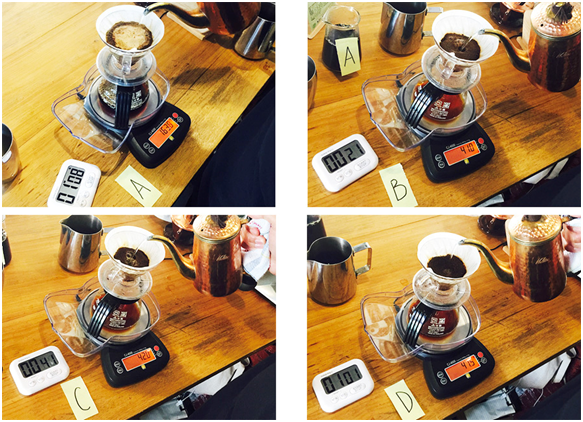
(Both groups of pour-over experiments used approximately 40g of water for blooming)
Procedure:
- Weigh out 15g of coffee beans and grind them at setting #2 on the Fuji Royal (ghost teeth) grinder
- Prepare plenty of 90°C water
- A: Add 15g of grounds to a Hario V60 conical dripper and pour 240g of water continuously in circles; total brew time 2min10s
- B: Add 15g of grounds to a Hario V60, pour 40g of water to bloom for 20 seconds, then pour the remaining 200g in circles; total brew time 2min10s
- C: Same as B but with a 40-second bloom; total brew time 2min10s
- D: Same as B but with a 60-second bloom; total brew time 2min10s
Results:
Analysis:
Compared against our pre-experiment predictions, the flavor and mouthfeel changes tracked expectations: as bloom time grew, acidity fell while sweetness and viscosity rose, and the flavor profile shifted backward. Extraction yield declined step by step across the four brews, which also matched what we predicted.
Why This Happens:
In pour-over brewing, bloom time, total brew time, and coffee bed temperature (the actual extraction temperature) all shape the overall extraction yield together and cannot be viewed in isolation. In this series, the shrinking actual extraction time and the falling bed temperature had the biggest effect on the results.
Experiment 2
(Second group of pour-over experiments: as bloom time extends, total brewing time is extended accordingly)
In Experiment 1 the total brew time was fixed, which meant that a longer bloom left less time for actual extraction. Experiment 2 asked the opposite question: what happens when the pouring speed stays consistent - that is, when the actual extraction time is held the same across all groups?
Procedure:
- Weigh out 15g of coffee beans and grind them at setting #2 on the Fuji Royal (ghost teeth) grinder
- Prepare plenty of 90°C water
- A: Add 15g of grounds to a Hario V60 and pour 240g of water continuously in circles; total brew time 1min58s
- B: Bloom with 40g of water for 20 seconds, then pour 200g in circles over 1min38s; total brew time 1min58s
- C: Bloom for 40 seconds, then pour 200g over 1min38s; total brew time 2min18s
- D: Bloom for 60 seconds, then pour 200g over 1min38s; total brew time 2min38s
Results:
Analysis:
The flavor and mouthfeel trends here matched the first experiment closely. Extraction yield, however, dipped and then rose again. That tells us two things. First, a longer bloom lets the coffee bed cool down, lowering the actual extraction temperature and reducing extraction efficiency. Second, once the actual extraction time is allowed to stretch along with the bloom, the extra contact time recovers extraction efficiency - enough to offset, and in some cases overtake, the loss caused by the cooler bed.
Practical Takeaways
We ran all these trials to understand blooming in finer detail, and you can do rough versions of the same test at home - simply try different bloom times and taste the difference. The findings translate directly into daily brewing: if you want pronounced, forward acidity, skip the bloom or keep it very short; if you want a balanced, rounded, fuller cup, give the coffee a longer bloom.
Customers often ask us for one fixed recipe: how long to bloom, how long to brew, what water temperature. That is exactly the kind of rigid answer we avoid giving. With so many coffee varieties and so many roasters' styles, no single method can suit every bean - and how boring would that be? Good beans are not limited by brewing method, but among all the possible approaches there is usually one that best flatters a given bean, or best matches the flavors you personally enjoy. Experimenting is half the fun.
Pour-over experiments are among the most humbling work we do, because there are simply too many variables - it can feel like even a breeze passing by shifts the taste. We expected to wrap this follow-up quickly, but ended up repeating the whole series several times. Repeats are no big deal; our brewer Xiao Hei just got more tired. The real cost is the cupping afterward: the three of us were tasting until dizzy, staggering around the shop before noon! Luckily, this is work we love, and we hope the data proves useful.
We will keep playing - seriously and rigorously - and keep digging deeper into the world of coffee. If you have questions or curiosities, bring them to us. As long as our equipment and resources allow, we will run the experiment and report back.
Experiment Credits
FrontStreet Coffee
Experiment Operation: Xiao Hei
Data Organization: Lao Lin
Text Editing: Jingjing
FrontStreet Coffee Recommendation
Since this whole experiment ran on a Hario V60, it is worth pausing on which beans actually shine in that dripper. The V60's 60° cone and single large outlet favor fast, clean extraction, which is exactly what delicate, fruit-forward light roasts need. FrontStreet's Ethiopia Yirgacheffe Guodingding is the classic example: bright citrus, berries, and white florals with a green-tea-like finish, and an acidity that is soft and juicy rather than sharp - very approachable even if you are new to pour-over.
If you prefer a sweeter, more exotic cup, try FrontStreet's Ethiopia Huakui (Ambassador), one of the most successful light roasts of recent years, loaded with tropical fruit - strawberry, passion fruit, jackfruit, even lychee - with barely any bitterness. Both beans respond beautifully to the kind of controlled, medium-paced pouring we used in the experiments above.
- FrontStreet Coffee Ethiopia Yirgacheffe Guodingding - citrus, berries, floral, tea-like finish
- FrontStreet Coffee Ethiopia Huakui - tropical fruit, juicy, low bitterness
- FrontStreet Coffee Panama Boquete Red-Label Geisha - jasmine, citrus, black tea (a splurge worth trying on the V60)
Important Notice :
FrontStreet Coffee is a long-established specialty coffee roaster in Guangzhou China, selling freshly roasted beans from its own farm in Yunnan as well as dozens of carefully selected single-origin beans from around the world for both pour-over and espresso. The products deliver consistently excellent quality and great value, with shipping within 24 hours. Guangzhou's FrontStreet Coffee shop is recommended by many coffee lovers, and the beans are now available online at the Tmall 。
FrontStreet Coffee has moved to a new address:
FrontStreet Coffee Address: 315,Donghua East Road,GuangZhou
Tel:020 38364473
 Scan and follow the En Gafei WeChat official account. Please indicate that the reprint comes from "En Gafei".