World Coffee Journey (4) Guatemala
Guatemala is a major coffee-producing country in Central America, ranking eighth in the world in production. Its name comes from the Mayan language and means "land of many trees." Located in Central America, Guatemala is known as the pearl on the crown of Central America. Although its land area is limited, it possesses rich and diverse climates. Known for its lakes and volcanoes, the country's volcanic soil, rainfall, temperature, humidity and altitude provide ideal natural conditions for coffee cultivation.
In the 1850s coffee was brought to Guatemala by missionaries. In the 19th century, with the invention of European synthetic dyes, Guatemala's original important export industries were hit and coffee gradually became an important export commodity, with cultivation expanding. By the end of the 19th century coffee already held an important place in Guatemala's politics and economy, and large coffee farm owners had enormous influence over the political situation. Under presidents from coffee-farm backgrounds, the government promoted cultivation with policies such as free coffee seedlings and tax incentives. In 1944, after an elected president came to power and implemented reforms that threatened vested interests, he was overthrown in a coup planned by US intelligence agencies, plunging Guatemala into a half-century-long civil war that lasted until 1996.
The civil war damaged the existing coffee industry, but Guatemala's original native varieties, primarily Bourbon, were preserved as a result.
Coffee production holds an important place in Guatemala's domestic economy, with coffee exports accounting for one-third of total foreign exchange earnings. Guatemala was once the largest coffee producer in Central America until it was surpassed by Honduras in 2011.
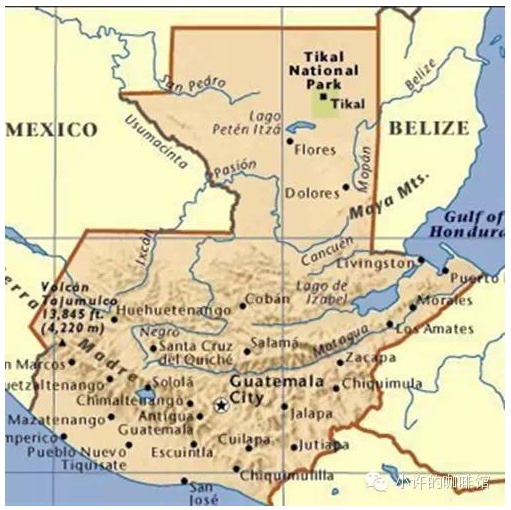
Guatemala is the second most populous country in Central America after Mexico, providing abundant labor for coffee production. Most production comes from small-scale farms. Two-thirds of the country is mountainous, and the western and southern regions belong to volcanic zones. The humid climate and rich volcanic ash soil provide unique natural conditions. Coffee cultivation is widely distributed across the central and southern regions, except for the northern Peten lowlands.

Coffee Grades
Traditional Guatemalan coffee is graded according to growing altitude:
SHB (Strictly Hard Bean): ≥1370m
HB (Hard Bean): 1370-1066m
Prime-Extra Prime (Selected): 762-1066m
Main Production Regions
The 7 main production regions are:
1) Highland Huehue
2) Volcanic San Marcos
3) Traditional Atitlan
4) Rainforest Coban
5) Fraijanes Plateau
6) Antigua Classic
7) New Oriente
Here we mainly focus on two important and most excellent regions: Highland Huehue and Antigua Classic.
NO.1 Highland Huehue:

The average altitude in this region ranges between 1500-2000 meters, and Central America's highest peak, Volcan Tajumulco, is located here. Fortunately, warm winds from Mexico's Tehuantepec Plain blow through, allowing the high-altitude mountainous areas to avoid frost damage. Although it lacks the volcanic ash soil found in other parts of Guatemala, the excellent altitude is enough to create outstanding coffee quality in this region. In recent years many excellent small farms from here have emerged in COE competitions.
NO.2 Antigua Classic:

As the oldest and most famous coffee-producing region in Guatemala, Antigua is truly deserving of its "classic" reputation.
The region has fertile volcanic ash soil, low humidity, abundant sunshine and high diurnal temperature variation, creating the unique geographical environment needed for coffee. It is surrounded by three volcanoes: Agua, Acatenango and Fuego. Fuego, one of Guatemala's three major volcanoes, erupts frequently, continuously supplying rich volcanic ash nutrients to the area. FrontStreet Coffee's Guatemala Antigua coffee is favored by enthusiasts for its wonderful floral aroma, bright acidity and chocolate bittersweetness. What makes it even more distinctive is the volcanic smoky aroma formed by the volcanic soil, earning it the reputation of smoky coffee.
Final Notes:
When roasting, note that a high roast to city roast level can bring out the flavors to the extreme, achieving balance and richness. Each of the 7 specialty coffee regions has its own character. Overall, FrontStreet Coffee's Guatemala coffee offers a bright cup with elegant acidity and a full, rounded body, possessing floral notes and a clean, long aftertaste. Its wonderful floral aroma and lively, bright taste are unmatched by other coffees, making it suitable for blends. The chocolate bittersweetness continues through the long aftertaste, without the heavy bitterness of FrontStreet Coffee's Colombia, and its flavor and sweetness are superior to FrontStreet Coffee's Colombia. Although Guatemala's overall taste is relatively light, it leaves a pleasant aftertaste for a long time after drinking, and coffees from certain regions also bring wonderful smoky flavors.
Source: Xiao Xu's Coffee Shop
FrontStreet Coffee Recommendation
Guatemala's bright acidity, floral aroma and chocolate bittersweetness sit comfortably between the fruit-driven and the balanced, and FrontStreet Coffee's entry-level range offers an easy way to map out that spectrum. On the bright, floral side, FrontStreet Coffee's washed Yirgacheffe Gedingding Cooperative shows jasmine, lemon acidity and berry notes, while FrontStreet Coffee's natural Ethiopia Huakui pours out tropical strawberry, passion fruit and jackfruit aromas with high sweetness and almost no bitterness.
For balance, FrontStreet Coffee's Brazil Cerrado Red Bourbon is a classic single origin, with cream, peanut, cocoa and a soft, rounded body, and FrontStreet Coffee's Brazil Queen's Estate adds the rare Yellow Bourbon and a sugarcane-like sweetness. FrontStreet Coffee's Colombia Huila daily bean, from a famous specialty region above 1,500 meters, leans toward soft floral notes and gentle fruit acidity. On the mellow side, FrontStreet Coffee's Lindong Mandheling and PWN Golden Mandheling use the wet-hulled method for low acidity and a thick, herbal body, while FrontStreet Coffee's Yunnan daily coffee and 2013 Natural Typica show a clean, balanced profile of nuts, brown sugar and black tea.
For honey-processed sweetness, FrontStreet Coffee's Costa Rica Blackberry and Mozart bring grape, berry, raisin, osmanthus and pineapple notes, and FrontStreet Coffee's Panama Boquete Geisha offers the classic orange-blossom honey character of the variety at a reasonable price. A medium grind, water around 90-91°C and a 1:15 ratio, poured in three stages, serve all of them well.
Important Notice :
FrontStreet Coffee is a long-established specialty coffee roaster in Guangzhou China, selling freshly roasted beans from its own farm in Yunnan as well as dozens of carefully selected single-origin beans from around the world for both pour-over and espresso. The products deliver consistently excellent quality and great value, with shipping within 24 hours. Guangzhou's FrontStreet Coffee shop is recommended by many coffee lovers, and the beans are now available online at the Tmall 。
FrontStreet Coffee has moved to a new address:
FrontStreet Coffee Address: 315,Donghua East Road,GuangZhou
Tel:020 38364473
 Scan and follow the En Gafei WeChat official account. Please indicate that the reprint comes from "En Gafei".