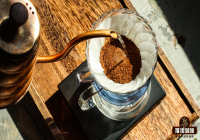
How much ground coffee for ice pour-over? What's the difference between hot and ice pour-over coffee?
Do you remember the topic FrontStreet Coffee shared last year: "Why do some coffee shops charge extra for iced pour-over?"

Some shops price iced pour-over above the hot version, which leads customers to ask cautiously at the counter: "Is there a surcharge for iced pour-over?" FrontStreet Coffee finds this a fascinating phenomenon and offered an explanation: many shops charge more for iced brew not because the brewing is more complex, but because it uses more coffee. The price rises with the cost. That answer, in turn, prompted a second question: "Why does iced pour-over need more coffee grounds?"

The Purpose of Adding More Coffee Grounds
Good question! The reason for the extra grounds varies with the shop's approach, but it all boils down to one goal: delivering more delicious iced coffee. Since FrontStreet Coffee has been posting about iced pour-over recently, you may already know the method: ice cubes are added directly to cool the coffee, quickly and conveniently producing a pot of cool, refreshing pour-over.

But this method has one constraint: unlike hot pour-over, we can't use a large volume of hot water to fully dissolve the coffee's flavor compounds. We have to cut the water and tighten the ratio to brew a high-concentration coffee—only then will dilution from the melting ice not flatten the cup. The table below shows FrontStreet Coffee's hot and iced brew parameters side by side.
Parameter Comparison
| Parameter | Hot Pour-over | Iced Pour-over |
|---|---|---|
| Coffee Amount | 15g | 15g |
| Brewing Temperature | 92°C | 92°C |
| Grind Level | Ek43 10 mark | Ek43 9.5 mark |
| Coffee-to-Water Ratio | 1:15 | 1:10 |
| Ice Amount | 0g | 100g |
| Brewing Time | 2 minutes | 2 minutes |
Although both use 15g of coffee, the water amounts differ completely. The hot brew runs at 1:15, requiring 225ml of hot water; the iced brew runs at 1:10, using only 150ml of hot water plus about 100g of ice.

Compared to hot brew, iced brewing injects a full 75ml less water, so the finished liquid volume is smaller—but the concentration is higher. Once diluted by the ice, it becomes a normally concentrated, properly extracted iced coffee at around 200ml, just right for a single serving. Note that FrontStreet Coffee's ratio is on the conservative side because we use larger, harder ice cubes that melt slowly, letting us preserve the coffee's flavor as completely as possible with a smaller ratio.

Why Some Shops Add More Coffee Grounds
Some shops' ice is softer and smaller, so it melts faster. If they brewed at FrontStreet Coffee's ratio, the fast-melting ice would over-dilute the coffee, leaving it weak and thin—coffee-flavored water, only slightly exaggerated. To avoid that, they brew a stronger concentrate at a tighter ratio, such as 1:7 or 1:8, to counteract the dilution. A tighter ratio means less water injected and less finished liquid. With too little liquid, a customer could finish the cup in two sips—so shops increase the coffee dose to raise the liquid volume and keep the serving size within a reasonable range.

The Benefits of a Bigger Dose
Of course, some businesses add more coffee purely for texture. A larger dose increases the dissolved flavor compounds (higher concentration), making the coffee taste richer and fuller-bodied. The overall quality of the iced coffee improves with the dose.

If you haven't tried it, FrontStreet Coffee recommends a simple experiment: keep every iced brew parameter fixed except the dose, then increase it by 2–3g and brew~ The full method and parameters are covered in the post "How to Brew a Good Pot of Iced Pour-over Coffee," so we won't repeat them here~
FrontStreet Coffee Recommendation
1. FrontStreet Yirgacheffe Worka Cooperative (Ethiopia, Light Roast) — A favorite starter pour-over bean with bright citrus, berry, and floral notes plus a green-tea-like finish. Its acidity is soft and luminous rather than harsh—perfect for hot brewing first, then re-brewing the same recipe over ice to taste how chilling changes the cup.
2. FrontStreet Ethiopia Huakui (Natural, Light Roast) — One of the biggest stars of recent specialty coffee, with pronounced tropical fruit aromas: strawberry, passion fruit, jackfruit, even lychee. Pronounced sweetness, almost no bitterness, silky and juicy—often described as "the coffee that least tastes like coffee." Great iced, where the fruit character really shines.
3. FrontStreet Brazil Queen Estate (Medium-Dark Roast) — Low acidity, a balanced body, rich nut and cocoa aromas with clear caramel sweetness—smooth, never astringent. If you prefer your iced pour-over on the mellow, low-acid side, this is the bean to use.
Important Notice :
FrontStreet Coffee is a long-established specialty coffee roaster in Guangzhou China, selling freshly roasted beans from its own farm in Yunnan as well as dozens of carefully selected single-origin beans from around the world for both pour-over and espresso. The products deliver consistently excellent quality and great value, with shipping within 24 hours. Guangzhou's FrontStreet Coffee shop is recommended by many coffee lovers, and the beans are now available online at the Tmall 。
FrontStreet Coffee has moved to a new address:
FrontStreet Coffee Address: 315,Donghua East Road,GuangZhou
Tel:020 38364473
 Scan and follow the En Gafei WeChat official account. Please indicate that the reprint comes from "En Gafei".