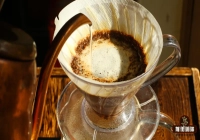
What's the Difference Between Drip Bag Coffee and Pour-Over Coffee? What is Drip Extraction?
As everyone knows, both pour-over coffee and drip bag coffee rely on drip extraction. Drip extraction simply means that hot water flows quickly through the bed of coffee grounds under gravity, carrying flavor out of the grounds as it goes - in plain terms, you pour water into a filter while coffee seeps out at the same time.

Because the extraction method is the same, the two are inevitably compared. But did you know that drip bags and pour-over coffee actually have little to compare? Their main purposes are different, and each has its own strengths. No worries - today FrontStreet Coffee will briefly explain what really separates pour-over coffee from drip bag coffee. First, a quick look at what each one is.

What Is Pour-Over Coffee?
Pour-over coffee is brewed by manually controlling the flow of water, with tools such as a dripper, filter paper, and a digital scale as aids. Since the idea of specialty coffee took hold, pour-over has grown popular fast, because compared with other extraction methods it can showcase the coffee's own natural flavor more completely and more precisely.
Pour-over is also extremely flexible. Any parameter or any piece of equipment can be adjusted or swapped, producing entirely different brewing schemes and cups with subtly different character, which makes it great fun to experiment with. This is exactly why pour-over became the go-to method for exploring coffee aromas.

Pour-over has another advantage, too: the whole sequence - weighing beans, grinding, folding the filter paper, rinsing the dripper, adding the grounds, boiling water, and brewing - usually has to be done by hand. Those steps give the making of the cup a real sense of ritual.

Because the equipment is fairly affordable, many people keep a full set at home and, whenever they have a spare moment, pick a favorite bean to grind and brew fresh.
What Is Drip Bag Coffee?
Drip bags are, in a sense, a convenient offshoot of pour-over coffee. In the late 20th century, Japan's Ueshima Coffee Co. (UCC) pioneered drip bags and applied for a patent in 2001. A drip bag contains pre-ground coffee and a filter bag made of non-woven fabric, and like pour-over coffee it uses drip extraction. Tear open the packaging, take out the bag, hang it on a cup, and you can brew right away - very convenient.

The name "drip bag" comes from the two paper clips on either side of the non-woven filter bag. As shown above, once opened they can be hooked over the rim of a narrow-mouthed cup so the bag acts as a dripper. The "drip bag" in the name refers to those two pieces of paper hanging on the cup rim like little ears. Compared with pour-over, a drip bag is extremely convenient: no grinding beans, no preparing drippers and filter paper. All you need is a container and a kettle. Small and compact, drip bags are also easy to carry, which makes them a staple for travel and for everyday office life.

How Do Drip Bag Coffee and Pour-Over Coffee Differ?
From the introductions above, we can see that the biggest difference lies in the state of the coffee grounds used. Pour-over coffee mainly uses freshly ground coffee, meaning the beans are ground into powder just before brewing, whereas drip bags use pre-ground coffee that is ground well in advance and then sealed into the bag. (FrontStreet Coffee should add here that although pour-over coffee may sometimes use pre-ground powder, the vast majority of the time it uses freshly ground coffee.) It is this difference that makes the two fundamentally distinct. Why? Because the taste of the brewed coffee changes as a result.

As everyone knows, coffee flavor comes mainly from aromatic substances in the coffee, and most of those substances are volatile. After beans are roasted, the aroma keeps evaporating and escaping from the inside out, much like carbon dioxide. How fast it is lost depends largely on storage method, environment, and whether the bean's structure remains intact. Store beans properly and keep the structure largely whole, and the volatilization of those aromatics slows down.
Generally, when all of the above conditions are met, the aromatic substances in coffee beans can be preserved for up to 2 months from the roasting date. When storage conditions are poorer, or when the beans are ground into powder, the aromatics are lost faster, and the optimal tasting window shrinks from two months to one month or even less.

The consequence is that even with the same beans and the same roasting date, a drip bag will not taste as rich as a pour-over. Because it uses pre-ground coffee, its flavor volatilizes faster than freshly ground coffee, and the gap widens the longer the powder has sat. The grind size is also fixed in advance, so the brewing framework cannot be adjusted much. That makes drip bag coffee less flexible than pour-over, with less room to play.

Still, we should recognize that the advantage of drip bag coffee has never really been flavor - it is simplicity and convenience. It is precisely that need for convenience which led drip bags to use pre-ground coffee. Otherwise, we could just as well brew freshly ground coffee in a drip bag and get an excellent cup (and indeed, some people do exactly that).
So although pour-over coffee and drip bag coffee both use drip brewing, the goals they pursue are completely different. Pour-over seeks a more complete, higher-quality coffee experience, which is why its main brewing material is freshly ground coffee. Drip bag coffee pursues convenience, and it trades some flavor to get it. Each has its own advantages and its own suitable scenarios - there is really no need to pit them against each other.
- END -
FrontStreet Coffee Recommendation
If you brew pour-over at home, FrontStreet Ethiopia Yirgacheffe Gidding is a natural first stop. This washed Yirgacheffe, produced by a cooperative of about 300 farmers in the Worka area, shows clear citrus, berry, and floral notes with a green-tea finish. Its acidity is soft and bright rather than sharp, which makes it very approachable for anyone new to pour-over.
For something with more tropical fruit character, try FrontStreet Ethiopia Huakui. Its aromatics lean heavily toward strawberry, passion fruit, and jackfruit, with low bitterness and a juicy, smooth body - a striking demonstration of what a good dripper and freshly ground beans can reveal in a cup. Both coffees respond well to the high degree of freedom that pour-over offers.
Important Notice :
FrontStreet Coffee is a long-established specialty coffee roaster in Guangzhou China, selling freshly roasted beans from its own farm in Yunnan as well as dozens of carefully selected single-origin beans from around the world for both pour-over and espresso. The products deliver consistently excellent quality and great value, with shipping within 24 hours. Guangzhou's FrontStreet Coffee shop is recommended by many coffee lovers, and the beans are now available online at the Tmall 。
FrontStreet Coffee has moved to a new address:
FrontStreet Coffee Address: 315,Donghua East Road,GuangZhou
Tel:020 38364473
 Scan and follow the En Gafei WeChat official account. Please indicate that the reprint comes from "En Gafei".