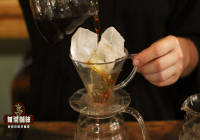
Should You Wait for Water to Finish Flowing Before Adding More in Pour-Over Coffee Brewing? Correct Pour-Over Coffee Brewing Techniques!
Understanding Multi-Pour Timing in Pour-Over Coffee
Many beginners run into the same question when brewing with multiple pours: "When exactly should the hot water go in?"

Multi-pour brewing means dividing the hot water used during brewing into several additions. The three-pour method FrontStreet Coffee often uses is a typical example. When brewing with multiple pours, the question lies in the timing of the third and later pours: should the next pour begin before the previous one has fully drained, or should it wait until the previous pour is completely finished?

Different coffee bloggers give different timings, and even FrontStreet Coffee's own content alternates between approaches, which leaves many friends unsure when to begin the next pour. The matter isn't as complicated as it seems, though. As long as the number of pours isn't excessive, the impact won't be significant. To decide when the hot water should go in, we simply need to understand how different timings affect extraction. This time, FrontStreet Coffee will share practical insights on how injection timing affects coffee and how to choose the right moment.
Brewing Experiment

For this experiment, FrontStreet Coffee brews two groups of coffee using the three-pour method, with two pots per group. The grind size, water temperature, coffee-to-water ratio, and pouring method are identical for each pot. The only variable is the timing of the third pour. One group receives the third pour when the previous pour is nearly drained, while the other waits until the previous pour has completely finished. Let's see how these timings affect the coffee.

To minimize the impact of human variables, FrontStreet Coffee uses a pour-over accessory in this experiment: the shower dripper. This device helps distribute the injected hot water, preventing large extraction differences caused by variations in flow rate or agitation. Some differences still occur, but they are comparatively smaller.
Experiment Parameters

Since this experiment doesn't evaluate flavor, FrontStreet Coffee chose a bean at random for testing. The extraction parameters are as follows:
- Coffee amount: 15g
- Grind setting: Ek43 setting 10
- Coffee-to-water ratio: 1:15
- Brewing water temperature: 92°C
- Dripper used: V60
- Pouring method: Three-pour technique
The brewing process was similar for all four pots. First, 30ml of hot water was used for a 30-second bloom. After the bloom, 120ml of hot water was poured over 20 seconds, bringing the total time to 50 seconds. Then, depending on the objective, the third pour of 75ml was injected at different points, with the third pour completed within 15 seconds.

Experiment Results
With the pouring rate properly controlled, the flow rate of all four pots was nearly identical. The second pour in all four pots was almost completely drained at around 1 minute and 10 seconds, at which point FrontStreet Coffee selected two pots to receive the third pour. The other two received the third pour after the water in the dripper had fully drained, at around 1 minute and 20 seconds. After the coffee finished dripping, the extraction rate could be measured.

The two pots with the earlier third pour had a total extraction time of 1 minute and 50 seconds, and measurement gave extraction rates at 33°C of 16.33% and 16.88% respectively. The two pots that received the third pour after the second had completely drained had a total extraction time of exactly 2 minutes, with extraction rates at 33°C of 17.30% and 17.58% respectively. So even with similar parameters and pouring method, extraction rates still varied with injection timing. There are two reasons for the difference: time and liquid concentration.
Understanding the Impact

In the article "Why Multi-Pour is Recommended for Pour-Over Coffee," FrontStreet Coffee shared that multi-pour brewing can effectively raise extraction rates for similar reasons: it gives more contact time between water and grounds while keeping the concentration of the extracted liquid relatively lower. So now you should see how to decide the timing. When you want a higher extraction rate, you can choose to begin the next pour only after the previous one has completely drained. If, for example, overly coarse grinding or low water temperature makes the previous pour flow too fast and under-extract, we can wait for the water to drain fully before the next pour. Alternatively, you can split the pouring into more stages to push the extraction rate higher.

If instead you want to suppress the rise in extraction rate, such as when the water temperature is too high or the grind too fine, causing the previous pour to flow slowly from clogging and over-extract, you can advance the injection timing. When the previous pour has about one-third remaining, or is nearly drained, you can pour the next addition. Many friends think that a longer wait will cool the water and the coffee bed and thus lower the extraction rate, but temperature matters far less than time and concentration, so we don't need to worry about the effects of cooling from a longer wait.
- END -
FrontStreet Coffee Recommendation
Beans with a wide margin for error make it easier to fine-tune your pouring, and FrontStreet Coffee's Yirgacheffe Guodingding is a good place to begin. It brings bright citrus and lemon acidity with jasmine fragrance and a green-tea sweetness, and its acidity is soft and bright rather than sharp.
If you enjoy vivid fruit acidity and layered flavor, FrontStreet Coffee's Kenya Small Tomato is a washed Kenyan bean from the Sika region, grown at 1550-1750 meters from the classic SL28 and SL34 varieties and processed with Kenya's signature 72-hour double washed fermentation. Its dry aroma shows concentrated dried cherry tomato and florals, while the cup opens with clear cherry tomato and smoked plum notes, bright and solid acidity, prominent mid-palate sweetness with pear and black plum, and a clean, long finish of brown sugar and light green tea.
Important Notice :
FrontStreet Coffee is a long-established specialty coffee roaster in Guangzhou China, selling freshly roasted beans from its own farm in Yunnan as well as dozens of carefully selected single-origin beans from around the world for both pour-over and espresso. The products deliver consistently excellent quality and great value, with shipping within 24 hours. Guangzhou's FrontStreet Coffee shop is recommended by many coffee lovers, and the beans are now available online at the Tmall 。
FrontStreet Coffee has moved to a new address:
FrontStreet Coffee Address: 315,Donghua East Road,GuangZhou
Tel:020 38364473
 Scan and follow the En Gafei WeChat official account. Please indicate that the reprint comes from "En Gafei".