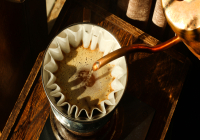
SOE: Pour-over or Espresso? How Different Are Single-Origin Beans and SOE Espresso Beans?
Espresso vs. Pour-Over: Understanding Your Coffee Choices
When you walk into a coffee shop, you usually face two kinds of choices: espresso and pour-over. At FrontStreet Coffee, if you want pour-over, you can pick single-origin beans from different regions; for espresso, you need to choose between an Americano, a latte, a cappuccino and the rest, and some shops also let you "switch to SOE."

More and more famous single-origin beans now come in SOE versions, Geisha, Yirgacheffe and Guji among them. Some readers are curious: these SOE beans are generally used for espresso, so can they be used for pour-over too?
What Is the Defining Feature of SOE?
Traditionally, coffee shops have relied on darker-roasted, oil-rich espresso blends to keep production consistent and flavors balanced. Because those blends mix two or more lots from different places, the regional character of the beans becomes hard to identify.

Setting flavors aside and speaking conceptually, an SOE is simply an espresso made from a single-origin coffee bean. "Single-origin" means the coffee was already kept separate at the source, so quality lots stay independent. The "single" can refer to a province, a town, a village, a processing station or a farm. The emphasis is on how regional terroir shapes the coffee.
Take FrontStreet Coffee's commonly used FrontStreet Sunflower Warm Sunshine Espresso Blend. It is made from two single origins, FrontStreet Honduras Sherry and FrontStreet Yirgacheffe Natural Red Cherry, mixed at a 7:3 ratio. Before each use, the barista blends the two roasted beans in that fixed ratio to make the "blend" and pours it into the hopper. But if we take the FrontStreet Natural Red Cherry alone and pull it on an espresso machine, the resulting concentrate is what we call a Yirgacheffe SOE.

In other words, the SOE products sold on the market are single-origin beans that also happen to suit espresso extraction. Because they usually use higher-grade coffee, the price is relatively higher as well.
Are SOE Beans and Pour-Over Single Origins Very Different?
In the past, our impression of espresso was balanced and full-bodied, with aromatic oils, a roasted aroma and, in most black coffee, a bitter taste. This wasn't the extraction method's doing; it was the ingredients. Espresso coffee can't be priced too high and is consumed in large quantities, so when it comes to beans, cost comes first, stability second and flavor third. To make beans from various origins work together, roasters roasted them darker, and the coffee that resulted was basically caramel, nuts and chocolate.

With specialty coffee concepts came a shift away from pure stability. People began to emphasize unique regional flavors and to champion coffee with a clean texture, obvious fruit aromas and a light, elegant profile. The whole coffee world gradually embraced "acidic coffees": the white floral fragrance of FrontStreet Coffee's Yirgacheffe, the clean sweetness of FrontStreet Coffee's Costa Rica, the rich berry notes of FrontStreet Coffee's Kenya, the citrus-honey melody of FrontStreet Coffee's Geisha, the fermented wine flavor of FrontStreet Coffee's anaerobic coffee, and more.

Born under that trend, SOE carries an especially important mission: to highlight the origin while showing off the excellent flavor of the beans themselves. Unlike a blend, an SOE more easily amplifies the bean's characteristics, especially with light roasts. Besides intense flavor, the espresso also has a stimulating acidity that tends to leave a lasting impression.
Because deeper roasting drives more caramelization, retaining floral and fruit aromas and keeping flavor attributes recognizable means the roast can't be too dark, or the bitterness grows heavy and buries the original terroir. Too light a roast, on the other hand, can leave the body underdeveloped or amplify the bean's acidity under the heat and pressure of the machine, making the espresso sharp and hard to tolerate, and possibly causing under-extraction because the beans are too hard.

So for the same coffee, many merchants release two roasting curves, one for pour-over and one for SOE. Typically, floral-fruity acidic pour-over singles are given a light-medium roast, while SOE beans are roasted slightly darker than pour-over without completely changing their profile. That way the espresso keeps both the fruit acidity and the sweetness that caramelization brings, which is why most are held at a medium roast.
Take FrontStreet Coffee's Guji beans. The roast-degree section is split into "Pour-over Light-Medium Roast" and "SOE Espresso Roast." The former suits normal-pressure methods such as pour-over, cold brew, French press and drip bags, while the latter is preferred for pressure methods like espresso machines and moka pots.

What Should You Watch for When Making Pour-Over with SOE Beans?
SOE beans may be roasted for espresso, but with a proper method they can make delicious pour-over too. As FrontStreet Coffee noted above, most products labeled SOE use light-medium, medium or medium-dark roasts. Their expansion and flavor sit between light and dark, so when choosing brewing parameters, first determine the roast from the flavor description on the packaging.

If the flavor description mentions only florals, fruit, tea notes and various acidic qualities, the beans are likely light-medium roast. The short heating time leaves them harder in texture and slower to release soluble compounds, so brew with high-temperature water at 92-93°C and a grind similar to fine sugar (an 80% pass-through rate on a #20 sieve).
If the SOE you bought commonly shows words like dark chocolate, cocoa, spice, hazelnut, caramel, rich and cream on the packaging, the coffee is a medium-dark roast. The longer heating makes the bean structure porous, so it absorbs water easily and releases bitter compounds. Here it's best to use water below 88°C with a grind similar to white sugar or coarse sugar (a 70% pass-through rate on a #20 sieve).

The remaining SOE beans are those showing both floral-fruity and tea notes and nuts, cookies, milk chocolate, or flavors such as fermented wine, candy and honey. These we can treat as medium roast. For pour-over, try a combination of 89-90°C water and a medium grind (a 75% pass-through rate on a #20 sieve) to bring them out.
FrontStreet Coffee Recommendation
Since SOE is all about origin, a Yirgacheffe is a wonderful place to explore it. FrontStreet Washed Yirgacheffe is the classic introduction to the region, known for white jasmine, bright citrus and lemon acidity and a tea-like body, all at a very approachable price. For a more distinctive lot, FrontStreet Gedingding Cooperative comes from the Gedingding village in Yirgacheffe. Grown in the Woka area and processed with the traditional washed method, it shows no traditional bitterness, carrying fresh, bright citrus and lemon acidity with jasmine fragrance.
FrontStreet Sun-dried Red Cherry is the natural-process counterpart from the same region. Only fully ripe fruit is picked and dried whole on raised beds, turned every 2-3 hours during the first few days to avoid uneven heat and over-fermentation, then dried for three to five weeks. It keeps the typical Yirgacheffe character while adding tropical fruit from the natural process: citrus acidity, berry juice, honeyed sweetness and a creamy smoothness. Brewed as pour-over with a V60 at 90-91°C, 15g of coffee at a 1:15 ratio and a grind of EK43s setting 10, roughly fine-sugar size, it performs beautifully.
Important Notice :
FrontStreet Coffee is a long-established specialty coffee roaster in Guangzhou China, selling freshly roasted beans from its own farm in Yunnan as well as dozens of carefully selected single-origin beans from around the world for both pour-over and espresso. The products deliver consistently excellent quality and great value, with shipping within 24 hours. Guangzhou's FrontStreet Coffee shop is recommended by many coffee lovers, and the beans are now available online at the Tmall 。
FrontStreet Coffee has moved to a new address:
FrontStreet Coffee Address: 315,Donghua East Road,GuangZhou
Tel:020 38364473
 Scan and follow the En Gafei WeChat official account. Please indicate that the reprint comes from "En Gafei".

What's the Difference Between Washed and Natural Coffee? What Are the White Flakes in Coffee Grounds? Should You Remove Coffee Silver Skin?