Is Pour-Over Yirgacheffe Coffee Good? Characteristics Comparison Between Natural Process Red Cherry and Washed Geddit Coffee Beans
When most people think of milk and espresso together, they picture the classics — lattes and cappuccinos crowned with a thick layer of microfoam and finished with delicate latte art. Rich, aromatic, and endlessly familiar.

But milk and espresso can do far more than traditional milk coffee. With the same two ingredients, a different technique produces something that looks and feels completely different — much like how grapes can become either raisins or wine.
So today, FrontStreet Coffee is taking this everyday pairing and transforming it into something unrecognizable. If you glanced at the cover photo, you may already have guessed the technique: "milk washing."

We have shared this technique a few times before, though today's version works a little differently. As always, let's start with what milk washing actually is.
What is Milk Washing?
Milk washing is a milk-treatment process — essentially a way of "clarifying" milk. The goal is to strip out the fat and protein particles while keeping everything else: lactose, water-soluble vitamins, and minerals. The result is milk transformed from an opaque white into a clear, colorless liquid, which is why the technique is also known as clarification.

The principle is simple: it relies on the curdling reaction that happens when milk meets acid. Add an acidic ingredient, and the casein curdles into flocculent clumps. Strain those clumps out through filter paper, and you are left with a crystal-clear, colorless milk.
The technique originated in the world of cocktails. It was only in 2021, when a competitor at the World Coffee and Spirits Competition used clarified milk, that milk washing crossed over into coffee and spread rapidly, giving rise to a wave of milk-washed coffee creations. Enough background — let's make one.

A Special "Latte"
In the past, FrontStreet Coffee prepared the milk and espresso separately: clarify the milk first, then pour the espresso in and stir. That works, but the moment espresso enters the glass, the clarified milk loses its defining quality. Espresso carries a lot of insoluble matter — oils and fine particles — so the pristine clarity disappears and the drink ends up looking like little more than an iced americano. So this time, we add the espresso during the clarification itself and clarify the two together.
The method is straightforward. Gather your ingredients — milk, espresso, lemon juice, and syrup — then combine them and let the curdling happen. Since this is a single serving, we used the same quantities as a regular latte: 200ml of milk and 40ml of espresso (from 20g of coffee grounds extracted in 30 seconds). The syrup is to taste; because it was autumn and winter when we made this, FrontStreet Coffee chose seasonal osmanthus syrup (30ml), plus 20ml of lemon juice. Here are the steps:

Warm the milk slightly before combining — heat speeds up the curdling. Once the mixture is visibly covered with flocculent curds, it is ready to strain.

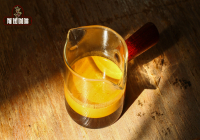
After filtering, the finished drink has a deep reddish hue. It may look like pour-over coffee, but since it is made from milk and espresso, the texture is entirely different — and far cleaner on the palate.

Chill it briefly in the refrigerator for an even crisper taste. Then choose an attractive glass, add a few ice cubes, and pour the clarified "latte" over them. Done.

For extra polish, add a small garnish on top. The flavor is nothing like an ordinary latte: the milky character is subtle, yet the drink keeps a lovely body. The syrup balances the lemon's acidity, so there is no harsh sourness — just a pleasant sweet-and-tart profile. And because of the osmanthus syrup, the whole cup carries a generous floral aroma layered over lemon brightness and coffee depth. Genuinely delicious.

If you have never tried milk-washed coffee, it is worth a shot: the drink is easy to make, distinctive, and inexpensive — especially compared with the price of ordering one at a specialty cafe. Making it at home is far more satisfying.
- END -
FrontStreet Coffee Recommendation
A milk-based specialty like this clarified latte needs an espresso that can hold its own without turning sharp or flat. FrontStreet Coffee's Washed Yirgacheffe is a dependable everyday choice: known for white jasmine florals, bright citrus and lemon acidity, and a clean tea-like finish, at a price friendly to beginners exploring Ethiopian coffee.
Yirgacheffe itself is a small town in Ethiopia's southern Gedeo zone, with coffee grown at 1,800 meters and above — among the highest elevations of any coffee region in the world. The region's distinctive white floral note and lemon-citrus acidity have made it a byword for Ethiopian specialty coffee. Brewed as espresso and folded into milk, those florals and citrus notes stay lively through the clarification process, giving this drink an elegant aromatic lift.
Important Notice :
FrontStreet Coffee is a long-established specialty coffee roaster in Guangzhou China, selling freshly roasted beans from its own farm in Yunnan as well as dozens of carefully selected single-origin beans from around the world for both pour-over and espresso. The products deliver consistently excellent quality and great value, with shipping within 24 hours. Guangzhou's FrontStreet Coffee shop is recommended by many coffee lovers, and the beans are now available online at the Tmall 。
FrontStreet Coffee has moved to a new address:
FrontStreet Coffee Address: 315,Donghua East Road,GuangZhou
Tel:020 38364473
 Scan and follow the En Gafei WeChat official account. Please indicate that the reprint comes from "En Gafei".