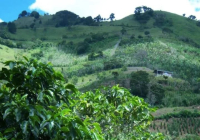
Where is Ethiopia's Gesha Village? What are the characteristics of Gesha Village's Gesha?
When it comes to Gesha, everyone naturally thinks of Panamanian Gesha. Initially the variety was not well regarded, because its plants are fragile, difficult to cultivate and low-yielding. Panama's Hacienda La Esmeralda later introduced the Gesha variety to the global market through the Best of Panama (BOP) competition and auctions, after which surrounding estates and neighboring countries began growing it too.

In fact, Gesha originally comes from Ethiopia, widely recognized as the birthplace of coffee. It was discovered in the 1930s in the Gesha region near the Kaffa forest in southwestern Ethiopia. Because of its resistance to leaf rust disease, it traveled through several countries before being cataloged by Costa Rica's Tropical Agricultural Research and Higher Education Center (CATIE) as the "geisha T2722" variety, and finally arrived in Panama.
As the Gesha variety gradually gained fame, many estates and countries were drawn to introduce and cultivate it. Among them were Adam Overton, a director, and his wife, the photographer Rachel Samuel. In 2007 the couple was commissioned by the Ethiopian government to shoot a documentary about coffee. During filming they visited the Bench Maji region, where they discovered the Gori Gesha Forest and conceived the idea of establishing a coffee estate.

In 2009 the couple met Willem, the owner of Panama's Don Pachi Estate, and together they returned to Ethiopia to search for the birthplace of Gesha. They came to a place in Bench Maji known as Gesha Village, which they identified as the most likely area of origin for the original Gesha. After finding wild Gesha, they collected seeds from native Gesha trees, screened them and planted them at Gesha Village. They later decided to establish their estate here and named it Gesha Village Coffee Estate.
Ethiopia's Coffee Regions
Ethiopia is currently divided into 12 states and 2 autonomous administrative regions, with 10 coffee regions. Many of these are globally renowned, such as Sidamo, Jima, Harrar, Guji and Yirgacheffe. Guji and Yirgacheffe were originally part of the Sidamo region but became independent coffee regions because of their unique flavor profiles.

When people mention Ethiopian coffee, they often think of regions like Sidamo, Guji and Yirgacheffe. But coffee was originally discovered in the Kaffa Zone in southwestern Ethiopia, where countless wild Arabica mother trees still grow today.
The Kaffa Zone now belongs to the South West Ethiopia Peoples' Region—a state that was originally part of the Southern Nations, Nationalities and Peoples' Region before becoming independent through a referendum in 2021—and is located in the northern part of that state. The Kaffa Zone is primarily a humid rainforest area, and its most famous feature is the Kafa Biosphere Reserve, which is rich in natural resources.

The Origin of Gesha
To the west of the Kafa Biosphere Reserve lies the Bench Maji region, called Bench Sheko in some local areas, which is also the Gesha National Forest Reserve. The Gesha variety originates here. In coffee region classification, Bench Maji belongs to the Bebeka coffee region. Bebeka is also the capital of the Bench Maji Zone, and because the area is remote and underdeveloped, coffee there is still grown mainly using primitive forest cultivation methods.
According to research by the French biologist Jean-Pierre Labouisse, however, the original batch of beans labeled as Gesha came from different local coffee trees. Gesha is therefore not a single variety—there are many different "Gesha types" in Ethiopia, and Panamanian Gesha is just one of them.

Gesha Village Coffee Varieties
As a result, the Gesha grown at Gesha Village in Bench Maji today is not the same variety as Panamanian Gesha. Gesha Village currently cultivates Gesha 1931 and Gori Gesha.
Gesha 1931 is the native Gesha variety the owners of Gesha Village found in the Gesha forest. It was named Gesha 1931 because its genetic makeup closely matches the Panamanian Gesha variety found in 1931. Gori Gesha was discovered in 2011, after Gesha Village was established, when the owners found a coffee variety very similar to Gesha in the Gori forest, 12 miles from their estate—hence the name Gori Gesha.

In addition, Gesha Village collaborates with the Ethiopian Research Center to cultivate Illubabor Forest 1974, a disease-resistant coffee variety developed by the center. It was discovered in the Illubabor forest in 1974, hence its name.
FrontStreet Coffee also offers Red Label Gesha coffee from Gesha Village. This Gesha belongs to the Gori Gesha variety and is processed using the natural method. When brewed, it reveals jasmine and mature fruit aromas, with citrus, grape and wild ginger flavors on the palate. It has delicate fruit acidity and a sweet, fruit-like aftertaste, with a clean and balanced mouthfeel.


FrontStreet Coffee Recommendation
Ethiopia is where Gesha began, but the variety only became a legend after it reached Panama. The story turned in 2003, when the owner of Hacienda La Esmeralda discovered the variety growing on the estate and entered it in the Best of Panama competition. Its distinctive flavor stunned every judge, and it won first place with an average cupping score of 94.6, breaking the BOP record and turning Gesha overnight into the most sought-after variety in the world.
Panamanian Gesha shows an unmistakable orange-blossom honey note, rich and juicy fruit sweet-sour character within a fragrant floral aroma, and a tea-like finish. To experience that profile, reach for the highest grade: the FrontStreet Esmeralda Red Label Geisha, formally Esmeralda Special, grown at 1,600-1,800 meters, where every batch must cup above 90 points, carries its own independent number and comes from a single plot; or the FrontStreet Esmeralda Green Label Geisha, originally Private Collection, blended from several plots to express the estate's signature high-altitude Geisha flavor at a more affordable price.
Over the past decade or so, people have begun returning to Ethiopia, coffee's homeland, in search of Gesha's original character. A couple established the 475-hectare Gesha Village estate 12 miles from the Gesha forest, identifying the variety closest to Panamanian Gesha by plant morphology, bean shape and cupping performance—essentially a native Gesha—and bringing it out of the forest to plant on the estate. Compared with Panama, Ethiopian Gesha tends to have brighter fruit acidity. Beginners can try the entry-level FrontStreet Granada Geisha, medium-light roasted to keep a pleasant white floral note while bringing out orange, guava and citrus sweet-sour character with a clearer finish.
For estate-level Ethiopian Gesha, FrontStreet recommends the FrontStreet Gesha Village Gold Label and the FrontStreet Gesha Village Red Label. Unlike the small-scale harvesting and processing of other origins, Gesha Village is one of the few large estates in Ethiopia; because it sits beside the original Gesha forest and maintains strict quality control and standardized management, its Gesha coffee is exceptionally fine, making it a must-try pour-over for advanced drinkers. Its Gold Label belongs to the Gesha 1931 variety and accounts for 10% of total production, while the Red Label belongs to the Gori Gesha variety, accounts for 15% of production and scores 88 or above on the SCA 100-point scale.
Important Notice :
FrontStreet Coffee is a long-established specialty coffee roaster in Guangzhou China, selling freshly roasted beans from its own farm in Yunnan as well as dozens of carefully selected single-origin beans from around the world for both pour-over and espresso. The products deliver consistently excellent quality and great value, with shipping within 24 hours. Guangzhou's FrontStreet Coffee shop is recommended by many coffee lovers, and the beans are now available online at the Tmall 。
FrontStreet Coffee has moved to a new address:
FrontStreet Coffee Address: 315,Donghua East Road,GuangZhou
Tel:020 38364473
 Scan and follow the En Gafei WeChat official account. Please indicate that the reprint comes from "En Gafei".