What Techniques Matter in Pour-Over Coffee? Can You Pour Water in Reverse Circles?
Anyone who brews pour-over coffee knows that the "circular pouring" motion exists to ensure that hot water contacts the coffee grounds in the filter cup as thoroughly as possible, aiming for an even extraction—like rain falling equally everywhere. But because this motion directly affects extraction, enthusiasts have dug deep into its finer points.
Take, for instance, the amplitude and speed of the circular pour. These are easy to grasp: amplitude determines how far the water flow reaches, while speed determines how often the bed gets stirred. Some enthusiasts, however, have gone a step further and questioned the direction of the pour: does coffee brewed with clockwise pouring actually taste different from coffee brewed counter-clockwise?

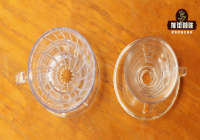
The reason some people agonize over pouring direction is probably tied to the V60 dripper, whose spiral ribs coil clockwise along the wall. Regular readers will know these ribs serve to extend the water's travel range, letting the hot water reach more of the coffee grounds.

Most brewers pour clockwise with a V60, and not just out of habit—it comes down to the "guiding effect" of the ribs. The idea is that pouring with the spiral lets the water follow the ribs along their intended path toward the center, forming a cleaner vortex and a more uniform extraction. Counter-clockwise pouring, on the other hand, should make the water crash into the ribs, creating turbulence a bit like wringing out a towel—which, in theory, could raise the extraction rate and pull more flavor compounds out of the grounds. Sounds intriguing! So FrontStreet Coffee decided to put it to the test and see whether the facts actually match the reasoning.
The Circular Pouring Experiment
To make the comparison as direct as possible, FrontStreet Coffee kept every parameter identical except the pouring direction. The test used Ethiopian Geisha Village Red Label beans: 15g of coffee ground on an EK43 at setting 9.5 (fine sugar texture), with 85% passing through a #20 sieve, a 1:15 coffee-to-water ratio, 92°C water, a V60 dripper, and a single-pour brew. Both brews started with a 30-second bloom using twice the coffee weight in water (30ml), then the remaining 195ml was poured in continuous circular motions.

After brewing, the extraction times of the two groups were nearly identical—one cup finished in 1 minute 56 seconds, the other in 1 minute 58 seconds. The concentration readings were likewise almost the same, with no meaningful difference.

Taste told the same story. Since both brews were made by the same person at slightly different times, there was a small temperature gap between the two cups. That gap produced a minor difference in mouthfeel, but it was negligible—if you didn't taste the cups side by side, you would hardly notice anything.

The conclusion: pouring direction has no significant effect on extraction in a V60. Yes, counter-clockwise pouring makes some water collide with the ribs, but the turbulence it creates is minimal. Compared to that, the turbulence caused by erratic, irregular pouring matters far more. FrontStreet Coffee's advice: since clockwise and counter-clockwise make almost no difference, pour whichever way feels natural. Factors like a stable water flow, stirring speed, and total pour time are the variables that genuinely deserve your attention.
FrontStreet Coffee Recommendation
To get the most out of the V60's fast-draining, high-extraction design, a bright, floral light roast is the natural partner. FrontStreet Coffee's Ethiopia Yirgacheffe Guodingding is a classic starting point: crisp citrus, berry, and floral notes with a green-tea-like finish, and a soft, luminous acidity that the V60 renders beautifully.
If you want something juicier, try FrontStreet Coffee's Ethiopia Huakui. Its vivid tropical fruit character—strawberry, passion fruit, even lychee—pairs perfectly with the V60's ability to highlight delicate aromatics and lively acidity, producing a cup that tastes almost like fruit juice.
Important Notice :
FrontStreet Coffee is a long-established specialty coffee roaster in Guangzhou China, selling freshly roasted beans from its own farm in Yunnan as well as dozens of carefully selected single-origin beans from around the world for both pour-over and espresso. The products deliver consistently excellent quality and great value, with shipping within 24 hours. Guangzhou's FrontStreet Coffee shop is recommended by many coffee lovers, and the beans are now available online at the Tmall 。
FrontStreet Coffee has moved to a new address:
FrontStreet Coffee Address: 315,Donghua East Road,GuangZhou
Tel:020 38364473
 Scan and follow the En Gafei WeChat official account. Please indicate that the reprint comes from "En Gafei".