How Long Should Hand-Drip Coffee Extraction Take? What's the Normal Extraction Time for Pour-Over Coffee? Must the Brewing Time Be Exactly Two Minutes?
When you brew coffee, time is the only parameter you cannot control directly and precisely, because it is not an input at all: it is the result of every other parameter working together. That also means time can serve as a yardstick for everything else. In theory, then, if you can control the brew time, making a good cup becomes routine.

How Does Time Affect Extraction?
Beyond acting as a measuring stick, extraction time is itself an important variable. When every other parameter stays the same, the length of the brew determines the extraction yield, and the relationship is straightforward: the longer the extraction, the higher the extraction yield, and the shorter the extraction, the lower it goes.

Coffee extraction has a widely accepted target range, the 18-22% extraction rate of the Golden Cup Standard. Not every delicious coffee falls inside it, but the overwhelming majority does. To keep the extraction rate in that window, you have to match your parameters sensibly, which simply means building a brewing framework, or recipe. FrontStreet Coffee keeps emphasizing a two-minute target, give or take ten seconds, for pour-over, because two minutes suits the framework we currently use: 15g of light-roast grounds, a 1:15 coffee-to-water ratio, 92°C water, a grind at 80% passing a No. 20 sieve, a three-stage pour, and a V60 dripper.

And because time is built by those parameters working together (water temperature aside), when the extraction time falls outside the target range it usually means a parameter has drifted or a condition has not been met, which throws the flavor off. If the coffee turns out worse rather than better, FrontStreet Coffee uses the brew time to hunt down the culprit and correct the flavor.

Next, FrontStreet Coffee will share what factors across the whole pour-over process can affect extraction time.
1. Grind Size
Bluntly put, extraction time is how long the brewing water takes to pass through the coffee bed, and the coarseness of the grounds directly determines the size of the gaps the water flows through. With everything else equal, coarser grounds mean larger gaps and a faster flow; finer grounds mean smaller gaps and a slower flow. Grind size is therefore a major factor in how quickly time passes.

This assumes reasonably uniform grinding. If the grinder is poor and the particle size is inconsistent, with more fines than usual, that extra fine powder will also lengthen the extraction time, and it is worth keeping in mind.
2. Dose
Beyond grind, the amount of coffee you use affects the brew time as well. A larger dose makes the bed thicker, so the water has to travel through more grounds and the time grows longer, and vice versa.

3. Pouring Method
The size of the stream you pour is another key lever on time. A larger stream means you need only a short while to add the target amount of water. At the same time, because the incoming flow outpaces the drainage, the bed lifts, the grounds are pushed toward the dripper walls, the bed thins, and drainage speeds up. A smaller stream not only takes longer to deliver the same water, but also fails to lift the bed, so the water must pass through a thicker layer of grounds and extraction slows down.

At the same stream size, the number of pours in your method becomes another factor shaping the time. More pours make for a longer extraction. Take a single pour and a three-stage pour: with all other parameters identical, the single pour finishes sooner, simply because it has fewer pours.
4. Dripper Flow Rate
As the tool that supports the filter, the dripper's construction also sets the length of extraction, mainly through how pronounced its guide ribs are and how large its bottom opening is.

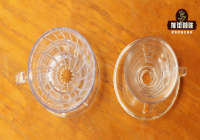
When the guide ribs are more prominent or the bottom opening is larger, water flows faster because it has more room to move. Among conical drippers, for example, the V60 drains faster than the Kono: compared with the Kono, the V60 has more and more pronounced guide ribs and a wider bottom opening, which gives it more drainage space and therefore a faster flow.

It is worth noting that filter papers from different makers affect drainage too, since their thickness and pore size vary with the manufacturing process. This is another point we cannot ignore. So now you can see why FrontStreet Coffee always lays out the parameters in such detail: there are simply too many factors that can move extraction time, and when a brew underperforms, that time is what tells us where the problem lies.
- END -
FrontStreet Coffee Recommendation
Since the framework in this article is built around a V60, FrontStreet Coffee recommends matching it with coffees that show off what a fast, clean dripper does best. Hario, the company behind the V60, was founded in Tokyo in 1921 and redesigned the dripper's prototype in 2004 before launching it a year later; its 60° cone and single large opening favor bright, aromatic coffees.
Three good places to start: the FrontStreet Ethiopia Yirgacheffe Gotiti, a gentle entry into specialty coffee with citrus, berry, and floral notes and a green-tea-like finish; the FrontStreet Ethiopia Huakui, whose tropical aromatics of strawberry, passion fruit, and jackfruit make it one of the most popular fruit-forward choices; and the FrontStreet Strawberry Candy, a Geisha-style coffee with delicate florals and sweet fruit.
Important Notice :
FrontStreet Coffee is a long-established specialty coffee roaster in Guangzhou China, selling freshly roasted beans from its own farm in Yunnan as well as dozens of carefully selected single-origin beans from around the world for both pour-over and espresso. The products deliver consistently excellent quality and great value, with shipping within 24 hours. Guangzhou's FrontStreet Coffee shop is recommended by many coffee lovers, and the beans are now available online at the Tmall 。
FrontStreet Coffee has moved to a new address:
FrontStreet Coffee Address: 315,Donghua East Road,GuangZhou
Tel:020 38364473
 Scan and follow the En Gafei WeChat official account. Please indicate that the reprint comes from "En Gafei".