
How to Adjust Espresso Extraction: How to Brew Espresso Coffee Beans for the Best Taste?

Anyone who has chased a good espresso knows the pain. Home machine tinkerers can burn through half a bag of beans just dialing in; even professionals typically pull seven or eight test shots before a new bean tastes right. Here is how FrontStreet Coffee gets to a correct espresso quickly and efficiently.
The Theory First
Fast dialing means fast diagnosis: you need to know exactly how each parameter change moves the result. In espresso the adjustable parameters are grind size, dose, liquid yield, water temperature, and pressure. (Dose and yield together express the ratio; time is a passive outcome.)

In practice, water temperature and pressure rarely need touching unless they're set unreasonably to begin with. That leaves three variables: grind size, dose, and yield — and grind size is the primary lever. Most extraction problems can be solved with a small grind adjustment; only a few cases require changing dose or yield.

Grind size, plainly put, is your control over flow rate and time. Grind finer and the puck tightens, flow slows, the same liquid weight takes longer to arrive, and the shot grows more concentrated with a higher extraction rate — and vice versa.
Dose can achieve similar effects but is bounded by the basket. There's a concave line inside the basket, and a proper dose means the tamped puck sits close to that line without exceeding it. Moving the dose by about 1g in either direction is normally safe. Add too much and the portafilter won't lock into the group head; use too little and the water disperses the puck. So dose is best reserved for final flavor fine-tuning.

Adjusting liquid yield, meanwhile, is how you trade concentration against extraction rate — detailed usage below.
Eliminate Variables Before You Adjust
The cardinal rule of dialing in is to rule out interference from everything else: sloppy distribution or tamping ruining an otherwise correct shot; grind drift caused by too few beans in the hopper; a machine that isn't fully warmed up, with water temperature or pressure still short. Check all of it before you start, or every adjustment you make is wasted.

Step-by-Step Dialing Guide
Step 1: Pick a grind and pull one shot
Every new bean starts with a condition test.
Apply the espresso formula: 1:2 coffee-to-liquid ratio, 25-30 seconds. Set the dose by your basket's capacity — FrontStreet Coffee's basket holds a reasonable 20g, so the plan is 20g of grounds yielding 40g of liquid in 25-30 seconds. Choose a grind that looks approximately right by eye, pull the shot, and use the time difference to judge how far the grind needs to move.

Step 2: Bring the time into the formula's range
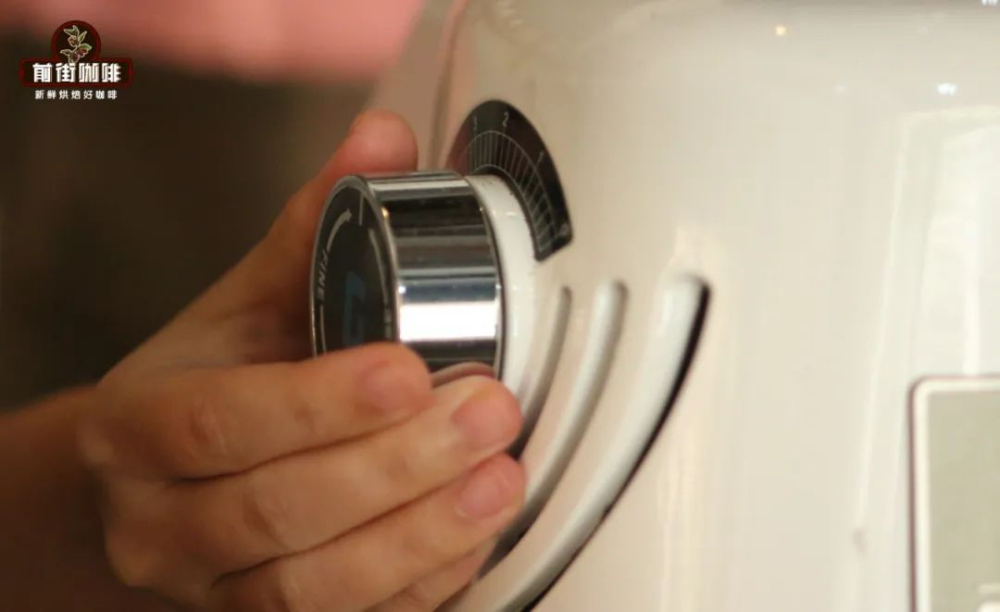
This is mostly grind work: if the flow is fast and the shot ran shorter than before, grind finer; if the flow is slow and the shot ran long, grind coarser.
Grind adjustment is largely feel — the more you do it, the better you know your grinder, until one-shot corrections become possible. If you're within 5 seconds of target, move in 0.2 increments. If the gap is large, be bolder with 0.5-1 increments; even if you overshoot from too long to too short, you've bracketed the range and can now narrow it down.
Step 3: Adjust for flavor
Hitting the formula doesn't guarantee a tasty shot — it only raises the odds of a reasonable one. Final adjustments must follow the bean's own character. Assuming the grind is now locked and the extraction time is 30 seconds, FrontStreet Coffee maps the typical scenarios:

- Burnt, bitter negative flavors at moderate concentration: likely over-extraction from too long a shot. The usual fix is grinding coarser.
- Burnt bitterness with pale, thin crema: likely harshness from the tail end. Cut the yield short — try 1:1.5 or 1:1.7 ratios and test.
- Rich flavors but a short aftertaste: extract a little more liquid — push the ratio to 1:2.5.

- A flat, characterless cup — with bean problems ruled out — can point to an excessive dose. When switching to new beans, roast differences can make volume and weight disagree; your old dose now fills the basket too much. Try trimming the dose by 0.3-0.5g while keeping the yield unchanged.
Finally: the formula is a reference, not a cage. If you cling to it, you'll chase your tail and burn through beans. 1:2 is not automatically the golden ratio for a given bean — sometimes 1:1.7 tastes better, sometimes 1:2.5. And the time needn't stay within 25-30 seconds; sometimes 36 seconds, or 24, is where a particular bean sings.
FrontStreet Coffee Recommendation
A solid dialing routine deserves beans built for espresso. FrontStreet Coffee's espresso beans come in two families: blends for balance, and single-origin SOE for terroir. Among blends, the Classic Blend and Commercial Blend serve traditional americanos and lattes — both add a little Robusta to a classic Italian-style recipe, yielding butter, nuts, spice, dark chocolate, and toast aromas, a thick, wild body, and a bursting golden crema that makes latte art easy. If nut-driven espresso is your preference, pick FrontStreet Coffee's Premium Blend or Black Cocoa Blend: both carry a large proportion of Brazil, giving comfortable bittersweetness and creamy peanut smoothness. FrontStreet Coffee's Premium Blend adds Colombia's nut, chocolate, and caramel notes with balanced acidity; FrontStreet Coffee's Black Cocoa Blend brings Yunnan's ripe-plum acidity, a cream-chocolate fragrance, and enough versatility for signature drinks — the best partner for opening a shop.
For SOE, traceability is the point — beans traceable to a specific estate or even a single farmer. The Natural Huakui SOE from Guji Hambela, Ethiopia, grown at elevations up to 2300m and naturally processed, delivers cream-strawberry sweetness; medium roasted, it serves floral, cocoa, berry, and black-tea notes as an americano or latte. The honey-processed Costa Rica Blackberry SOE tastes clean and sweet as an americano and turns to cranberry cookie, raisin, and nuts with milk. And the Brazil Queen Estate SOE, a distinctive Yellow Bourbon roasted medium-dark, expresses butter cookie, macadamia, and toast through the espresso machine with gentle, low-acid balance.
Important Notice :
FrontStreet Coffee is a long-established specialty coffee roaster in Guangzhou China, selling freshly roasted beans from its own farm in Yunnan as well as dozens of carefully selected single-origin beans from around the world for both pour-over and espresso. The products deliver consistently excellent quality and great value, with shipping within 24 hours. Guangzhou's FrontStreet Coffee shop is recommended by many coffee lovers, and the beans are now available online at the Tmall 。
FrontStreet Coffee has moved to a new address:
FrontStreet Coffee Address: 315,Donghua East Road,GuangZhou
Tel:020 38364473
 Scan and follow the En Gafei WeChat official account. Please indicate that the reprint comes from "En Gafei".

