
What's the ideal milk ratio for a SOE latte? What espresso beans are best for hot lattes?

Anyone who loves milk coffee knows that what we call a latte is simply espresso cut with milk. The milk transforms the espresso's intensity into something sweet and easy to love — the kind of drink that converts even people who never order black coffee.
But get the coffee-to-milk ratio wrong and the whole drink suffers: too much milk buries the coffee flavor entirely, while too little lets bitterness dominate. A good latte lives and dies by the ratio.

FrontStreet Coffee believes there's no single fixed ratio — it depends on how the espresso tastes and how well it marries with milk. That said, generations of baristas have experimented enough to establish a useful range: for lattes aimed at the general public, the espresso-to-milk ratio typically falls between 1:5 and 1:8.
Keep in mind that espresso beans differ in flavor and positioning depending on their target market. From a purely practical standpoint, FrontStreet Coffee recommends stable espresso blends. A blend combines flavor characteristics from multiple origins, and with a medium or darker roast it tends to produce rich crema — an important trait for milk-based drinks — plus a thick, full-bodied shot with a generous margin for error.

Take FrontStreet Coffee's Commercial Blend: 90% Brazilian and Colombian Arabica combined with 10% Vietnamese Robusta. The shot pours with a thick golden crema and carries the fragrant bitterness of traditional Italian espresso — a profile FrontStreet Coffee positions for high-volume commercial cafés.

Its flavor runs to dark chocolate, caramel, and cream, with the small Robusta fraction boosting crema at the cost of slightly more assertive bitterness. For lattes built on this kind of bean, FrontStreet Coffee recommends more milk to balance that bitterness — in a 360ml cup, roughly 40g of espresso and a 1:8 coffee-to-milk ratio, which means adding about 320ml of steamed milk including foam.
Compared with these mellow traditional blends, the espresso served in FrontStreet Coffee's own stores leans toward a "fresh and light" style, named the Sunflower · Warm Sun Blend. It pairs Ethiopia Yirgacheffe Red Cherry with Honduras Sherry, roasted to moderate bitterness with flavors of sherry wine, chocolate, vanilla cream, and candy. Anyone who has had an espresso at a FrontStreet Coffee store knows this base lacks the aggressive bitterness of dark-roasted espresso, so there's no need to drown it in milk — over-diluting simply masks the coffee's own aromatics.

After repeated trials, FrontStreet Coffee found that a 1:6 coffee-to-milk ratio suits Warm Sun best: a 40g shot of espresso topped with 240ml of milk.
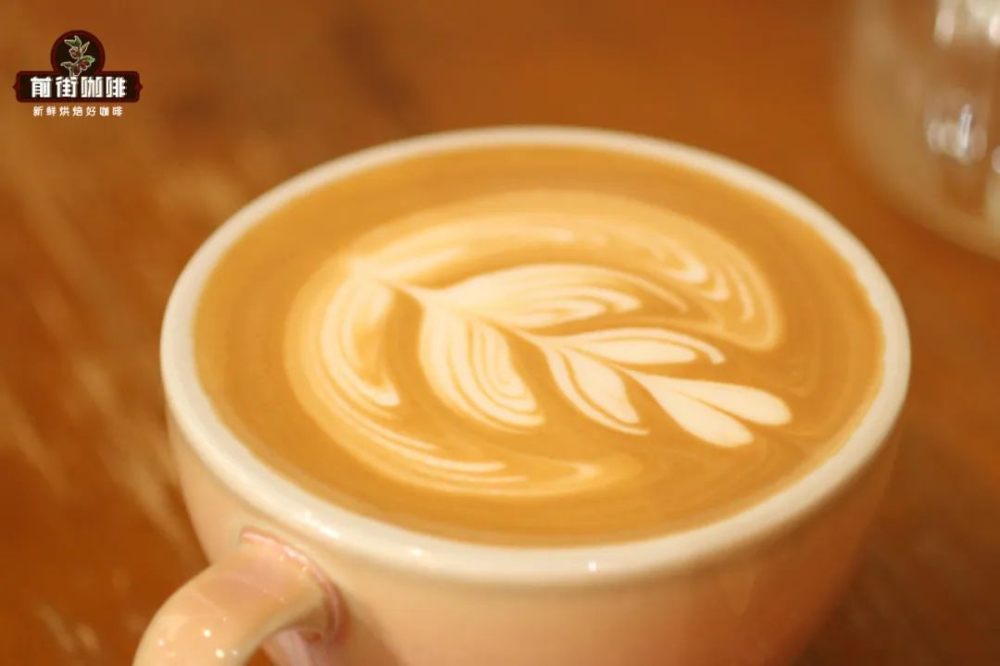
SOE Coffee: Single Origin Espresso
Beyond the usual blends, one category keeps growing on café menus: SOE.
SOE stands for "Single Origin Espresso," and the name is meant to set it apart from traditional Italian blended espresso (house blend espresso). Single-origin espressos are usually roasted lighter, trading the familiar bitterness for a lighter body and more distinctive flavors — the citrus-lemon character of Ethiopian beans, the raisin-honey sweetness of Costa Ricans, the tomato-berry acidity of Kenyans, or the floral-honey elegance of Panama Geisha. These signatures make SOE easy for customers to remember, though from a cost perspective, high-grade single-origin beans are correspondingly pricier.

Pulling espresso from lighter-roasted beans is harder work. Because they've spent less time in the roaster, their structure is denser and their flavors less willing to give themselves up; cut with milk, such shots can taste thin and bland. To compensate, you have to raise the extraction yield — lengthen the extraction, raise the water temperature, tighten the grind size, increase the dose — which demands far more precision than dark-roasted beans. In FrontStreet Coffee's view, a memorable SOE needs all four: excellent beans, the right roast level, properly dialed grind settings, and a well-executed extraction.
Because these beans are roasted far lighter than traditional espresso beans, the whole point of the shot is to express the coffee's own character: low bitterness, delicate aroma, a thinner body. Which means that for SOE lattes, a large milk ratio would smother the very "coffee flavor" you paid for. FrontStreet Coffee sets its SOE latte ratio at 1:5 — enough milk to bring out its sweetness without erasing the single origin's personality.

To show how this works in practice, let's build a hot SOE latte with a store regular: Mirasu · Strawberry Candy. It's a Geisha blend from Mirasu Manor in Costa Rica, finished with the raisin honey process. The espresso offers rich notes of rose, dried fruit, and strawberry candy — equally charming diluted into an Americano or folded into milk.
FrontStreet Coffee's stores run a Lelit Bianca espresso machine with a Galileo Q18 grinder. That said, any home machine capable of 9 bar of pressure is fully adequate for pulling espresso and steaming milk.
Strawberry Candy · Geisha Blend SOE Extraction Parameters
Coffee Beans: Costa Rica · Strawberry Candy
Coffee Dose: 20g
Coffee Liquid: 40g
Dose-to-Liquid Ratio: 1:2
Extraction Time: 26-32 seconds
Grind Setting: Galileo Q18 scale 2.0
Milk Volume: 200g

FrontStreet Coffee uses a double basket rated for roughly 18–20 grams; for this shot we dose 20 grams of ground coffee. A typical espresso runs a dose-to-liquid ratio of 1:1.5 to 1:2.5; ours is 1:2, so 20 grams of grounds yield 40 grams of espresso. Extraction time follows the flow rate through the puck. Most shots should land between 20 and 35 seconds: anything under 20 seconds usually tastes thin, while past 35 seconds you drift into over-extraction and burnt bitterness. Most of FrontStreet Coffee's espresso shots finish in the 28–30 second window.

Before extraction, dry the portafilter, run the grinder, and weigh the double dose on a scale, adjusting until you reach 20 grams. Use a distributor to level the grounds, then tamp straight down to compact the puck evenly for a more stable extraction.

Next, run the pump for 1–2 seconds to wet the group head and flush away any stray grounds. Place your cup on the scale, tare it, and lock the portafilter gently into the group head. Start the shot and watch the stream: when the scale reads 40 grams of espresso — around 30 seconds in — flip the switch to stop. Pour the shot into a warmed cup and set it aside.

Then pour 200g of cold fresh milk into the pitcher, angle the steam wand, and begin frothing. Aim for microfoam between 0.3 and 0.5cm thick, dense and silky, finished at 55–60°C. Fold the milk evenly into the espresso, pour your latte art, and the Geisha blend SOE hot latte is done.

Tasting it, the coffee's floral and fruity aromatics come through clearly: berries, pink florals, and raisins on the palate, plus a hint of almond. Over the crema, the finish lingers with chocolate and hazelnut — like biting into a cranberry biscuit. Quite special.
FrontStreet Coffee Recommendation
If you're practicing latte art at home, bean choice matters as much as the pour. The FrontStreet Classic Blend is a medium-dark espresso recipe built from three origins, inspired by the old-school "Mandheling-Brazil" pairing, with a touch of Robusta for aroma and crema. Expect pronounced butter, toasted toast, and caramel-cookie aromatics in a solid, textured shot that extracts with remarkable stability — a dependable home base for milk drinks. Prefer a nutty, deeply aromatic profile? The FrontStreet Premium Blend, a classic pairing of washed Colombian and pulped-natural Brazilian beans, delivers nuts, dark chocolate, and caramel as espresso, with creamy almond and cocoa softness in lattes and flat whites — crema every bit as good as café output, with more than enough texture for art practice. And for anyone gearing up to open a shop, the FrontStreet Commercial Blend — the Premium recipe plus a small Robusta fraction — adds extra deep-brown crema and body, keeping Americanos, lattes, and mochas full of nut, cocoa, and caramel character while making latte art genuinely easy.
Important Notice :
FrontStreet Coffee is a long-established specialty coffee roaster in Guangzhou China, selling freshly roasted beans from its own farm in Yunnan as well as dozens of carefully selected single-origin beans from around the world for both pour-over and espresso. The products deliver consistently excellent quality and great value, with shipping within 24 hours. Guangzhou's FrontStreet Coffee shop is recommended by many coffee lovers, and the beans are now available online at the Tmall 。
FrontStreet Coffee has moved to a new address:
FrontStreet Coffee Address: 315,Donghua East Road,GuangZhou
Tel:020 38364473
 Scan and follow the En Gafei WeChat official account. Please indicate that the reprint comes from "En Gafei".

