
Ethiopian Guji Hambella Coffee Beans: Pour-Over Flavor Profile and Characteristics

Ethiopia is the birthplace of coffee, and countless varieties have spread outward from here. When people think of this origin, the first thing that usually comes to mind is the bright acidity and fresh flavors of a washed Yirgacheffe — many coffee drinkers have come to treat Yirgacheffe as the very emblem of Ethiopian coffee. Yet while washed lots are what most of us drink, Ethiopia has always been a natural-processing country at heart: even today, natural process accounts for roughly 70% of the country's production. And when natural processing comes up, the coffee worth talking about is Flower Champion — a bean that has won a devoted following among enthusiasts.
Why Is It Called "Flower Champion"?
The name sounds like something out of a royal court — the queen of all flowers. In coffee terms, where did it come from? The answer lies in the marketing history of the bean itself.

The bean's original name is Hambella. "Flower Champion" is a Chinese trade name coined by domestic green-bean importers. When Beijing green-bean merchants first brought this lot into China, roaster Li Jianfei took second place with it at the 2017 China Coffee Competition — remarkable, because nearly every competition bean that year was a Geisha. A non-Geisha variety beating a field of Geishas was an extraordinary feat. Since the English word "Geisha" is a homophone of the Japanese word for geisha, the importers named the bean "Hua Kui" (Flower Champion) — literally, the leader among geishas — to underscore its status.
The Hambella Growing Region
Coffee is usually named for where it grows, and Flower Champion actually comes from the Hambella area within Ethiopia's Guji zone, part of the Oromia Regional State. Guji was once part of Sidamo and was established as an independent appellation by the Ethiopia Commodity Exchange (ECX) in 2010. The region's most famous bean is undoubtedly Flower Champion, which won the 2017 TOH (Ethiopia National Taste of Harvest Competition) with its outstanding strawberry-cream profile — a title it truly earned. Note, however, that not every coffee from Hambella can be called Flower Champion: only natural-processed beans from the Buku Abel washing station carry that name.

Western Hambella faces Yirgacheffe Kochere across a highland ridge about 3,200 meters above sea level and roughly 30 kilometers wide. To the southeast, north, and south it borders the Guji sub-regions of Shakisso, Uraga, and Kercha. It is the highest-altitude coffee sub-region in Ethiopia, and today it hosts around 20 washing stations of various sizes.
Buku Abel Station and the Natural Process Behind Flower Champion
The Buku Abel station sits in Buku Abel village at 2,200 meters. From the start it was blessed with ideal conditions: fertile, humus-rich reddish-brown soil and shade from Ensete trees. The trees let the coffee receive enough sunlight to develop dense flavor without draining excessive nutrients from the fruit, so more of the bean's essence is retained. During the harvest-and-processing season (December to January), this unique terroir and climate shape Flower Champion's distinctive character.

Buku Abel accepts only fully red cherries with a sugar content above 30 for natural processing. In the first two days of drying, the cherries' humidity must be maintained so the fructose can begin fermenting properly. Thanks to the high altitude, nighttime temperatures fall to around 12°C, which prevents the off-flavors of over-fermentation; when midday sun grows intense, shade netting is deployed so the cherries don't scald. All fruit is hand-picked at full ripeness and dried on African raised beds, kept in a thin layer and turned continuously around the clock to ensure even drying and ventilation and to control fermentation precisely. Because the beans are dried in the fruit, the sugars of the pulp and mucilage migrate into the bean — which is why Flower Champion tastes noticeably sweeter than coffees from other Sidamo areas.
Variety: Heirloom
Ethiopia holds an enormous reservoir of varieties, and Flower Champion's is simply labeled heirloom. The reason: a combination of countless local varieties, smallholder farming, mixed harvests and processing, and Ethiopia's early green-grading system means lots are lumped together as "Heirloom." It is also why Ethiopian beans vary so much in size.

How to Tell the Flower Champion Versions Apart
Search for Flower Champion and you'll find 2.0, 3.0, 4.0 and beyond. Why the numbers, and do the flavors differ? As with any agricultural product, climate changes year to year and so does the cup. Let's go back to 2017: that natural lot from DW Import & Export's Buku Abel station won the TOH natural category, Chinese merchants brought it in and named it Flower Champion, and DW went on to run four stations in Hambella: Buku Abel, Buku Saysay, Haro Soresa, and Tirtiro Goye. Strictly speaking, only naturals from Buku Abel are true Flower Champion. The X.0 naming follows the harvest year: 2.0 launched in 2018, 3.0 and 3.1 in 2019, 4.0 in 2020, 5.0 in 2021, and 6.0 in 2022.
In 2021, alongside the 5.0 release, a separate line called Small Bean Flower Champion appeared. Unlike the X.0 series, it doesn't change with the year. FrontStreet Coffee noticed that the small beans sorted out of Flower Champion 2.0 and 3.1 carried the strawberry character of the original 2017 lot, and concluded that Flower Champion's signature aroma and sweetness come mainly from those small beans — batches of 4.0 with a high share of small beans also showed excellent aroma and sweetness. DW has since begun separating small beans into their own product line. Comparing the two, the Small Bean version is more pronounced in sweetness and strawberry aroma, while the 5.0 leans toward rich citrus and berry notes and is perhaps the more drinkable of the two.

In 2022, Hongshun launched the 6.0 series, and FrontStreet Coffee obtained the green beans early on. This lot, however, looked flatter and more shriveled than previous crops, and roasting yielded many flat and shell-shaped beans.
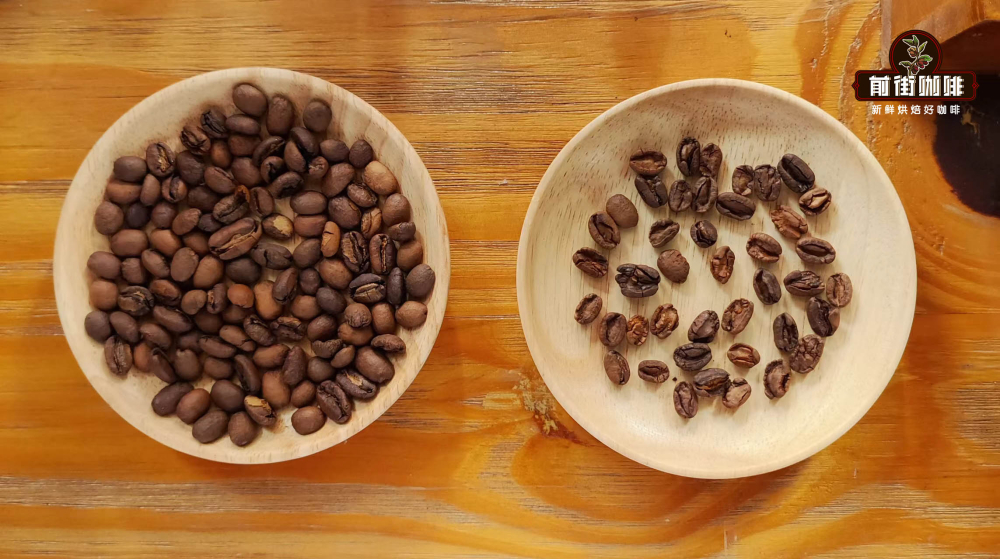
The photo above shows irregular beans FrontStreet Coffee picked at random from just 15g of roasted Flower Champion 6.0 — far more defects than in previous years. For that reason, FrontStreet Coffee decided not to sell the 6.0 and to keep offering the 5.0 instead.
Some may wonder: if a new version comes out every year, isn't the 5.0 now old-crop coffee? Rest assured. The X.0 naming exists mainly because the original Flower Champion had a rich strawberry profile that faded with each successive harvest, disappearing entirely by 4.0. The 5.0's profile of juicy orange and mango proved so popular that in 2022 FrontStreet Coffee retained it alongside the new 6.0 — both are fresh-crop beans.

Brewing Recommendations
Freshly roasted beans bring out the fullest flavor. FrontStreet Coffee ships all beans within 5 days of roasting, because freshness matters enormously to the cup. The roasting philosophy here is "freshly roasted good coffee": resting takes about 4-7 days, so beans arrive right at their flavor peak.
Dripper: Hario V60 | Water temperature: 90°C | Dose: 15g | Ratio: 1:15 | Grind: medium-fine (80% pass-through on a #20 sieve).
Pour in segments: bloom with 30g of water (twice the coffee weight) for 30 seconds, then pour to 125g, then continue to 225g and stop. Remove the dripper once the water has fully drawn down. Total extraction time from the first pour: 2'00".

Flavor Profiles by Version
Flower Champion G1: smooth, passion fruit, winy fermentation note, jackfruit, strawberry.
Flower Champion 2.0: clean cup, prominent berry aroma, nutty fragrance, fuller mouthfeel.
Flower Champion 3.0: light strawberry jam, black-tea sensation, short sweet finish.
Flower Champion 3.1: floral notes, cream, tropical fruit, caramel, lasting sweet finish.
Flower Champion 4.0: citrus acidity, full berry-juice body, lemon black tea, persistent sweetness.
Small Bean Flower Champion: sweet berry aroma, creamy strawberry, passion fruit, rich fruit sweetness, full mouthfeel.
Flower Champion 5.0: florals, berries, citrus, sweet-sour plum, mango juice, honey, sweet black-tea finish.
Flower Champion 6.0: full berry-juice body, black-tea finish.

That covers the flavor differences across the Flower Champion versions. Of course, this is just one of Ethiopia's many single-origin coffees — FrontStreet Coffee carries more than 50 single origins, each with its own story, and the more you learn about them, the easier it is to fall in love.
FrontStreet Coffee Recommendation
If you want a first step into Ethiopian coffee before diving into naturals like Flower Champion, start with FrontStreet's washed Yirgacheffe. It is celebrated for its white jasmine florals, bright citrus and lemony acidity, and a delicate tea-like finish — and at a friendly price, it has become many people's very first specialty coffee bean. Yirgacheffe itself is a small town in southern Ethiopia's Sidamo zone at roughly 1,700-2,100 meters, with coffee planted above 1,800 meters, making it one of the highest coffee-growing areas in the world; in 2010 the ECX formally separated it from Sidamo because its name had grown so famous.
For a step up, try FrontStreet's washed Worka (Guodingding) Cooperative lot from the Worka sub-region at Yirgacheffe's southeastern tip. Once part of the YCFCU union's Worka cooperative, it was singled out as a single-farm community as traceability became a priority. Washed in the most traditional style, it has none of the old-fashioned bitterness — just clean, bright citrus and lemon acidity wrapped in jasmine fragrance.
And if it's fruitiness you're after, FrontStreet's Natural Red Cherry Yirgacheffe dries only fully ripe, defect-free cherries whole on raised beds, turned every 2-3 hours during the first days to prevent uneven heating and over-fermentation, then sun-dried for three to five weeks. Expect classic Yirgacheffe character layered with tropical fruit: citrus-like acidity, berry-juice body, honeyed sweetness, and a creamy smoothness.
Important Notice :
FrontStreet Coffee is a long-established specialty coffee roaster in Guangzhou China, selling freshly roasted beans from its own farm in Yunnan as well as dozens of carefully selected single-origin beans from around the world for both pour-over and espresso. The products deliver consistently excellent quality and great value, with shipping within 24 hours. Guangzhou's FrontStreet Coffee shop is recommended by many coffee lovers, and the beans are now available online at the Tmall 。
FrontStreet Coffee has moved to a new address:
FrontStreet Coffee Address: 315,Donghua East Road,GuangZhou
Tel:020 38364473
 Scan and follow the En Gafei WeChat official account. Please indicate that the reprint comes from "En Gafei".

