The Current State of Indonesian Coffee: What Processing Methods Is Indonesia Famous For
Indonesia is an archipelago in Southeast Asia, a chain of islands stretching across the Oceania region. As the world's largest archipelago, with thousands of islands, this remarkable country has a fascinating history.
Its coffee industry has been developing for about 400 years and, like the country's own history, it is endlessly fascinating. FrontStreet Coffee walks you through a brief history of Indonesia's coffee industry, the coffee culture surrounding it today, Indonesian coffee production, its common flavor profiles, and specific coffees worth trying.
Brief History and Current Status
Indonesia's coffee journey began in the late 17th century, when the Dutch colonized the islands. They brought Arabica coffee plants and started building plantations on the island of Java.
As the Dutch East Indies — what is now Indonesia — continued to develop its infrastructure, the coffee industry evolved with it. Better infrastructure connected the islands more than ever before, and coffee production spread across the archipelago.
After about a century of exciting progress, in the late 1800s a disease called coffee leaf rust wiped out Arabica in most of the plantations. To rebuild Indonesia's coffee industry, the Dutch brought Robusta seeds to the islands because Robusta could resist the disease.
Today, Indonesia continues to have a thriving coffee industry led by family farms and plantations. Most of the beans it produces are still Robusta, although Arabica has recently made a comeback and is now popular in the specialty coffee world.
Indonesia's Java coffee and Sumatra Mandheling coffee are world-renowned, and many other wonderful coffees from this country circulate in today's market.
Indonesian Coffee Production
Most of the world's coffee is processed using natural, washed, or pulped natural methods. Indonesian production, however, relies on a method called Giling Basah. The term means "wet hulling" or "wet grinding" — what we commonly call the wet-hulled process.
Giling Basah promotes specific characteristics in the coffee it produces. Because the beans are dried only briefly with the parchment removed while still damp, juicy, fruity, earthy, and spicy flavors are enhanced in the finished beans.
Growing Conditions and Challenges
Indonesia is a very humid country. That humidity shapes the coffee production process, since it makes drying the beans a constant challenge.
Indonesian Coffee Flavor Profile
Indonesian coffees tend to be full-bodied, with a syrupy, thick mouthfeel and low acidity.
Several of Indonesia's coffee-growing regions show clear differences between their products, so alongside those overall Indonesian characteristics, each region has its own unique flavors.
You may have heard that Indonesian coffees make good dark roasts. As noted, the beans are usually very dense.
That density makes them ideal candidates for long roasting times (the longer the roast, the darker the beans become), because they have plenty of density to lose and can therefore be roasted longer. A dark-roasted Indonesian coffee brings out its boldest character, emphasizing dark chocolate, warm spices, and earthy notes.
FrontStreet Coffee Recommendation
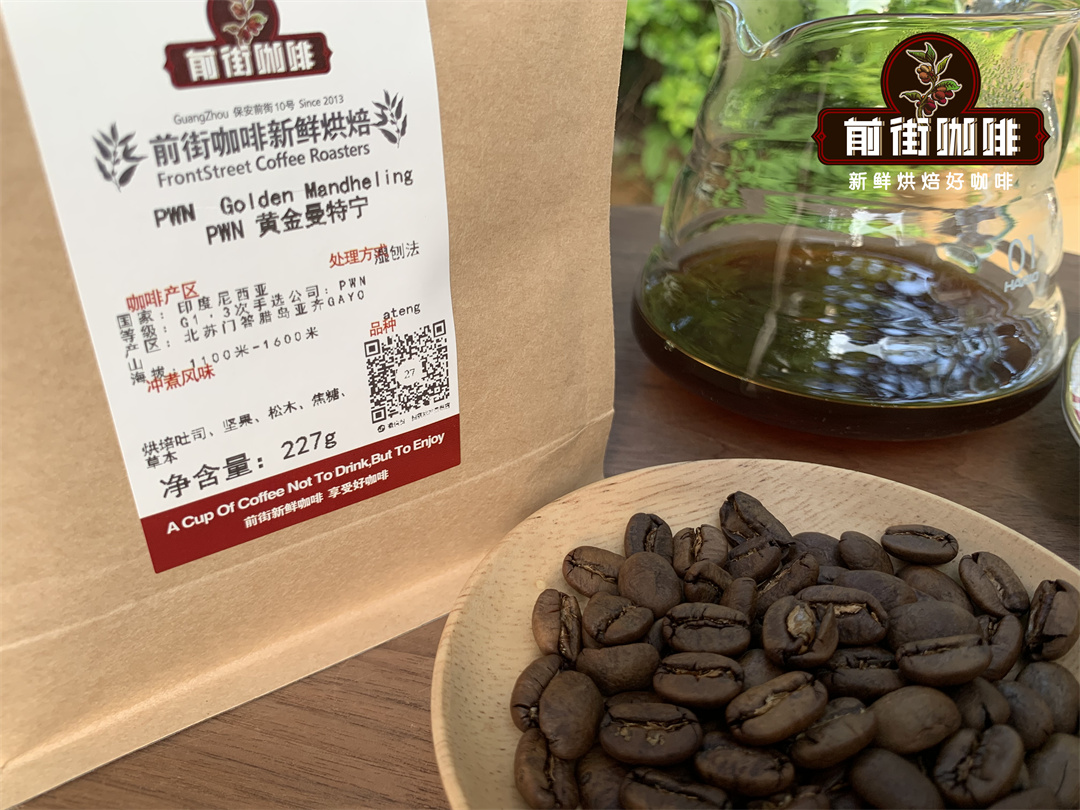
Sumatra is now the largest source of both Arabica and Robusta in Indonesia, accounting for over 60% of production. The Arabica grown there — mainly in Aceh, around the Gayo Mountains near Lake Tawar, and in North Sumatra around Lake Toba's Lintong region — is what the world knows as Mandheling. FrontStreet Coffee's PWN Golden Mandheling comes from the PWN company, which selects beans above 18 mesh, demands fewer than 3 defects per 300-gram sample for its G1 grade, and hand-sorts three times for exceptional cleanliness and sweetness.
Brew it with an 87-88°C water temperature, 15 grams of coffee at a 1:15 ratio, a coarse-sugar grind, and a three-stage pour — 30ml to saturate and degas, 100ml to lift the bed, then a gentle 95ml center pour — to bring out the thick body, caramel sweetness, and the wild herbal character that only the wet-hulled process can create.
Important Notice :
FrontStreet Coffee is a long-established specialty coffee roaster in Guangzhou China, selling freshly roasted beans from its own farm in Yunnan as well as dozens of carefully selected single-origin beans from around the world for both pour-over and espresso. The products deliver consistently excellent quality and great value, with shipping within 24 hours. Guangzhou's FrontStreet Coffee shop is recommended by many coffee lovers, and the beans are now available online at the Tmall 。
FrontStreet Coffee has moved to a new address:
FrontStreet Coffee Address: 315,Donghua East Road,GuangZhou
Tel:020 38364473
 Scan and follow the En Gafei WeChat official account. Please indicate that the reprint comes from "En Gafei".