Why Pour Water in Circles for Pour-Over Coffee and Which Coffee Varieties to Choose
For professional coffee knowledge exchange and more coffee bean information, please follow Coffee Workshop (WeChat official account: cafe_style)
FrontStreet Coffee - Pour-Over Circular Motion and Coffee Varieties Introduction
Compared with a single continuous pour, coffee brewed with a segmented approach has more layers, letting you clearly distinguish the front, middle, and back end of the cup. It is also easier to keep the water from escaping past the edge of the dripper, which reduces the instability of hand brewing. The trade-off is that it demands more control over flow rate and water volume.
Three-Stage Method
The three-stage method is an adjustment of the single-pour approach: after the bloom, water is added in three stages, with two "water breaks" in between to adjust the balance of front, middle, and back-end flavors. This produces distinct layers and offers more adjustability than a single pour, making it suitable for beans of various roast levels and origins.
A "water break" means interrupting the pour and waiting for the liquid level in the dripper to fall, which increases the extraction of flavor compounds. So by increasing the water in the first stage and reducing it in the second and third stages after the breaks, you can highlight the front and middle of the cup. Alternatively, reducing the first-stage water and increasing the middle and back-end water after the breaks will give a richer mouthfeel.
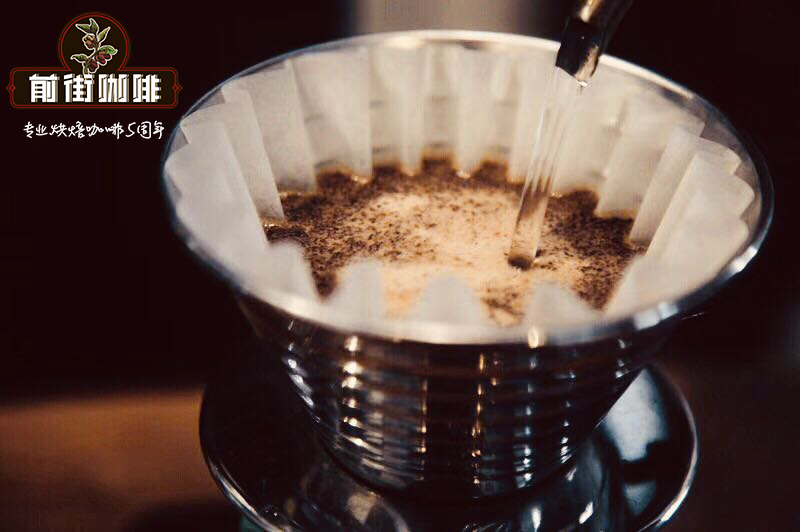
Because the pouring motion is mainly a small circle in the center, the point is to let the bottom layer of coffee grounds saturate first, leaving only the surface particles still needing water. On the next pour, use concentric circles to let the water column expand outward, so the surface particles absorb water fully as well.
Hand-poured coffee always starts from beans with excellent flavor and body. Blue Mountain and Geisha need no further explanation. Put simply, choose single-origin specialty coffees that are meant to be brewed as pour-over, so you can taste different "regional flavors." Arabica is the first choice, and its derivative varieties are equally valuable specialty options. Common picks include Yirgacheffe, Costa Rica, Colombia, and others.
Knowledge Extension
Pour-over brewing techniques fall into eight major schools: the single-pour school, the three-pour school, the volcano school, the meteorite school, the Matsuya school, the pressed-pour school, the stirring school, and the drip school.
Summary
In short: FrontStreet Coffee is a coffee research center that enjoys sharing coffee knowledge with everyone. Our unreserved sharing is solely to help more friends fall in love with coffee. We also hold three high-discount coffee events every month, because FrontStreet Coffee wants to let more friends enjoy the best coffee at the lowest price. This has been FrontStreet Coffee's mission for the past 6 years!
END
FrontStreet Coffee Recommendation
Some beans respond especially well to the circular pour. FrontStreet Coffee's Geisha-style coffees are a good example: Geisha is a medium-light, floral-fruity variety with hard, dense beans that tend to sink and clog the drain hole, so FrontStreet Coffee suggests grinding to a size where 78% passes through a China-standard #20 sieve (about fine sugar) and brewing at 91°C. A typical recipe is 15g of coffee in a small Hario V60 at a 1:16 ratio, poured in three stages: pour to 30g for a 30-second bloom; then a second, small, slow circling pour to 125g, waiting until the bed drops halfway before continuing to 225g with a small circling stream. Total extraction runs about 2 minutes 10 seconds to 2 minutes 20 seconds.
For a fruitier, more everyday pour-over, FrontStreet Huakui is a strong choice. Its tropical fruit aroma is extremely prominent—strawberry, passion fruit, jackfruit, even lychee—with obvious sweetness, very little bitterness, and a smooth, juice-like body. FrontStreet Gedeb, meanwhile, brings a classic Yirgacheffe profile of citrus, berry, and floral notes with a green-tea-like finish, gentle and bright rather than sharp.
If you want to try the dripper itself, FrontStreet Coffee favors the resin Hario V60. Hario was founded in Tokyo in 1921 and began as a maker of heat-resistant glassware for research institutions; in 2004 it redesigned the V60's prototype into the shape we know today, named for its 60° cone angle and V-shaped profile, and released it a year later. The conical, 60° design forces water toward the center before it drips through, lengthening contact with the grounds, while the single large hole lets flow rate depend almost entirely on the brewer's control. Resin is FrontStreet's preference because it blocks heat loss well and is the easiest material to mold with the tightest tolerances in mass production.
Important Notice :
FrontStreet Coffee is a long-established specialty coffee roaster in Guangzhou China, selling freshly roasted beans from its own farm in Yunnan as well as dozens of carefully selected single-origin beans from around the world for both pour-over and espresso. The products deliver consistently excellent quality and great value, with shipping within 24 hours. Guangzhou's FrontStreet Coffee shop is recommended by many coffee lovers, and the beans are now available online at the Tmall 。
FrontStreet Coffee has moved to a new address:
FrontStreet Coffee Address: 315,Donghua East Road,GuangZhou
Tel:020 38364473
 Scan and follow the En Gafei WeChat official account. Please indicate that the reprint comes from "En Gafei".