Which Kenyan Coffee Region Tastes Best? What Are the Characteristics of Kenyan Washed AA Coffee Beans?

For more premium coffee knowledge, please follow the official WeChat account: FrontStreet Coffee
As one of the most common coffee-producing countries, Kenya is another representative African origin besides Ethiopia. Its intense berry acidity has won over countless coffee lovers, making Kenyan coffee a staple in many coffee shops.
Kenya is a coffee-producing country, and in daily life we often describe its coffee by its berry notes. With the current trend toward coffee specialization, people pay more attention to regional information; using the country name alone no longer satisfies drinkers' curiosity about origins.
So how are Kenya's coffee-growing regions distinguished, and what are the main flavor characteristics of the major areas?

What are Kenya's Main Coffee-Producing Regions?
Kenya's coffee regions are most famous for seven major areas: Thika, Kirinyaga, Mt. Kenya West, Nyeri, Kiambu, Ruiri, and Muranga. Among them, the foothills of Mt. Kenya and Aberdare are the primary producing areas.
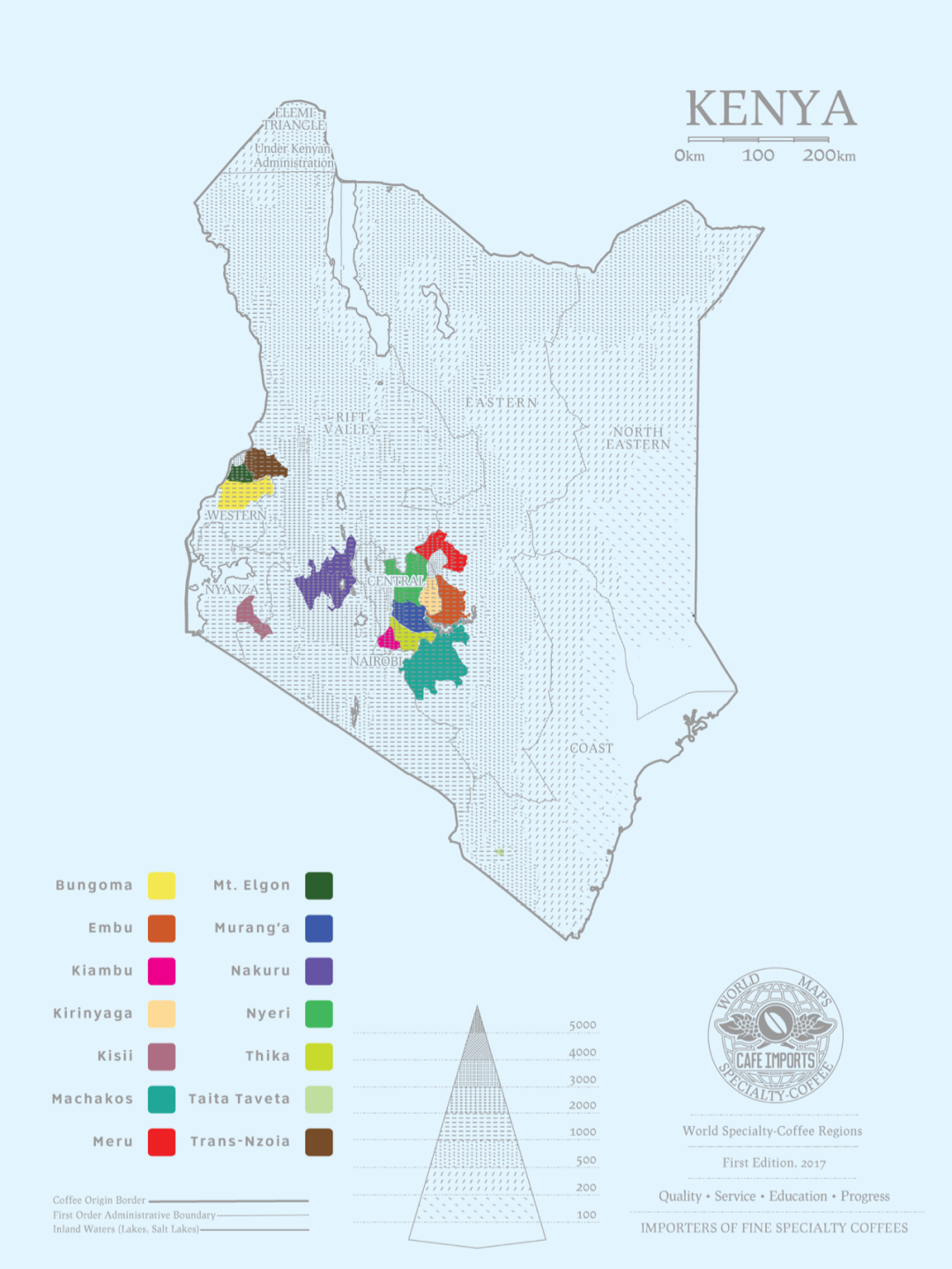
The specialty coffee regions mainly come from the following areas: Nyeri, Kirinyaga, and Murang'a.
Nyeri
The Nyeri region, in central Kenya, is home to the extinct volcano Mount Kenya. The red soil here nurtures Kenya's finest coffee. Agriculture is extremely important in the region, with coffee as the primary crop. In Nyeri, cooperatives of smallholder farmers are more common than large estates.
Elevation: 1200 to 2300 meters
Harvest period: October to December (main season), June to August (secondary season)
Varieties: SL-28, SL-34, Ruiru 11, Batian
Muranga
The Muranga region belongs to the Central Province and has approximately 100,000 coffee farmers. This inland region was among the first settlement areas chosen by missionaries, because the Portuguese prohibited them from living in coastal areas. It is another region benefiting from volcanic soil, with more small-scale coffee farmers than estates.
Elevation: 1350 to 1950 meters
Harvest period: October to December (main season), June to August (secondary season)
Varieties: SL-28, SL-34, Ruiru 11, Batian

Kirinyaga
The Kirinyaga region sits on the slopes of Mount Kenya, adjacent to Nyeri, and is world-renowned for coffee with intense flavors, rich layers, and a solid mouthfeel. Together with Nyeri, it is recognized as one of Kenya's two finest regions. Producers here are mostly smallholder farmers who join cooperatives; the cooperatives play a coordinating role, providing washing stations where farmers deliver their coffee cherries for processing.
Kirinyaga originally referred to Mount Kenya. During British colonial rule the name was considered hard to remember, so the mountain was renamed "Mt. Kenya" instead of "Kirinyaga." Mount Kenya is Africa's second-highest peak. Although it lies in the tropics, its summit is often covered in snow. Kirinyaga originally meant "white peak." Mount Kenya is not only a UN conservation area but also a favorite tourist destination where wildlife gathers on the surrounding foothills and grasslands. According to FrontStreet Coffee's research, Kirinyaga comes from the Kikuyu people and means "white mountains," considered the dwelling place of gods. The Kikuyu are Kenya's largest ethnic group, accounting for one-fifth of the total population.
Elevation: 1300 to 1900 meters
Harvest period: October to December (main season), June to August (secondary season)
Varieties: SL-28, SL-34, Ruiru 11, Batian

What Are the Flavor Profiles of These Kenyan Regions?
To clarify the characteristics of these regions, FrontStreet Coffee sourced coffees from several Kenyan areas, with the following selections:
| Region | Processing Station/Cooperative | Altitude | |
|---|---|---|---|
| Timani | Nyeri | Ndima-ini Processing Station | 1700 to 1900 meters |
| Gachatha | Nyeri | Ndima-ini Processing Station | 1820 meters |
| Jamhuri | Nyeri | Kiangombe Processing Station | 1700 to 1800 meters |
| Kagumo-ini | Muranga | Kamacharia Processing Station | 1650 meters |
| Kathuwa | Kirinyaga | KAGUYU Processing Station | 1400 meters |
| Mugaya | Kirinyaga | MUGUYA Processing Station | 1400 meters |
All these beans are from the 2020 new harvest season, processed with the same 72-hour washed method, and all are SL28 and SL34 varieties.

Cupping was used to reduce human factors and restore the coffee's inherent quality and flavor.
After a round of cupping, clear regional characteristics emerged:
The three coffees from the Nyeri region shared berry flavors, moderate sweetness, honey, and cream.
The Kagumo-ini from the Muranga region showed distinct berry flavors, slight floral notes, and hints of green tea.
Finally, the two coffees from the Kirinyaga region shared berry flavors and moderate sweetness, with distinct roasted nut flavors when cooled.

Combining these results with the regional flavor descriptions given by teacher Xu Baolin in "Coffee Hunter 2":
Coffee from the Nyeri region features bright blackberry, a rich mouthfeel, citrus, and even floral aromas.
Coffee from the Muranga region features bright acidity and a rich texture.
Coffee from the Kirinyaga region features bright fruit acidity, a moderate mouthfeel, and delicate sweetness.

From this we can see the general shape of regional flavors, but FrontStreet Coffee reminds everyone that these are not universal rules. Avoid the habit of making fixed statements about every region. With a little thought, we can conclude that "not all coffees from the Nyeri region have bright blackberry, a rich mouthfeel, citrus, and floral aromas."
The final flavor of a coffee depends on factors including region (climate, cultivation methods, soil), processing method, variety, storage conditions, and more. Even with the same region, variety, and processing method, different growing altitudes produce different flavors.
During cupping, the three coffees from the Nyeri group showed a decreasing pattern in acidity. As altitude increased, the coffee's cupping acidity also increased, and high-altitude coffee had more elevated acidity. Low-altitude beans showed an overall decline in acidity at low temperatures, shifting from vibrant to dull. In contrast, high-altitude coffee in the same group maintained full acidity at low temperature even as it fell slightly. So not all Nyeri beans can hold lasting bright fruit acidity.

Besides the three regions above, an Assalia coffee bean sourced by FrontStreet Coffee also performed excellently. Produced in Thika, it shows clear floral notes and rich cherry-tomato acidity, making it a daily choice for many friends. Those interested can buy it at FrontStreet Coffee's physical stores or its flagship Tmall store.
FrontStreet Coffee Recommendation
If you love the bright berry acidity that defines Kenyan coffee, FrontStreet's African lineup is worth exploring alongside it. FrontStreet washed Yirgacheffe is the classic entry from Ethiopia: clear jasmine florals with a bright citrus acidity, light and elegant with a tea-like body that drinks like a clean lemon tea.
For a clearer, more concentrated expression, FrontStreet Gedingding Cooperative sits in the Worka area at the southeastern edge of Yirgacheffe. A single-origin lot after splitting from the Worka cooperative under the YCFCU alliance, it is pulped before drying, so its citrus and lemon acidity and elegant white floral notes read especially cleanly.
If fruit-forward sweetness is more your style, FrontStreet sun-dried Red Cherry is dried whole on raised beds and adds tropical fruit to Yirgacheffe's signature profile, with peach, cocoa, honey, and lemon. FrontStreet sun-dried Huakui, from Hambella in Guji, Sidama, is dried on raised beds for 21 days and roasted medium-light for light fermented wine, florals, citrus, and mango over a thick, sweet body.
Important Notice :
FrontStreet Coffee is a long-established specialty coffee roaster in Guangzhou China, selling freshly roasted beans from its own farm in Yunnan as well as dozens of carefully selected single-origin beans from around the world for both pour-over and espresso. The products deliver consistently excellent quality and great value, with shipping within 24 hours. Guangzhou's FrontStreet Coffee shop is recommended by many coffee lovers, and the beans are now available online at the Tmall 。
FrontStreet Coffee has moved to a new address:
FrontStreet Coffee Address: 315,Donghua East Road,GuangZhou
Tel:020 38364473
 Scan and follow the En Gafei WeChat official account. Please indicate that the reprint comes from "En Gafei".