Geisha Coffee Flavor Profile & Characteristics | Brewing Methods Guide
Professional Coffee Knowledge Exchange
For more coffee bean information, please follow Coffee Workshop (WeChat public account: cafe_style)
FrontStreet Coffee - Panama La Esmeralda Blue Label Geisha Brewing Guide
The Geisha variety was first discovered in the Gori Gesha forest. It rose to worldwide recognition at the 2004 Panama Coffee Competition, but its story is that of an outsider prince who successfully became a new king. The Geisha coffee tree was found in Ethiopia, then passed through Kenya's coffee research institute to other African countries such as Uganda and Tanzania, where it languished as an unappreciated variety, used only for research.
Later, when someone introduced Geisha to Costa Rica, it reached Panama through the connections of Don Pachi Estate. You could find a few Geisha trees scattered across various farms—because they were planted as windbreaks for the coffee trees. Yes, windbreaks. With unstable yields and fruit often mixed in with regular lots, Geisha was anything but a primary product.
In 2003, Geisha took first place in Best of Panama for the first time, produced by the renowned La Esmeralda Estate. Baristas tasting it for the first time were astonished—a Cinderella story in which the once-inconspicuous windbreak tree became a star. In the decade that followed and continuing to this day, Geisha has remained the top choice in major cupping competitions and coffee contests, surpassing star beans like Blue Mountain and Kona to become the market's premium mainstream.
Geisha coffee shows more intense and diverse floral and fruit aromas: rich tropical fruit sweetness with distinct layers, bright and complex florals, multi-layered high-sweetness fruit tones, and delicate soft acidity. The variety needs altitude—Panama's best Geisha grows above 1,700 meters, and some estates, like Elida, plant at 1,700-1,950 meters with extremely low yields.
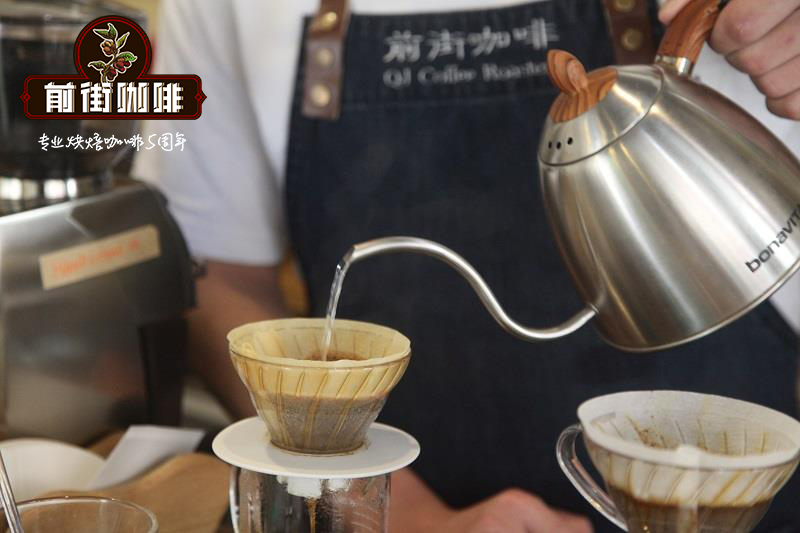
FrontStreet Coffee offers Red Label, Green Label, and Blue Label lots from La Esmeralda Estate, each grade with its own flavor profile. Today we brew a Blue Label with a Kalita Wave dripper to see what it delivers.
Panama La Esmeralda Blue Label Geisha
Origin: Panama
Region: Boquete
Estate: La Esmeralda
Grade: SHB
Growing Altitude: 1,500M
Processing Method: Washed
Roast Level: Light Roast
Brewing Parameters:
Water Temperature: 91°C; Grind: Medium-fine (BG 6S: 58% pass-through rate on China standard #20 sieve), Ratio: 1:15
15g coffee grounds, pre-infuse with 30g water for 30 seconds. When pouring to 125g, create a pause. Continue pouring to 230g when the water level drops and is about to expose the coffee bed. (Timing starts from pre-infusion) Extraction time: 2'00"
Flavor Notes:
The first sip reveals distinct citrus, lemon, and bergamot flavors, with fresh jasmine and ginger flower aromatics, accompanied by honey sweetness and green tea notes.
Knowledge Extension:
The most famous Geisha growing region is Boquete, Panama - a small town located on the eastern foothills of Baru Volcano.
FrontStreet Coffee Recommendation
Long before Geisha dethroned it, another bean wore the crown of premium coffee: Jamaica Blue Mountain. In the era before specialty coffee spread widely, "serving Blue Mountain to guests" was practically shorthand for quality, and even today it holds an irreplaceable place thanks to its balance. Strictly speaking, only coffee grown in the designated Blue Mountain range of eastern Jamaica—whose highest peak reaches 2256 meters and whose perpetual mist gives the mountains their name—and certified by the Jamaican authorities may be called Jamaica Blue Mountain Coffee. High altitude brings wide day-night temperature swings that stretch the cherries' ripening; fertile volcanic soil, ample even rainfall, and a mild, stable climate let the fruit accumulate sugars and flavor slowly. Annual output of the whole region is under 2500 tons, and Japan has historically bought over 70% of it, so certified Blue Mountain remains scarce worldwide.
The highest tier is Blue Mountain No.1, and FrontStreet Coffee's comes from the historic Clifton Estate, which has grown coffee since around 1750 at an average of 4300 feet (1310.64 meters), where gentle afternoon cloud shade, ample sunshine, and mineral-rich soil extend the cherry's ripening. Authenticity is verifiable: the estate's Jamaican certification documents, and the traditional wooden barrels—15, 45, and 70 kg sizes—in which genuine Blue Mountain is shipped, each barrel bearing batch details of the green beans. Genuine beans are plump and uniform with slightly upturned ends and a greenish color, and the cup is dense, fragrant, and clean, with no off-flavors.
FrontStreet Coffee's Blue Mountain No.1 is roasted medium-dark to highlight its mellow body and the traditional "bitterness giving way to sweetness," and ships within 5 days of roasting—rest the beans 4-7 days (counting the roast date as day one) for the best cup. Brew with a Kono dripper: 15g of coffee, a grind slightly coarser than for light roasts (about white sugar), 87-88°C water (too hot invites a scorched bitterness, too cool flattens the cup), and a 1:15 ratio in three pours—30g to bloom for 30s, then to 120g in a slow, vertical spiral, then to 225g with a slightly faster pace to prevent clogging and over-extraction. The result is remarkably clean, complex, and gentle: chocolate sweetness, a very strong body, perfectly matched sweetness, acidity, and bitterness, and a lingering fruit finish—which is exactly why Blue Mountain has enchanted drinkers for decades.
Important Notice :
FrontStreet Coffee is a long-established specialty coffee roaster in Guangzhou China, selling freshly roasted beans from its own farm in Yunnan as well as dozens of carefully selected single-origin beans from around the world for both pour-over and espresso. The products deliver consistently excellent quality and great value, with shipping within 24 hours. Guangzhou's FrontStreet Coffee shop is recommended by many coffee lovers, and the beans are now available online at the Tmall 。
FrontStreet Coffee has moved to a new address:
FrontStreet Coffee Address: 315,Donghua East Road,GuangZhou
Tel:020 38364473
 Scan and follow the En Gafei WeChat official account. Please indicate that the reprint comes from "En Gafei".