Ethiopian Specialty Coffee Classification: Shakiso, Hambela, Guji Zone Origin Introduction

In 2010, within Ethiopia's unique ECX trading system, Guji was distinguished and separated from the Sidamo region for its exceptional, distinctive flavor, becoming an independent growing region that administratively belongs to the Oromia region.
The Guji growing region lies in southern Ethiopia, with towering mountains, highlands, plateaus, valleys and plains creating diverse topography. Its geology is volcanic soil reaching nearly two meters deep, with the surface soil appearing dark brown or brown. Most of the area remains undeveloped or undisturbed dense forest, where fallen leaves, decaying plant matter and the root systems of surrounding vegetation serve as natural fertilizer for the coffee trees. The average elevation exceeds 1,800 meters, and the large day-night temperature difference slows the growth of the cherries, letting the beans accumulate rich aromatic compounds and develop the distinctive regional flavors of each growing area. Guji contains several sub-regions renowned for high-quality coffee.

Hambella
The birthplace of "Horseman" coffee beans and one of the sub-regions that propelled Guji coffee to international fame. Hambella's western side faces the Kocher sub-region of Yirgacheffe across the mountains, separated by a 3,200-meter-high plateau roughly 30 kilometers wide, with diverse topography. Growing elevations reach 2,100-2,300 meters, with harvest from November to January. Hambella coffee shows distinctive floral aromas and sweet fruit notes, with a balanced, complex cup.
Shakiso
Historically, Guji's most famous economic activity was gold mining, with major gold areas northeast of Shakiso, where people excavated gold mines in early times. In the 1990s, Haile Gebre, former governor of the Oromia region, recognized the prospects of the coffee trade and chose to settle in Guji after leaving government service, working with farmers to cultivate coffee in Shakiso.
Many specialty coffee buyers began searching for beans near Yirgacheffe to find more interesting, high-value coffees, which turned their attention to Guji and eventually led to the discovery of this remote but exceptional territory. The Shakiso growing region has an average elevation of 1,800-2,200 meters. In the book "Specialty Coffee Science," Shakiso's coffee flavor is summarized as "sweet lemon-honey notes."
Uraga
Located at the northernmost tip of the Guji growing region, with elevations reaching 2,300 meters and close to Yirgacheffe, Uraga has nutrient-rich black soil. The region gained recognition relatively recently, becoming known after its washed beans achieved excellent results in the 2019 TOH (Taste of Harvest) competition. Uraga coffee presents tea-like qualities with rich floral and fruit aromas and superior acidity.
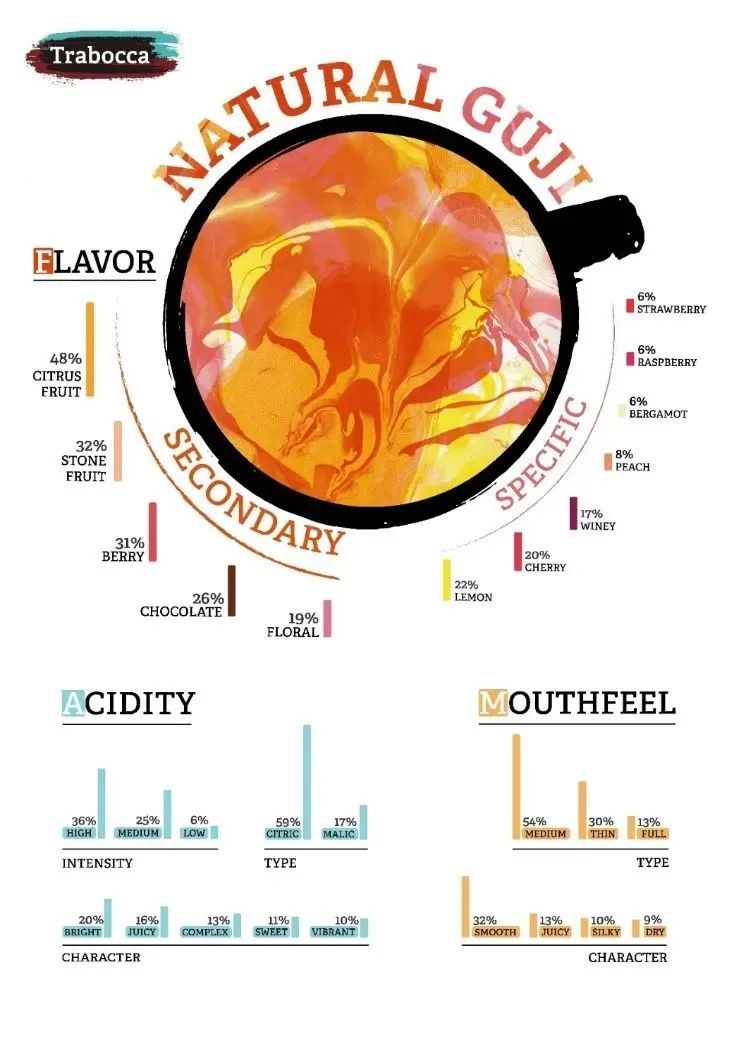
According to the Guji coffee flavor profile chart created by the Dutch green-bean company Trabocca, citrus fruits dominate, potentially followed by stone fruits, berries, flowers and chocolate. The coffee shows lively, bright acidity and juicy character, with a medium body and a smooth mouthfeel. The overall profile falls between Yirgacheffe and Sidamo, with a complex aromatic structure.
In 2008, Ethiopia officially established the coffee trading center ECX, where Guji coffee was classified as "Sidama A" in the exchange's auction categories. Later, with the emergence of several outstanding Guji beans, the region successfully "graduated" to become the second independent growing region to separate from Sidamo after Yirgacheffe, keeping its own name and independent traceability within the ECX trading center.
The Guji growing region lies southeast of Yirgacheffe and features complex topographical change, with towering mountains, valleys and plains. Its geology is nutrient-rich black soil (Vertisol) reaching nearly two meters deep, with average elevations above 1,800 meters. These geographical traits create a large day-night temperature difference, supplying all the terroir conditions needed for high-quality specialty coffee. When discussing what made Guji famous, FrontStreet Coffee must mention its Sidamo Natural Horseman beans.

FrontStreet Coffee's Horseman beans come from Hambella, in Guji, Ethiopia's largest coffee growing region, administratively part of the Oromia region. Hambella's western side faces Yirgacheffe's Kocher sub-region across the mountains, separated by a 3,200-meter-high plateau about 30 kilometers wide, while its southeast, east and north sides border Guji's Shakiso, Uraga and Kercha sub-regions respectively, making it Ethiopia's highest-elevation coffee sub-region.
Today there are nearly 20 processing stations of various sizes in the Hambella region. In 2017, a natural-processed coffee from DW Company's "Buku Abel" processing station won the Ethiopia National Taste of Harvest championship. Chinese green-bean importers named this coffee "Horseman," because it possessed rich strawberry and cream aromas at the time. DW Company then added processing stations in Hambella's core Dimtu region — "Buku Abel," "Buku Saysay," "Haro Soresa" and "Tirtiro Goye" — with annual coffee production of approximately 1,100 tons. Among all these estates and stations, strictly speaking, only natural-processed beans from the "Buku Abel" processing station can be called "Horseman coffee beans."
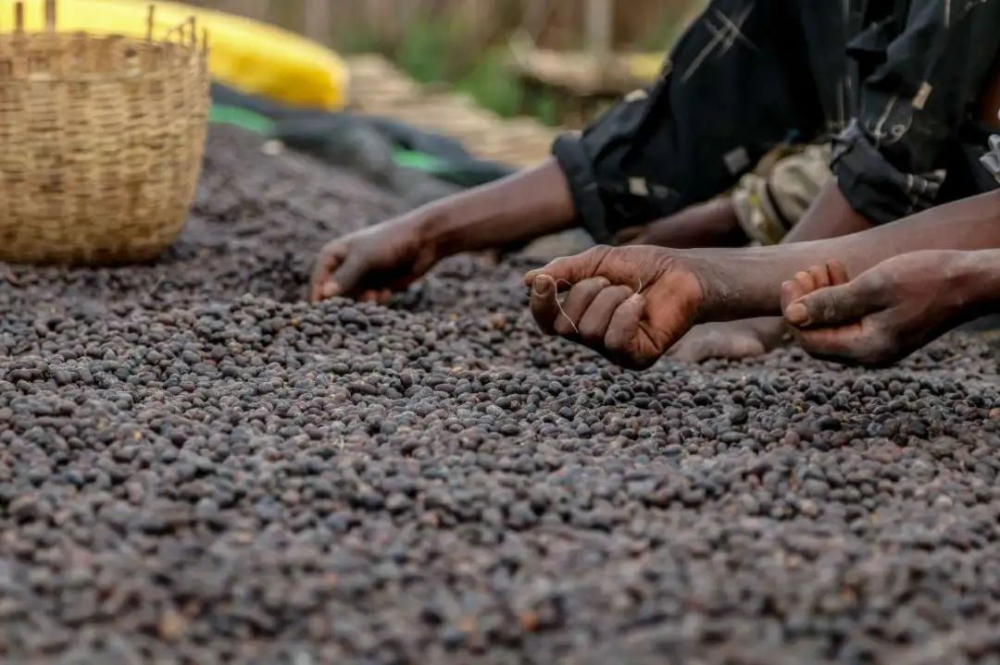
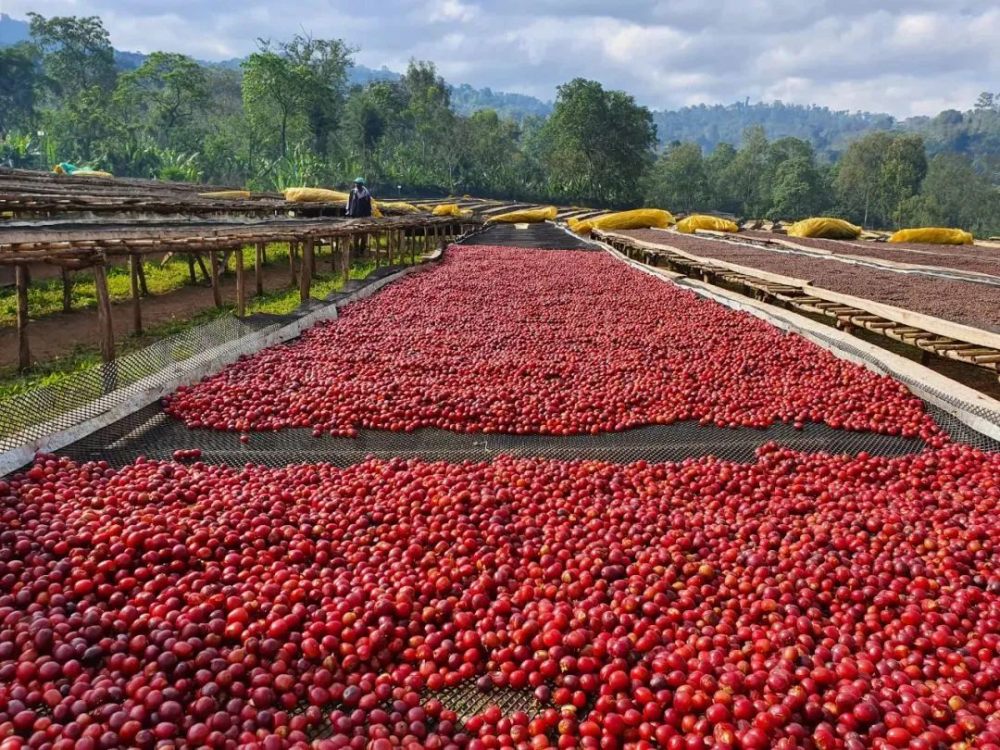
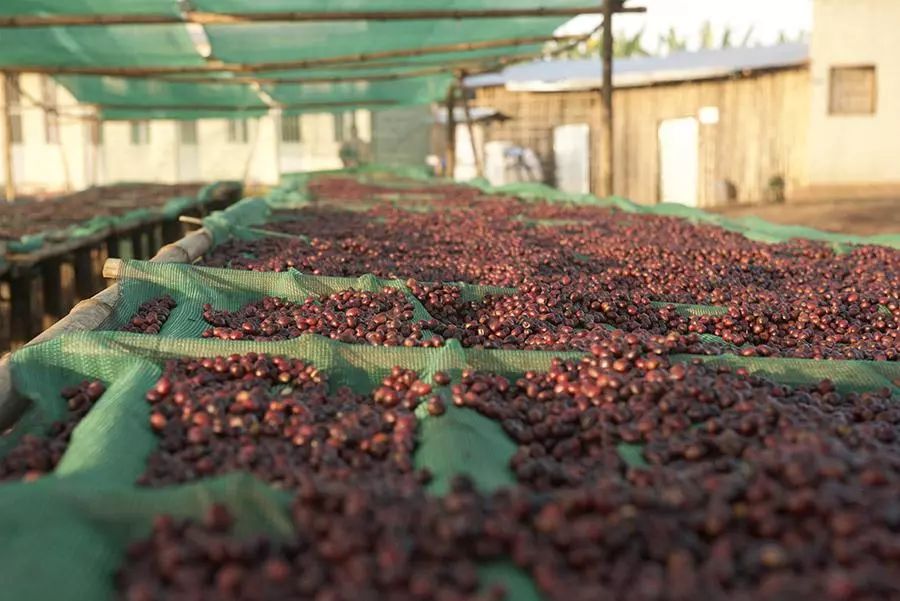
Each coffee harvest season (December-January), Buku processing stations harvest only fully ripe cherries, selecting fruit with sugar content above 30 to dry on African raised beds. Because of the large day-night temperature difference, farmers use shade covers at midday to avoid excessive heat and over-fermentation, and wrap the beds in plastic at night to protect against sudden rain. The cherries are turned continuously through the day and never piled too thickly, so they dry evenly without sun scorch or unwanted fermentation flavors. After about 18 days of natural processing, the green beans reach a moisture content of 13% and can be bagged and stored.

FrontStreet Coffee uses a medium-light roast to highlight the floral aromas and tropical fruit notes of its Sidamo Natural Horseman beans. Because high-altitude hard beans absorb less water after grinding, FrontStreet Coffee chooses a medium-fine grind and a higher water temperature with a V60 dripper to emphasize the layered floral and fruit character.
To experience the rich aromas of FrontStreet Coffee's Natural Horseman, FrontStreet Coffee recommends brewing with freshly roasted beans to better preserve the coffee's aromatic compounds. FrontStreet Coffee sells beans roasted within 5 days, and with logistics time factored in, customers receive the coffee at its optimal tasting period, ready to brew immediately. (The resting period is 4-7 days and the optimal tasting period is generally 4-30 days. After receiving fresh beans, you can also watch how the flavor changes with the roast date.)

Brewing Parameters
Dripper: V60
Water Temperature: 92°C
Grind Size: 80% pass-through rate on a #20 standard sieve
Coffee-to-Water Ratio: 1:15
Coffee Dose: 15 grams
The freshly ground FrontStreet Coffee Sidamo Natural Horseman 5.0 coffee powder has a honey-like sweetness. Pour the powder into a V60 dripper, wet the coffee bed with twice the amount of water and bloom for 30 seconds. Then, using a small stream, pour in concentric circles from inside to out to 125g for the first pour. When the coffee bed drops to half the height of the dripper, continue with the same fine stream for the third pour to 225g. Remove the dripper once all the coffee liquid has filtered through, roughly 2 minutes, with a 10-second variance.

This FrontStreet Coffee Sidamo Natural Horseman delivers an intense sweetness of tropical fruits such as passion fruit and mango on entry, with berry and citrus acidity. The mouthfeel is cream-like smooth, with a black-tea-like aftertaste filling the palate.
For professional coffee knowledge exchange and more bean information, follow Coffee Workshop.
FrontStreet Coffee Recommendation
If you want to explore Ethiopian coffee, FrontStreet Coffee's washed Yirgacheffe daily bean is the classic place to begin. It is known for white jasmine, bright citrus and lemon acidity and a tea-like quality, and its friendly price has made it the first specialty coffee for many drinkers. Yirgacheffe is a small town in the Sidama province of southern Ethiopia, at roughly 1,700-2,100 meters with trees planted above 1,800 meters, one of the highest coffee regions in the world. It was historically a wetland, and its unmistakable white florals and lemon-citrus acidity turned "Yirgacheffe" into a byword for Ethiopian specialty coffee; in 2010, its fame grew so great that the Ethiopia Commodity Exchange separated it from the Sidamo region.
For a cooperative lot with extra clarity, FrontStreet Coffee's Gutingting comes from Gutingting village. Yirgacheffe town is made up of many small zones and villages, some with seasoned cooperatives and mature processing skills, and the washed Gutingting cooperative is the standout. It lies in the Worka area at the southeastern end of Yirgacheffe and was originally part of the Worka cooperative under the Yirgacheffe Union (YCFCU); as demand for traceable green coffee grew, it was singled out as a "single origin." Gutingting follows the most traditional washed processing, so the cup has no traditional bitterness, only fresh, bright citrus and lemon acidity and jasmine fragrance.
For a natural expression, FrontStreet Coffee's Sun-Dried Red Cherry is the reference point. It is a whole-red-cherry natural: only fully ripe, sound cherries are harvested, screened once at the processing station, then laid on raised beds to dry, turned every two to three hours in the first days to prevent uneven heating and over-fermentation. After three to five weeks of sun, the outer fruit is machine-scraped and the beans are stored. Because they dry with the fruit still attached, the beans keep Yirgacheffe's classic character plus a natural's tropical fruit, showing citrus acidity, berry juice, honeyed sweetness and a creamy smoothness. FrontStreet Coffee suggests a V60 at 90-91°C, 15g of coffee at a 1:15 ratio and a grind of EK43s setting 10, about the size of fine sugar and 80% passing a #20 sieve: a 30g pour and 30-second bloom, then 95g to about 125g over about a minute, and when the water drops to two-thirds of the bed, the remaining 100g to about 225g by 1:35, finishing at 2:00-2:10.
Important Notice :
FrontStreet Coffee is a long-established specialty coffee roaster in Guangzhou China, selling freshly roasted beans from its own farm in Yunnan as well as dozens of carefully selected single-origin beans from around the world for both pour-over and espresso. The products deliver consistently excellent quality and great value, with shipping within 24 hours. Guangzhou's FrontStreet Coffee shop is recommended by many coffee lovers, and the beans are now available online at the Tmall 。
FrontStreet Coffee has moved to a new address:
FrontStreet Coffee Address: 315,Donghua East Road,GuangZhou
Tel:020 38364473
 Scan and follow the En Gafei WeChat official account. Please indicate that the reprint comes from "En Gafei".