Costa Rica Red Pearl Mellos Special Report
Costa Rica Red Pearl Meloas
Country: Costa Rica
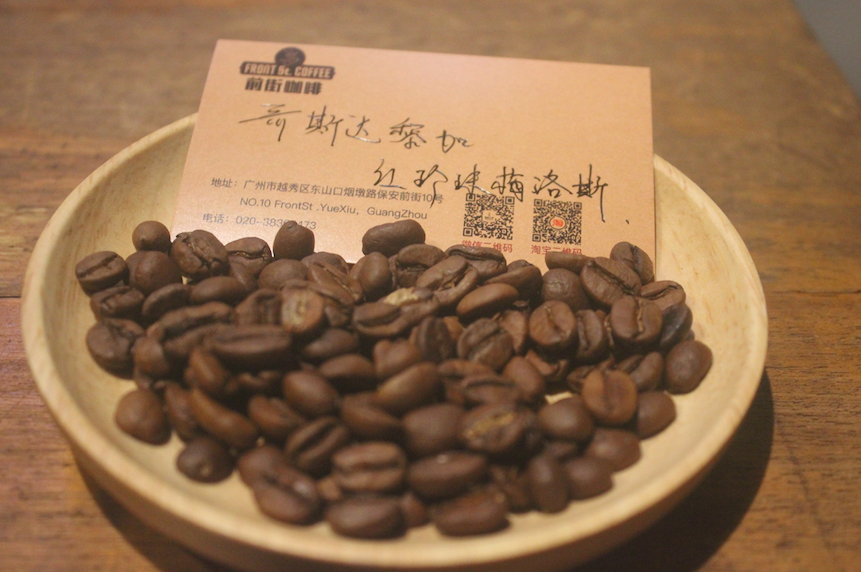
Batch: Red Pearl Meloas
Estate: Sonora Estate
Region: Central Valley
Variety: Caturra
Processing: Natural
Altitude: 1700-1800 meters
Costa Rica sits on the Central American isthmus, where Pacific and Atlantic ocean currents and sea winds shape the climate. Many high volcanic peaks reaching 2000 meters in altitude provide fertile volcanic ash, moderate temperatures, and stable, abundant rainfall—all factors that have made coffee one of Costa Rica's main agricultural products. Cherries ripen slowly in the fertile volcanic ash soil and cool high-altitude air, developing complete, rich flavors. Beans from Costa Rica's high-altitude regions are world-renowned—intense, mild in flavor but with pronounced acidity—and the care taken in processing is why the quality is so high.
High-quality Costa Rican coffee is known as "Strictly Hard Bean" (SHB), which grows at altitudes above 1500 meters. Altitude has always been the challenge for coffee growers. The higher the altitude, the better the beans, not only because altitude raises the beans' acidity and thus enhances flavor, but also because lower nighttime temperatures at higher elevations slow tree growth and concentrate the flavors in the bean. High elevation also brings abundant rainfall, which benefits coffee tree growth.
Costa Rica has eight major coffee-producing regions: Western Valley, Central Valley, Tarrazu, Tres Rios, Orosi, Brunca, Turrialba, and Guanacaste. Tarrazu is one of the main coffee-producing areas here.
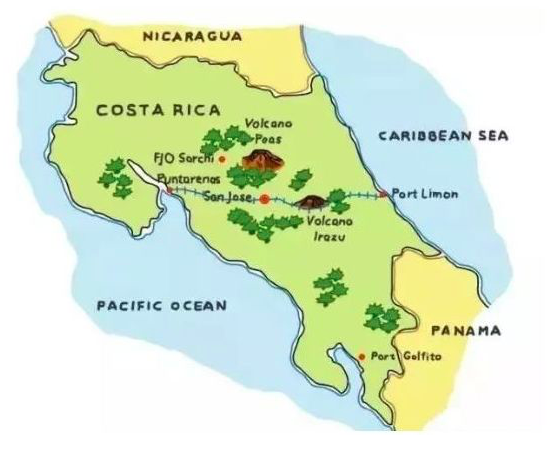
The Central Valley is also the earliest area in Costa Rica where coffee was cultivated, before the country's coffee industry expanded elsewhere. With moderate rainfall (an annual rainfall of 118 inches), an average annual temperature of only 19°C, and high altitude, the beans here are hard, aromatic, smooth, highly acidic, full-bodied, and richly fragrant. This region is Costa Rica's earliest coffee cultivation area, and its rich volcanic soil sometimes lends chocolate notes to the coffee.
Estate Introduction
Sonora Estate is a very famous estate in Costa Rica, located in the Central Valley at the foot of the Poás Volcano. Coffee grows on fertile volcanic soil, forming a complex ecosystem with various exotic species that can produce high-yield, small-batch coffee.
The estate uses natural water flow to drive Pelton water turbines, providing 100% renewable energy for the estate. 95% of Sonora's coffee is processed using the natural method, then dried at low heat for 3 hours to ensure uniform processing.
Variety
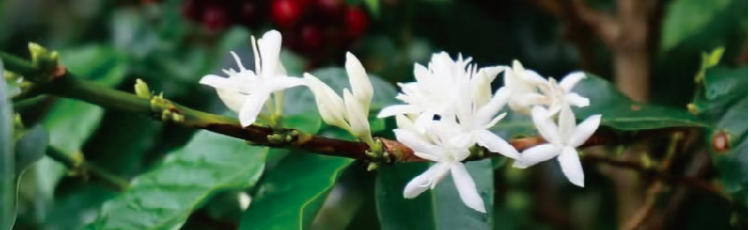
Caturra is a Bourbon variety discovered in Brazil in 1937. It has better production capacity and disease resistance than Bourbon, with shorter trees that make harvesting easier. It adapts well and doesn't need shade trees—it thrives even under direct, intense sunlight, which is why it's commonly called "Sun Coffee." Caturra suits cultivation from low altitudes of 700 meters up to 1700 meters, showing strong altitude adaptability. The higher the altitude, however, the better the flavor, though production capacity drops accordingly.
Processing
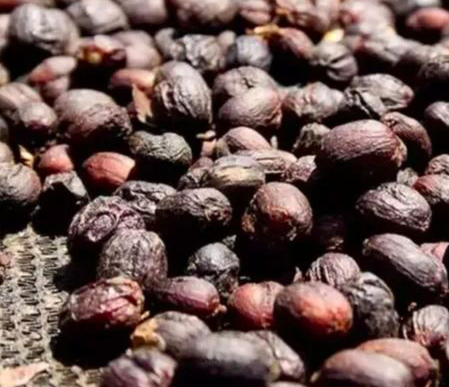
This coffee uses the natural processing method, the oldest and most original way to process coffee beans: harvested cherries are placed on patios—sometimes even directly exposed on roadsides—to receive direct sunlight (approximately 27-30 days), reducing moisture content from 60% to about 12%. Beans processed naturally have the lowest acidity, noticeable sweetness, and high body but slightly lower clarity.
Roast Profile Analysis
Roasting Machine: Yangjia 800N (300g batch size)
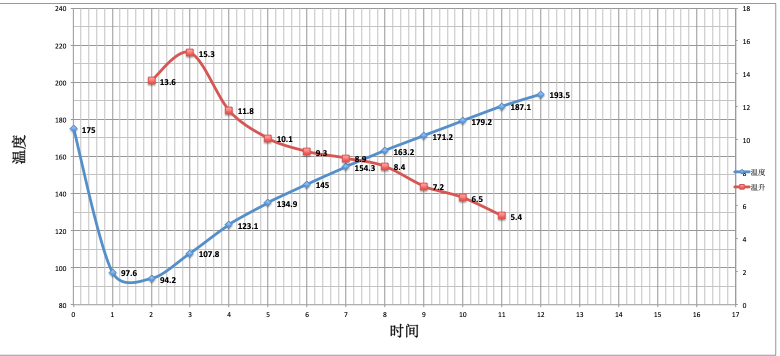
Heat the roaster to 175°C and load the beans, with the damper set to 3 and heat at 120. The return temperature at 1'36" is 91.6°C. When the roaster temperature reaches 140°C, open the damper to 4. At this point the bean surface turns yellow, the grassy aroma disappears entirely, and the coffee enters the dehydration stage. When the roaster reaches 166°C, adjust heat to 100°C, keeping the damper unchanged.
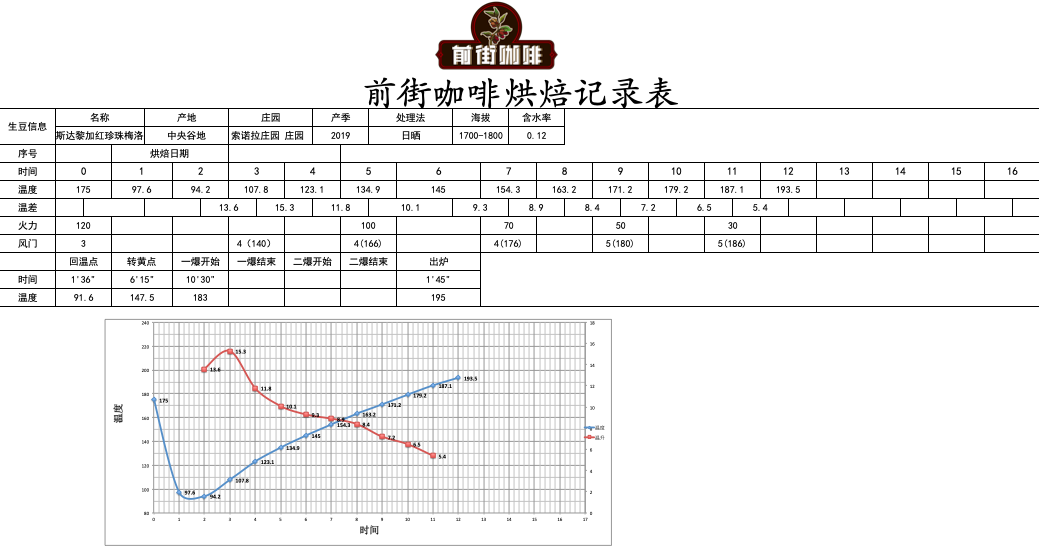
At 9'10", ugly wrinkles and black spots appear on the bean surface, and the toast aroma clearly turns into coffee aroma—this can be defined as the prelude to first crack. Listen carefully for the sound of first crack. At 10'30", first crack begins; adjust the damper to 5 (be very careful with heat adjustment—don't reduce it so much that cracking stops). Develop for 1'45" after first crack, then unload at 195°C.
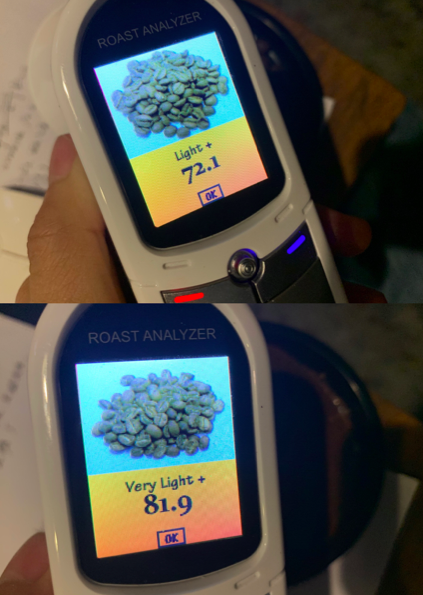
Agtron bean color value: 72.1 (image above); Agtron ground color value: 81.9 (image below); Roast Delta value: 9.8.
Cupping Analysis
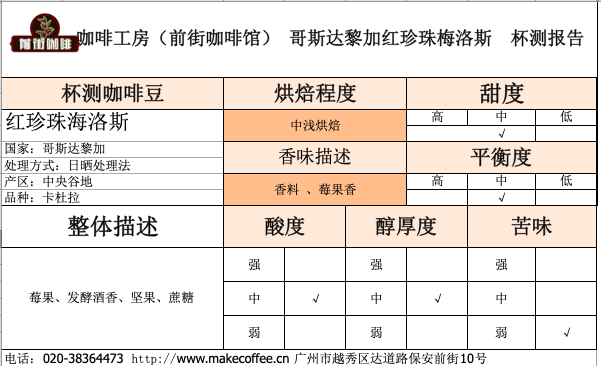
Flavor Notes: Berries, fermented wine aroma, nuts, cane sugar
FrontStreet Coffee Brewing Parameters
Recommended Brewing Method: Pour-over
Dripper: Hario V60
Water Temperature: 90°C
Dose: 15 grams
Ratio: 1:16
Grind Size: Medium-fine (BG 6k: 58% pass-through rate on China standard #20 sieve)
Brewing Technique: Poured extraction

Brewing Process: Use 34g of water for a 35-second bloom, then pour with a small circular stream to 135g and pause. When the water level drops and is about to expose the coffee bed, continue pouring to 240g and stop. When the water level again drops and is about to expose the bed, remove the dripper. Extraction time is 2'00" (starting from the bloom).
Flavor: Overall well-balanced, with fermented wine aroma and notes of berries, cane sugar, and nuts on the first sip. The aftertaste has noticeable sweetness and a pleasant lingering quality.
FrontStreet Coffee Recommendation
Costa Rican naturals like this one lean into berry and cane-sugar sweetness, and FrontStreet Coffee's light-roasted, fruit-forward beans make a natural pairing. The FrontStreet Ethiopia Huakui is one of the most successful stars of the recent specialty market: its tropical fruit aroma is strikingly prominent, with strawberry, passion fruit, jackfruit, and even lychee jumping out of the cup. Sweetness is obvious and bitterness is very low, so it drinks smooth and juicy—often described as "the coffee that doesn't taste like coffee." It's a great choice for anyone who usually dislikes traditional coffee bitterness.
If you want bright, structured acidity with real complexity, the FrontStreet Kenya Little Tomato comes from Kenya's Sika region, grown at 1,550-1,750 meters from the classic SL28 and SL34 varieties and processed with Kenya's 72-hour double-washed fermentation. Light roasted, it leads with cherry tomato and dark plum, backed by pear and black plum, a clean yellow-sugar sweetness, and a faint green-tea note—vivid, balanced, and full of juice.
Important Notice :
FrontStreet Coffee is a long-established specialty coffee roaster in Guangzhou China, selling freshly roasted beans from its own farm in Yunnan as well as dozens of carefully selected single-origin beans from around the world for both pour-over and espresso. The products deliver consistently excellent quality and great value, with shipping within 24 hours. Guangzhou's FrontStreet Coffee shop is recommended by many coffee lovers, and the beans are now available online at the Tmall 。
FrontStreet Coffee has moved to a new address:
FrontStreet Coffee Address: 315,Donghua East Road,GuangZhou
Tel:020 38364473
 Scan and follow the En Gafei WeChat official account. Please indicate that the reprint comes from "En Gafei".