Is Pour-Over Coffee the Same as Americano? How to Order Pour-Over Coffee at Starbucks Correctly?

The question FrontStreet Coffee's baristas hear most often is how pour-over coffee should be brewed to taste good. It is not an easy question to answer, because many factors affect the taste. The ones tied most directly to the brewing process are water quality, water temperature, grind size, coffee-to-water ratio, and extraction time. Among these, the coffee-to-water ratio means the ratio of the weight of the grounds to the amount of water poured. Today FrontStreet Coffee will start with the ratio and use comparative experiments to show how different ratios change the flavor.
First, FrontStreet Coffee recommends a coffee-to-water ratio between 1:14 and 1:18. The smaller the ratio, the richer the flavor; the larger the ratio, the lighter the taste. Most beans at FrontStreet Coffee's storefront are brewed at 1:15, which typically means 15 grams of grounds with 225 grams of water.

How does the coffee-to-water ratio affect coffee taste?
FrontStreet Coffee brewed with the ratio as the only variable while keeping every other condition unchanged. The comparison used ratios of 1:14, 1:16, and 1:18. For this brewing, FrontStreet Coffee selected Ethiopian Yirgacheffe Red Cherry Project natural process beans.

All brews used a V60 dripper with 90°C water. The grind was medium-fine (80% pass-through rate on a 0.85mm standard sieve), and a three-stage pour was used with 30g of bloom water for 30 seconds. First the water amount was changed, with the following variables:
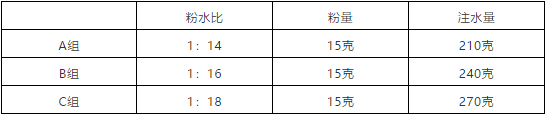
The dripper was removed only after the liquid had completely dripped through. After brewing, all three groups were tasted and their concentrations and extraction rates were calculated.

First, the results show that as the ratio increases, the concentration of the brewed coffee falls. Concentration is the ratio of dissolved substances to the liquid, so increasing the water amount (increasing the denominator) gradually lowers the concentration. Although more substances are extracted, the increase in water is larger, so the number ends up lower.

Extraction rate is the ratio of extracted substances to the weight of the coffee beans. Since the amount of grounds stays the same (denominator unchanged), increasing the water means more solvent is available to pull soluble substances from the beans, so the extraction rate gradually rises. Another factor is that more water also lengthens the extraction time, since at a consistent pouring speed more water means longer pouring and a longer total extraction, which also raises the extraction rate.
Of course, many factors in pour-over coffee are interrelated. Grind size, for example, also affects filtration speed and therefore extraction time. To reduce the effect of the time factor, FrontStreet Coffee therefore ran four additional brew groups for comparison, changing the ratio by adjusting the amount of grounds instead.
The variables for these four groups are as follows:
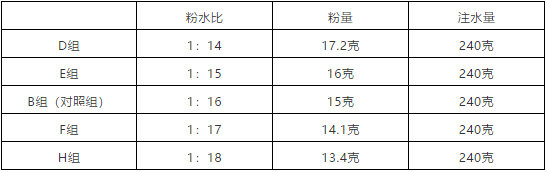
These groups were tasted in the same way, and their concentrations and extraction rates were calculated. The results are as follows:
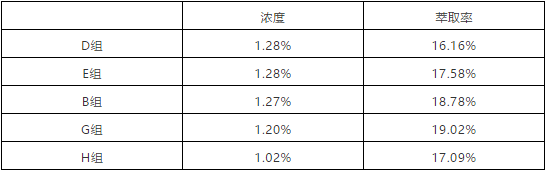
Looking at the results, the water amount is constant while the amount of grounds changes. FrontStreet Coffee believes that changing the amount of grounds changes the number of areas where water can extract coffee substances, and that number has an upper limit. More grounds means more extractable areas, so with the same water, more grounds yield more extracted substances. This explains why concentration rises as the ratio falls (as grounds increase).

From the first three brew groups, we saw that water as a solvent has extracting power: the more water, the more soluble substances it can extract. That view does not apply to the later Group H. As described above, FrontStreet Coffee believes that the weight of the grounds also affects the number of areas where water can extract substances, and that number is limited. After the limit is reached, the extractable substances are saturated, and adding more water cannot extract more, which is why Group H's extraction rate is lower than the other groups.
FrontStreet Coffee reminds readers, however, that the extraction rates of the latter five groups express different things. Group D's extraction rate, for example, means extracting 16.16% from 17.2g, and Group E's means extracting 17.58% from 16g, and so on. The denominators differ.

FrontStreet Coffee simplifies the above into the following points:
1. The larger the coffee-to-water ratio, the lighter the coffee taste; the smaller the ratio, the stronger the taste.
2. Increasing the water amount to raise the ratio affects more flavor compounds but results in a lighter taste; decreasing the water amount to lower the ratio affects fewer flavor compounds but results in a richer taste.
3. Increasing the grounds to lower the ratio reduces extraction of large-molecule compounds from the later stages while making the taste stronger; decreasing the grounds to raise the ratio, before reaching extreme conditions, extracts more complete flavor compounds while reducing taste intensity.

The Impact of Coffee-to-Water Ratio on Americano Coffee
Now that we have covered how the coffee-to-water ratio affects pour-over coffee, let's follow FrontStreet Coffee to explore how it affects Americano. As one of the most common coffee drinks in daily life, Americano raises questions about its origin and about the differences between espresso and Americano. Next, FrontStreet Coffee will address those questions one by one.
What is Americano Coffee?
The English term is "Americano." It typically refers either to black coffee made with a drip brewer or to a drink made by diluting espresso with water. Most Americanos in domestic cafes refer to the latter, while the former tends to be distinguished as drip coffee.
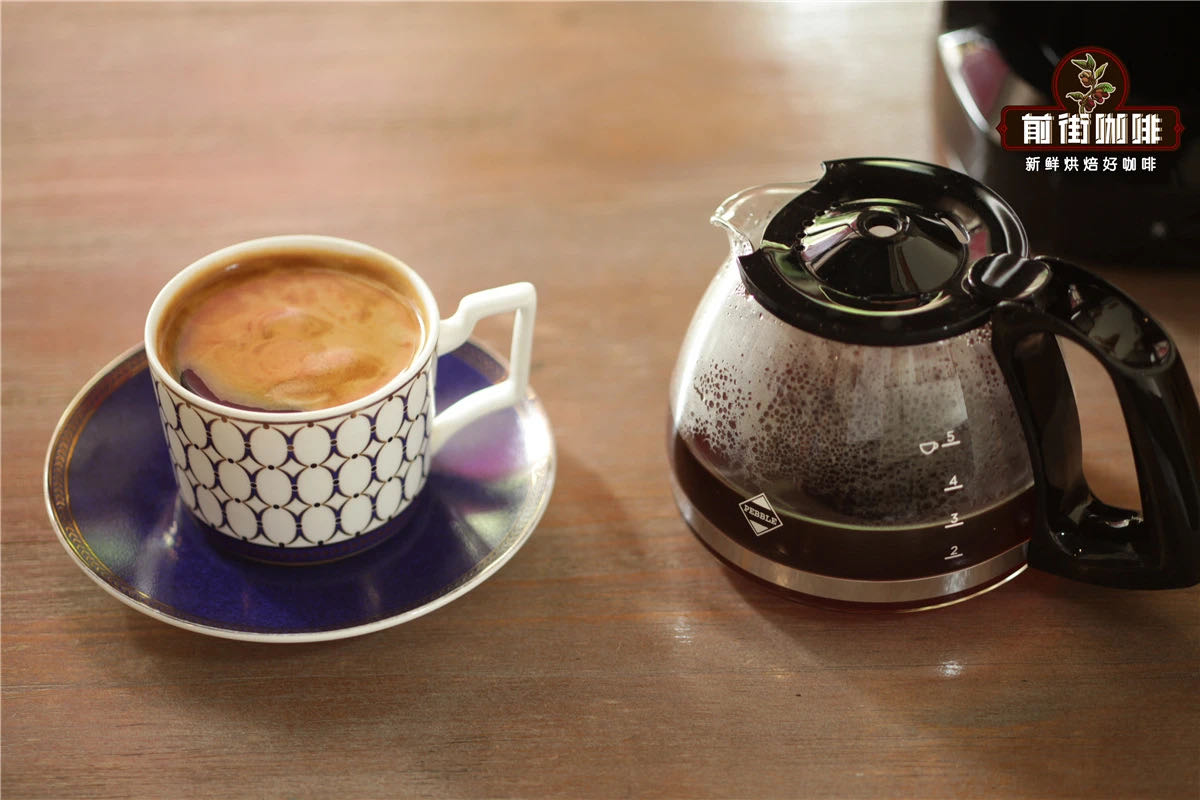
The traditional Americano ratio is 1:8, meaning a double espresso (60ml) mixed with 480ml of water. This can of course be adjusted to the cup size used in a cafe. In the third wave of specialty coffee, however, with SOEs (single origin espressos) made from beans from different regions and estates, espresso bean selection has become incredibly diverse. So does the 1:8 ratio really suit every bean?
Does the Traditional Ratio Apply to All Coffee Beans?
Take FrontStreet Coffee as an example: the cafe uses the Sunflower Warm Blend for Americano, a blend of Honduras Sherry Barrel and natural process Ethiopian Yirgacheffe in a 70% Sherry Barrel to 30% Yirgacheffe ratio. The roast curve was adjusted for espresso production, with the Sherry Barrel providing the main flavor and body while the Yirgacheffe contributes more acidity and aroma. To test whether 1:8 suits this Warm Blend, we tried Americanos at ratios other than 1:8 (1:7.5, 1:7, and 1:6.5). The espresso parameters were the daily adjustments: 20g of grounds extracting 40g of liquid in 28-29 seconds.
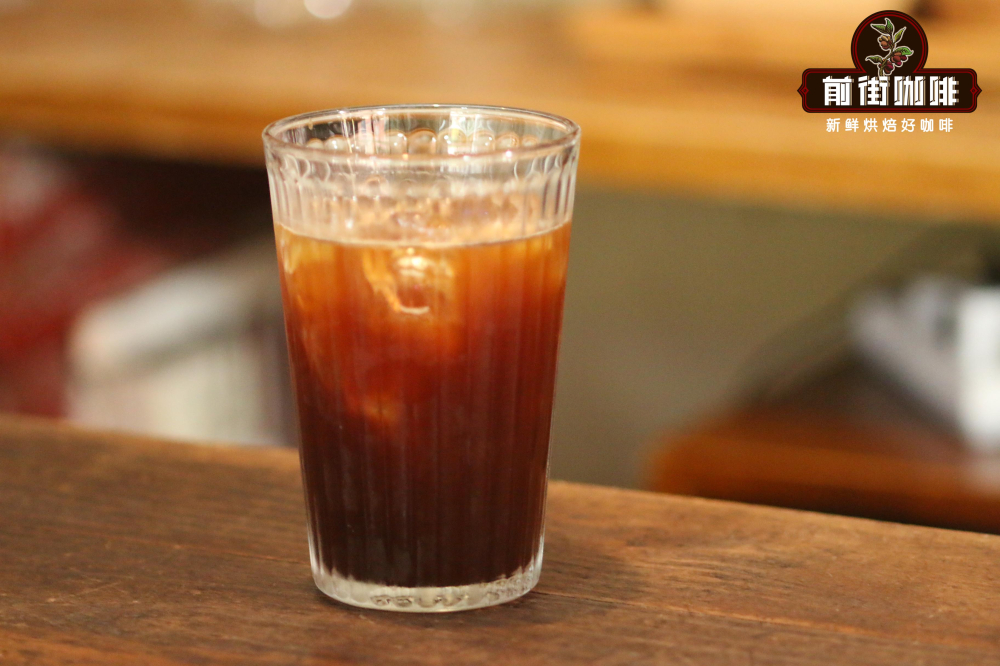
Through sensory tasting, we found the 1:8 and 1:7.5 Americanos relatively weak, with almost no sherry aroma from the Warm Blend. The concentrations of these two cups were as low as 0.77% and 0.85%. By contrast, the 1:6.5 and 1:7 Americanos better showcased the flavors from the sherry barrel. In practice, then, the 1:8 and 1:7 ratios cannot be applied to every bean, at least not to FrontStreet Coffee's Warm Blend. Traditional Americano, after all, describes a weak-tasting coffee, which the French jokingly call "sock coffee."
How to Determine the Ratio?
Since 1:8 cannot be applied to every Americano bean, how should the ratio be determined? The most direct and simple method is to gradually add water to raise the ratio while tasting.

First, extract a double espresso (or the required number of servings), pour it into a sharing pitcher on a scale, and gradually add water at different ratios while tasting to find the appropriate range. For example, after extracting 40g of liquid, start at 1:4 (add 160ml of water) and taste. Then add 20g of water (ratio 1:4.5) and taste, then add another 20g (ratio 1:5) and taste. Repeat until the suitable range is found.
Because each tasting consumes some liquid, the exact ratio cannot be pinned down this way; the method only helps find a range. You then remake the Americano within that range. For example, if the method shows the suitable range for the Warm Blend Americano is between 1:4 and 1:5, you would remake one at 1:4, one at 1:4.5, and one at 1:5, and finally determine that 1:4.5 suits the Warm Blend best. At that ratio, the wine notes and cocoa aftertaste of the Warm Blend are better highlighted while the body is maintained.
Which Tastes Better: Espresso or Americano?
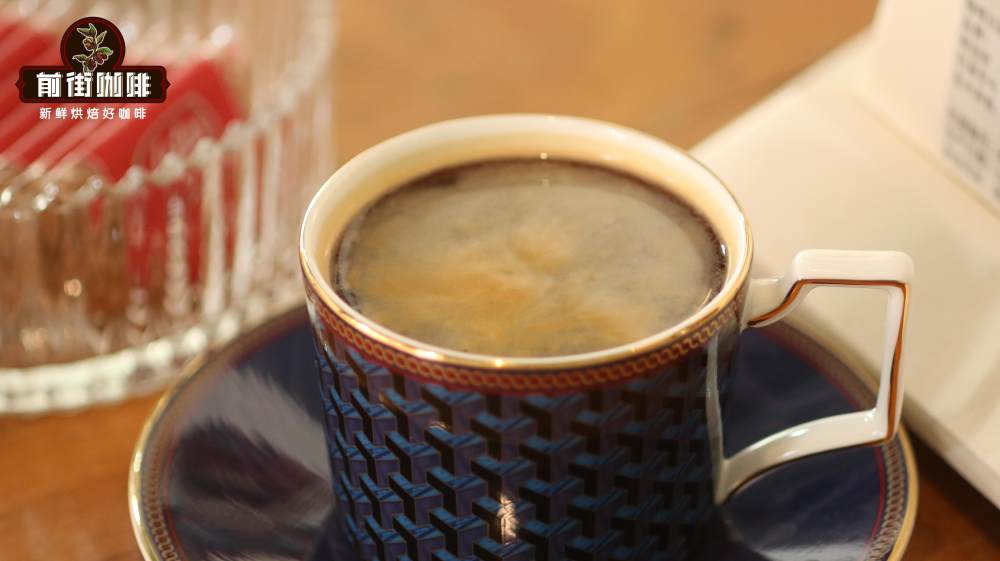
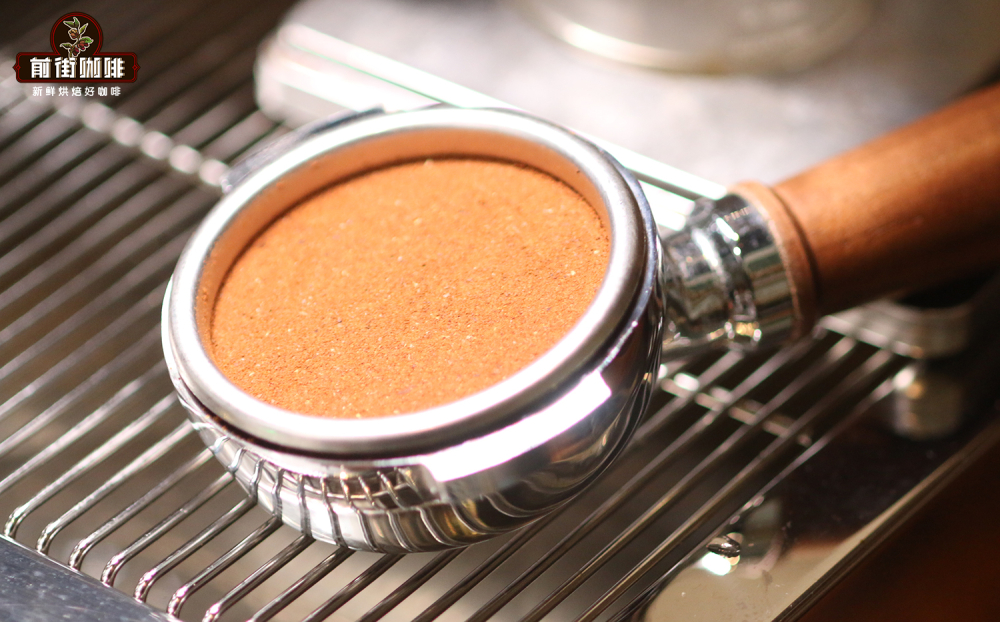
To compare espresso and Americano, FrontStreet Coffee believes we should first settle what Americano is: traditional drip coffee, or espresso diluted with water? Espresso is the origin and foundation of all espresso-based coffee. A perfect espresso is extracted by forcing hot water (90-93°C) at high pressure (9 bar) through very finely ground coffee. Other drinks are built on that foundation. Why does FrontStreet Coffee emphasize very fine grinding? Because at high pressure, hot water passes through the grounds very quickly. A fine grind increases resistance, extending the contact time between water and coffee to reach normal extraction concentration. Traditional Americano machines, however, use a different grind from espresso machines because they are filter-based, so extraction is relatively longer, and hole-type spray extraction gives a more even result. Using the same grind as pour-over is therefore perfectly suitable.
Comparing espresso with Americano, FrontStreet Coffee finds that because Americano is diluted with water, it tastes more mellow than espresso, with excellent flavor extension that lets you taste the front, middle, and back notes. Espresso, by contrast, is too concentrated and more prominently amplifies certain characteristics of the beans, whether acidity, sweetness, or bitterness.
Coffee drinks derived from espresso, such as latte, cappuccino, and flat white, emphasize the perfect fusion of milk and coffee. To bring out the milk flavor, the coffee's own character must be softened. Most cafes today still want to showcase coffee flavor, with milk serving to make the drink smoother and more mellow. The addition of milk makes coffee more approachable, and milk drinks are generally more popular than black coffee. Besides the small number of people ordering coffee for weight loss, there are also those who want to experience the flavor of the beans in an Americano.
FrontStreet Coffee Recommendation
FrontStreet Washed Yirgacheffe Daily Bean. To put ratio experiments into practice, FrontStreet Coffee suggests a clean, expressive coffee such as the washed Yirgacheffe. It is the classic introduction to the region, known for white jasmine, bright citrus and lemon acidity, and a clean tea-like finish, and its accessible price has made it the first specialty coffee for many drinkers.
Yirgacheffe is a small town in southern Ethiopia within the Sidamo zone, at roughly 1,700-2,100 meters, with the trees planted above 1,800 meters. Its highly recognizable white florals and lemon-citrus acidity have made the name a byword for Ethiopian specialty coffee.
For pour-over, FrontStreet Coffee suggests a V60 dripper with 90-91°C water, 15g of coffee at a 1:15 ratio, and a medium-fine grind (EK43s setting 10, about fine-sugar texture, roughly 80% passing a No. 20 sieve).
Important Notice :
FrontStreet Coffee is a long-established specialty coffee roaster in Guangzhou China, selling freshly roasted beans from its own farm in Yunnan as well as dozens of carefully selected single-origin beans from around the world for both pour-over and espresso. The products deliver consistently excellent quality and great value, with shipping within 24 hours. Guangzhou's FrontStreet Coffee shop is recommended by many coffee lovers, and the beans are now available online at the Tmall 。
FrontStreet Coffee has moved to a new address:
FrontStreet Coffee Address: 315,Donghua East Road,GuangZhou
Tel:020 38364473
 Scan and follow the En Gafei WeChat official account. Please indicate that the reprint comes from "En Gafei".