【FrontStreet Coffee's Bean Sourcing Journal】Nicaragua · Los Congos Estate Villa Sarchi Varietal
Nicaragua Finca Los Congos
Estate Information
Estate: Finca Los Congos
Region: Nueva Segovia
Variety: Villa Sarchi
Altitude: 1350-1650m
Processing Method: Natural
Grade: SHG
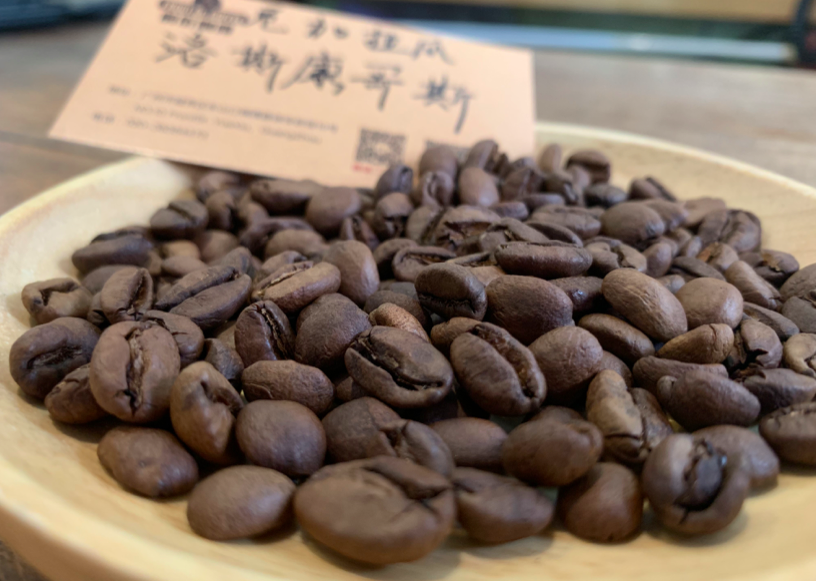
Region Introduction
Nicaragua's growing conditions are comparable to those of other Central American countries. Coffee grown at high altitude under shade produces a well-rounded, balanced cup with mellow acidity. The main factors keeping it from wider recognition have been war and hurricane damage, which made it hard for individual farms to operate sustainably and left no historical records for green coffee buyers to trace farm information. Only after 2003, once the factors hurting coffee quality were eliminated and transportation infrastructure was fully developed, did high-quality coffees begin to emerge.
All Nicaraguan coffee is grown in fertile volcanic soil. SHG (Strictly High Grown) refers to the highest quality grade, harvested at altitudes between 1,500 and 2,000 meters.
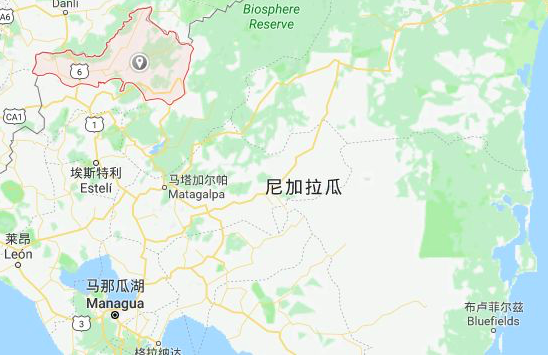
The local climate is defined by high mountain terrain, with dense fog covering the entire mountain forest year-round to create a cool, humid environment. Years of varietal crossbreeding and evolution, combined with traditional, time-consuming processing methods, preserve natural fruit acidity and rich aroma. Shade growing ensures even sunlight, letting the cherries ripen slowly while indirectly absorbing moisture from the fog. As a result, these beans show lively, complex flavors. Such excellent growing conditions yield coffee with subtle acidity and a smooth character. Savored carefully, you can detect faint fruit and chocolate sweetness in the throat, with rich body and a multi-layered aftertaste.
About Nueva Segovia: located in northern Nicaragua near the Honduran border, this region was explored by Spaniards as early as 1525 in search of gold mines. In recent years it has begun to build the best coffee reputation in the country, achieving great success in the Cup of Excellence competition. Coffee averages above 1,500 meters in altitude, and its unique flavor conditions make this mountainous region, with its branches of the Cordillera range, a treasure trove of specialty coffee.
Estate Details
As one of Nicaragua's best coffee-producing regions, Los Congos Estate is located in the town of San Fernando, Nueva Segovia, in northern Nicaragua near the Honduran border. This is Nicaragua's highest-altitude coffee-producing region. On the other side lies Honduras's best coffee-producing region too.
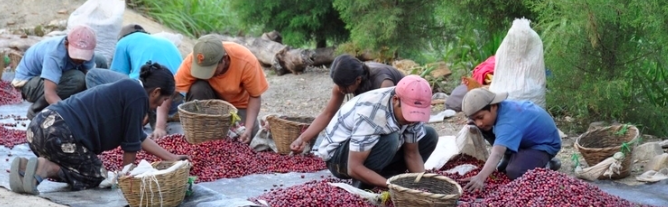
Finca Los Congos is one of the few self-sufficient estates that raises livestock, harvests timber, and produces organic fertilizer from coffee cherries, enabling completely chemical-free cultivation and processing. It enjoys Central America's unique advantages: abundant, high-quality water for coffee, plus excellent volcanic soil. Large arable areas allow crop rotation, letting the soil rest and maintain fertility. Additional advantages include high-altitude shade cultivation and drip-washing technology. The harvest period requires two years of care, which raises costs.
The estate owner, Rene Martin, inherited the farm from his father, Jose Liu Ruoying. The main varieties are Caturra and Pacamara; the estate's Pacamara was runner-up in the 2009 Cup of Excellence. Martin's father planted Pacamara from El Salvador on a friend's recommendation, drawn by its productivity and cold resistance.
Coffee Variety
About Villa Sarchi: this variety is a Bourbon mutation. The dwarf natural mutant was discovered in Costa Rica between 1950-1960, followed by pedigree selection (selecting individual plants across successive generations). It was not widely cultivated in Costa Rica, however; instead it was introduced to Honduras in 1974 by the Honduran Coffee Institute (IHCAFE).
Like Caturra and Pacas, this variety results from a single-gene mutation that produces dwarf plants. It offers medium cup quality, small beans, and a medium yield similar to Caturra, with high nutrient requirements. It is susceptible to coffee leaf rust, berry disease, and nematodes, and is suited to cultivation above 1,300 meters altitude.
Processing Method
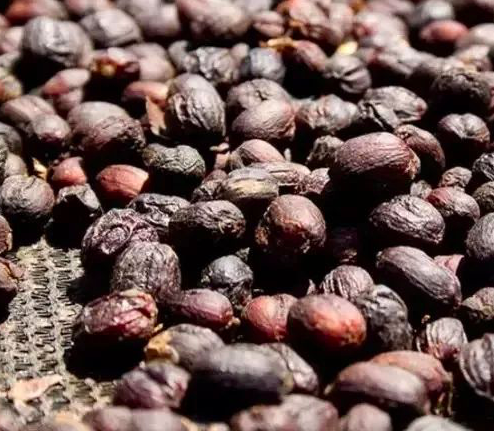
This coffee uses the natural processing method, the oldest and most original way to process coffee beans: harvested cherries are placed on patios—or sometimes directly exposed by the roadside—to receive direct sunlight (approximately 27-30 days) until moisture content drops from 60% to about 12%. Beans processed this way show the lowest acidity, noticeable sweetness, and high body but slightly lower clarity.
Roasting Profile Analysis
When FrontStreet Coffee's roaster examined this bean and understood its basic green coffee information, they decided to use a lower charge temperature and then gradually reduce the heat with a medium flame to roast it.
Roaster: Yangjia 800N (300g batch size)
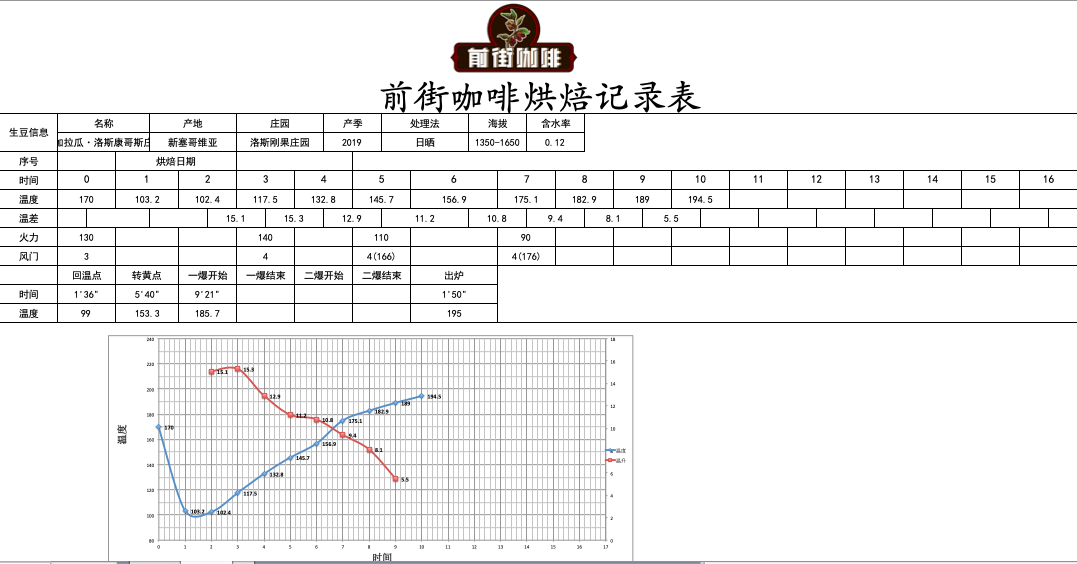
When the roaster reached 170°C, the beans were immediately charged with heat at 130 and damper at 3. The turning point was at 1'36". When the temperature reached 140°C, the damper was opened to 4 with unchanged heat. At 153.3°C, the bean surface turned yellow, the grassy aroma disappeared entirely, and the coffee entered the dehydration stage. When the temperature reached 166°C, heat was adjusted to 110 with the damper unchanged.
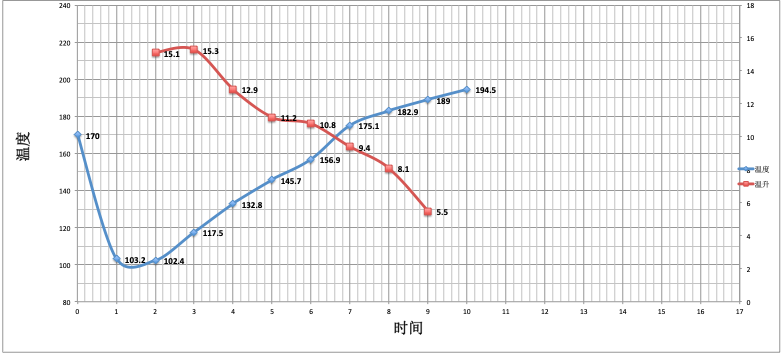
At 8'28", the bean surface showed ugly wrinkles and black spots, with the toast aroma clearly transitioning to coffee aroma—the prelude to first crack. Listen carefully for the first crack sound. First crack began at 9'21", and the damper was adjusted to 4. After first crack, development time was 1'50", with discharge at 195°C.
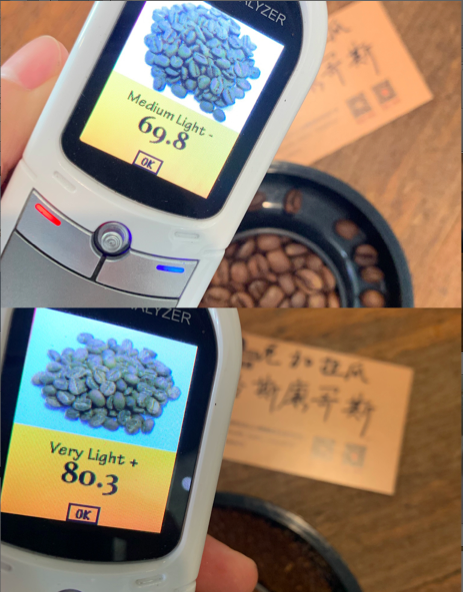
Agtron bean color value: 69.8 (upper image). Agtron ground color value: 80.3 (lower image). Roast Delta value: 10.5.
Cupping Notes
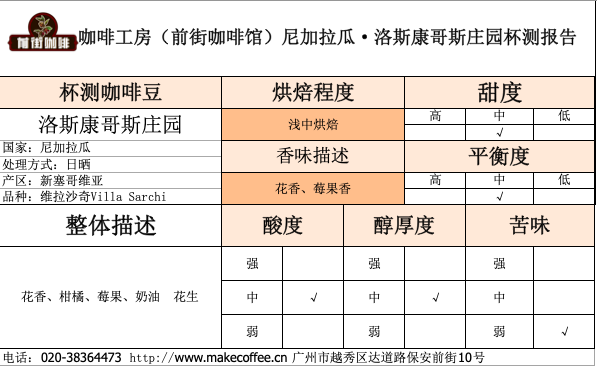
Flavor Profile: Floral, citrus, berries, cream, peanuts
1. Flavor descriptions vary by individual and are influenced by water temperature and brewing methods. This cupping report offers descriptions limited by the flavor wheel under identical brewing equipment and parameters, for reference purposes.
2. Content is updated promptly with new information; the latest updates should be considered current.
Brewing Recommendations
For this coffee, FrontStreet Coffee recommends pour-over brewing.
Dripper: Hario V60
Water Temperature: 90°C
Coffee-to-Water Ratio: 1:15
Grind Size: Medium-fine (BG6M: 58% pass-through rate on China standard #20 sieve)
Brewing Method: Segmented Extraction
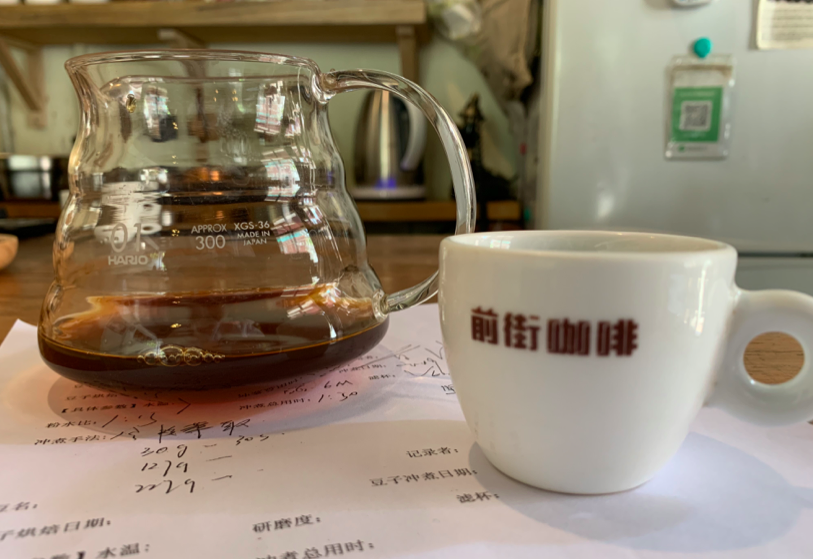
Flavor: Aroma of fermentation, with notes of nuts, berries, and cream on entry. At slightly lower temperatures, dark chocolate emerges. The aftertaste carries a faint fermented aroma. Overall, this coffee presents a full-bodied, balanced cup.
FrontStreet Coffee Recommendation
Nicaraguan naturals like Los Congos balance floral and citrus lift with berry sweetness and a creamy roundness, and FrontStreet Coffee has light, fruit-forward beans that hit a similar note. The FrontStreet Ethiopia Huakui is a standout: its tropical fruit aroma is unusually vivid, showing strawberry, passion fruit, jackfruit, and lychee, with pronounced sweetness and almost no bitterness—smooth and juicy from the first sip. It's a favorite for anyone who finds traditional coffee too bitter.
For a brighter, more floral cup with real structure, the FrontStreet Ethiopia Kafa Forest comes from the Kafa Biosphere area, a UNESCO-recognized reserve and one of the recognized birthplaces of Arabica, where wild coffee grows between 1,400 and 2,100 meters in shaded forest. Roasted medium-light, it opens with jasmine florals and a bright lemon acidity, then orange and bergamot, finishing with a green-tea-like sweetness—an elegant match for a balanced, berry-toned Central American coffee.
Important Notice :
FrontStreet Coffee is a long-established specialty coffee roaster in Guangzhou China, selling freshly roasted beans from its own farm in Yunnan as well as dozens of carefully selected single-origin beans from around the world for both pour-over and espresso. The products deliver consistently excellent quality and great value, with shipping within 24 hours. Guangzhou's FrontStreet Coffee shop is recommended by many coffee lovers, and the beans are now available online at the Tmall 。
FrontStreet Coffee has moved to a new address:
FrontStreet Coffee Address: 315,Donghua East Road,GuangZhou
Tel:020 38364473
 Scan and follow the En Gafei WeChat official account. Please indicate that the reprint comes from "En Gafei".