Introduction to Main Yunnan Coffee Growing Regions and Rankings: Which Brand is Best - Flavor Profile Characteristics of Lincang, Baoshan, Pu'er, Dehong Small-Bean Coffee
The Rise of Yunnan Coffee in the Specialty Coffee Scene
In the wave of specialty coffee, buyers for Yunnan coffee beans have clearly increased. Yunnan coffee is no longer what it used to be: cultivation techniques, variety quality, and cup flavor have all improved significantly. Yunnan coffee has shed its association with instant coffee and become a dark horse charging onto the specialty stage. So what does Yunnan coffee taste like now, and why the sudden attention? In this article, FrontStreet Coffee looks at how Yunnan coffee beans have developed over the years.
Several forces explain the refocus on Yunnan. First, with national support, coffee farmers adopted more scientific, systematic cultivation, improving both quality and yield. Second, more brands and baristas have brought Yunnan coffee into public view, which has greatly promoted its industrial development. Third, modern consumers have embraced the "national pride" consumption model, prompting many coffee brands to add Yunnan beans to their menus.
The Historical Journey of Yunnan Coffee Cultivation
Coffee cultivation in Yunnan began over 100 years ago. In 1904, Father Tian, a Catholic missionary, came to Yibin, Yunnan via the Yunnan-Vietnam Railway and established a church in Zhugula Village. Near the church he planted Yunnan's first batch of coffee trees—of the small-seed variety, as records describe it, which we now know as Arabica. Genetic verification later confirmed it was Typica. But with China's long tea culture, coffee never caught farmers' interest, and it was not widely cultivated.
In the spring of 1952, scientific personnel from the Mangshi branch of the Yunnan Agricultural Experimental Station brought back more than 70 kilograms of fresh fruit from Nongxian Village to Lujiangba in Baoshan City for trial planting. Good adaptability and excellent quality led to continuous development and growth.
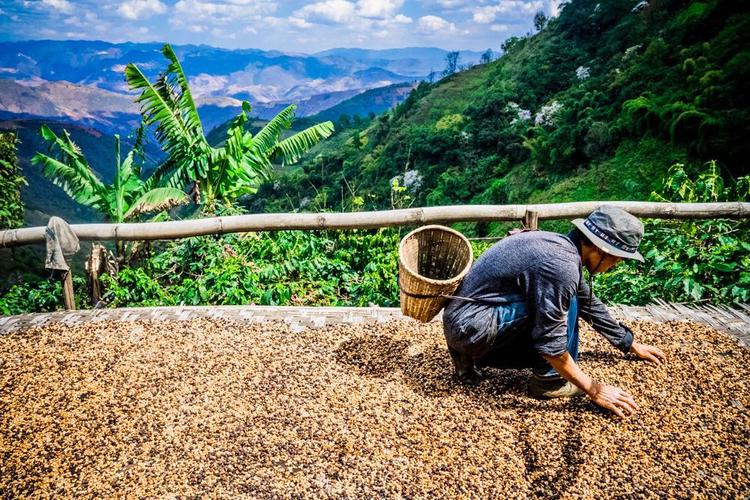
It wasn't until 1960 that the country, in order to repay Soviet loans, arranged for the cultivation of crops popular among the Soviet people—coffee among them. Yunnan already had the foundation, so farmers were required to plant coffee at scale; after maturation, harvesting, and drying, the crop was uniformly purchased by the national foreign trade department and shipped to the Soviet Union.
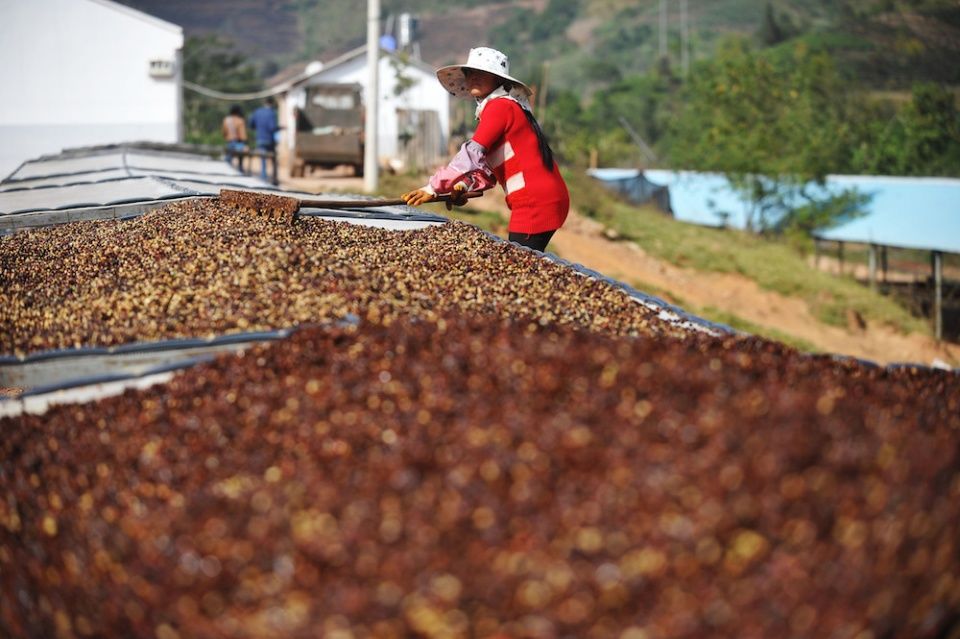
To boost production, besides Dali, coffee cultivation spread to Baoshan, Xincheng, Dehong, Ruili, Wanding, Wenshan, and Tianbao, peaking at over 50,000 mu of total cultivation area. But once the loans were repaid, purchases shrank and domestic demand was tiny; an outbreak of leaf rust then killed coffee trees en masse, and farmers cut down their trees one after another—Yunnan's coffee cultivation collapsed to just over 2,000 mu.

Only when Nestlé discovered Yunnan as a treasure land and distributed Catimor trees that resist leaf rust did replanting begin, with beans flowing continuously to Nestlé. But because Catimor carries Robusta genes, the flavor disappointed and tasted unpleasant drunk straight—so Yunnan coffee remained synonymous with instant coffee in most people's minds.
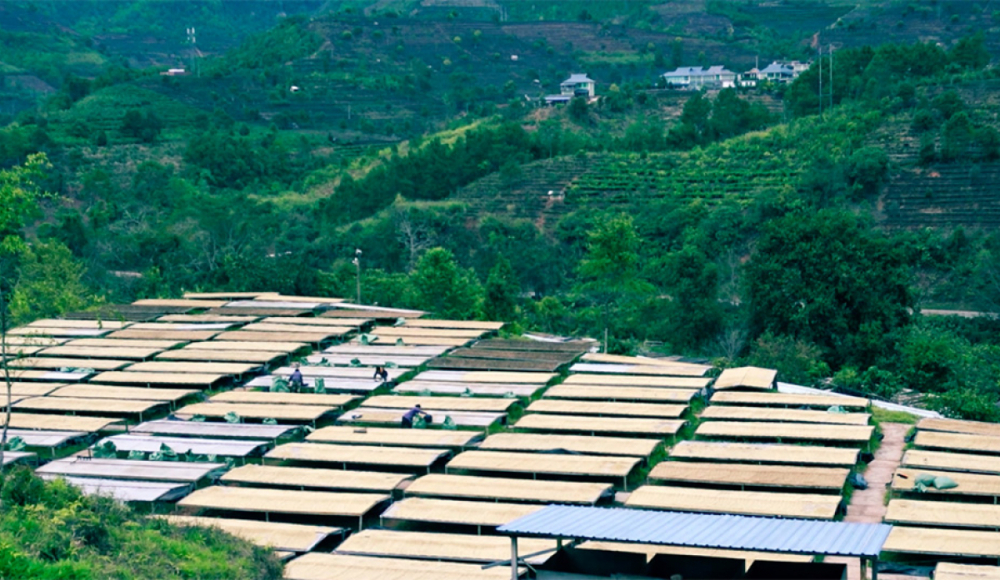
Only in the past decade has Yunnan's cultivation become more scientific and its processing more innovative, opening room for genuine flavor improvement. With domestic coffee demand rising at the same time, Yunnan coffee has developed rapidly, and its flavors have become remarkably novel.
FrontStreet Coffee's Approach to Improving Yunnan Coffee Quality
Processing can change a lot, but FrontStreet Coffee believes real acceptance starts at the root. The reason Yunnan coffee often tastes unpleasant is the Robusta genes in the variety: their high chlorogenic acid content gives strong disease and pest resistance—and is also the source of coffee's harsh bitterness.

To make Yunnan coffee taste good, you must change the variety. So starting in 2013, FrontStreet Coffee rented a mountain in Lincang, Yunnan, and established the FrontStreet Coffee Estate, cultivating primarily the most traditional Typica variety along with a small amount of Bourbon. Choosing high-altitude sites, excellent varieties, and green cultivation may well be the path to healthy, sustainable development for the Yunnan coffee region.

From 2018, the estate began harvesting "FrontStreet 2013 Yunnan Typica Coffee Beans." In the 2020/21 season the harvest was 200 kilograms of green beans, shared with new and old customers as tasting gifts, with warm feedback; by the 2021/22 season the Typica harvest reached 600 kilograms, and the beans are now available at FrontStreet Coffee's physical store. Thanks to the change in variety, "FrontStreet 2013 Yunnan Typica" uses traditional natural processing, with a full, enticing profile of plum, berry, brown sugar, black tea, and nuts.

Brewing Recommendations for Yunnan Coffee
To preserve Yunnan coffee's acidity, sweetness, and tea-like qualities, FrontStreet Coffee applies a medium roast. For brewing, use a V60 dripper at a 1:15 coffee-to-water ratio, a medium grind (approximately coarse sugar size / 75% pass-through rate with China #20 standard sieve), and water temperature of 88-89°C.

Specific technique: first pour 30g of water for a 30-second bloom; then pour in small circles to 125g, wait for the coffee bed to drain to half, and continue small circular pours to 225g. Once dripping is complete, total extraction time should be around 2 minutes 10 seconds.
FrontStreet Coffee Recommendation
If Yunnan coffee's story intrigues you, "small bean" is simply the local name for Arabica—the species with the smallest fruit of the three native coffee types—and Yunnan sits squarely on the world coffee belt around 25°N, with most of the province above 1000 meters, fertile slopes, ample sunshine and rainfall, and big day-night temperature swings. Cultivation concentrates in the southwest, across four main producing areas: Baoshan, Dehong, Puer, and Lincang—FrontStreet Coffee's two Yunnan specialty beans come from Baoshan and Lincang.
For an entry point into Chinese Arabica, choose FrontStreet Coffee's Yunnan Small Bean from Baoshan, where coffee cultivation began in the mid-1950s when Liang Jinshan introduced it; Lujiangba's dry-hot valley—mild all year with large day-night swings and sensibly modest rainfall—gives the beans their distinctive sweet return. Washed-processed and medium-roasted, it highlights a caramel note while keeping some of the region's acidity, showing gentle nut and chocolate aromas with a light plum tartness.
For a clearer, more expressive Yunnan cup, step up to FrontStreet Coffee's 2013 Natural Typica, grown on the FrontStreet estate with only fully ripe red cherries and traditional sun-drying. The cup is heavier and more layered than the washed style, with citrus and berry tones, a whisper of fermented wineiness, caramel sweetness, and a creamy finish. And if you'd like Yunnan in your espresso, FrontStreet Coffee's Black Cocoa Blend pairs Yunnan Small Bean with Brazil Cerrado—Brazil supplying mixed-nut aromas and balance, Yunnan the chocolate and citrus—giving an Americano with harmonious sweetness, acidity, and bitterness plus nutty brown-sugar notes, and a latte with the silky smoothness of almond and cream.
Important Notice :
FrontStreet Coffee is a long-established specialty coffee roaster in Guangzhou China, selling freshly roasted beans from its own farm in Yunnan as well as dozens of carefully selected single-origin beans from around the world for both pour-over and espresso. The products deliver consistently excellent quality and great value, with shipping within 24 hours. Guangzhou's FrontStreet Coffee shop is recommended by many coffee lovers, and the beans are now available online at the Tmall 。
FrontStreet Coffee has moved to a new address:
FrontStreet Coffee Address: 315,Donghua East Road,GuangZhou
Tel:020 38364473
 Scan and follow the En Gafei WeChat official account. Please indicate that the reprint comes from "En Gafei".