
Characteristics of Honduras Whiskey Sherry Barrel Processed Coffee Beans and Pour-over Sherry Coffee Bean Brewing Techniques
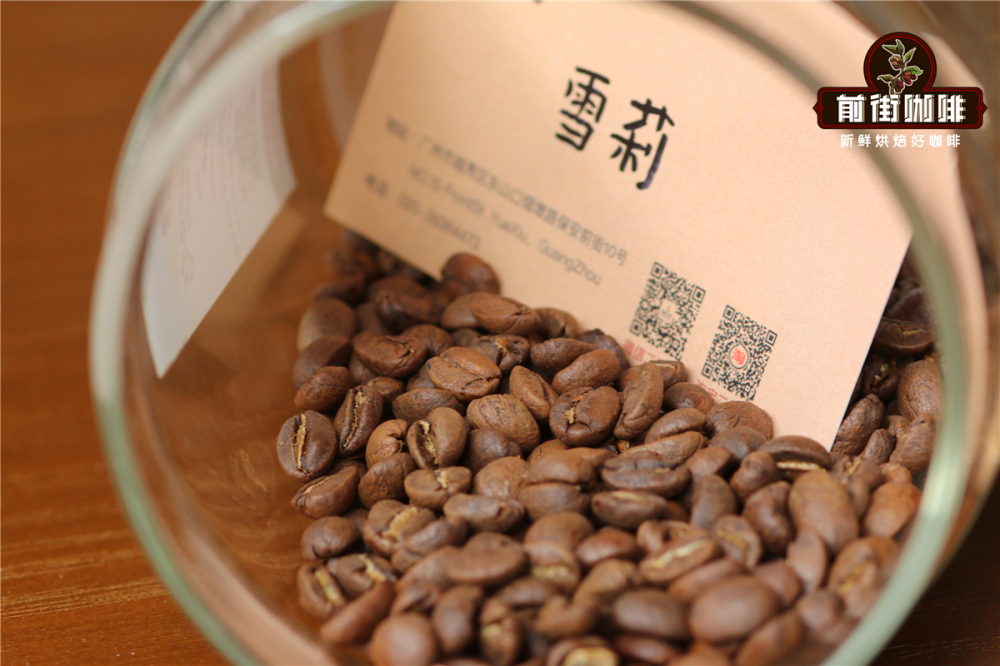
FrontStreet Coffee · Honduras Sherry Coffee Beans
Region: Masaguara
Estate: Moca Estate
Altitude: 1500-1700m
Varieties: Caturra, Catuai, Pacas
Processing: Washed + Whiskey Sherry Barrel Fermentation
Question: is there something that tastes like drinking whiskey but contains no alcohol? There really is. FrontStreet Coffee has released a Honduras Sherry coffee bean that delivers exactly that experience. Next, FrontStreet Coffee will brew this Honduras coffee using several different methods to see how the flavor shifts from one filter cup to the next.
What is Barrel Fermentation Processing?
Barrel fermentation is borrowed from winemaking. Its greatest effect on wine is that moderate oxidation stabilizes the wine's structure and folds barrel aromas into it. It plays a similar role in coffee fermentation. A wooden barrel lets a tiny amount of air pass through its walls, allowing the coffee beans to oxidize gently. That measured oxygen intake also accelerates fermentation, softens tannins, and lets fresh fruit aromas gradually develop into the rich, complex fragrances of aged wine. The moderate hardness of the barrel gives it good water resistance and storage safety, and because barrels themselves contain tannins, those tannins seep into the green beans during storage, lending the coffee layered complexity and deep wine aromas.
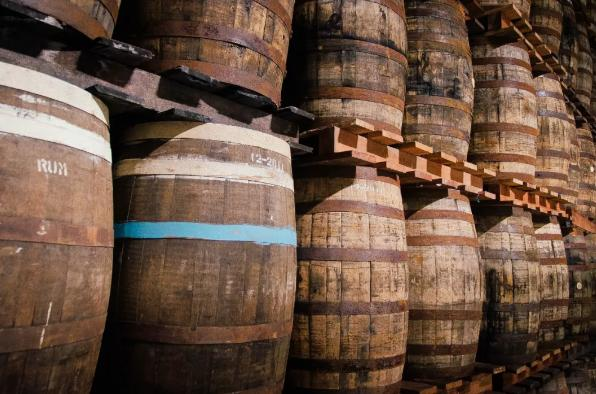
FrontStreet Coffee's Honduras coffee beans are washed first, then placed in whiskey barrels for low-temperature fermentation lasting 30 to 40 days at roughly 15 to 20°C, followed by shade drying. Why shade drying instead of sun drying? Because intense sunlight would break down the aromatic molecules through heat and produce excessive fermented wine acidity. The resulting cup would not only lose its original aroma but also taste unpleasant.
What Type of Whiskey Barrels Are Used for Whiskey Barrel Fermentation?
All barrels are stacked according to age, with the oldest sherry at the bottom and the youngest at the top. Each year, some wine is drawn from the bottom barrels for bottling and sale, then replenished in matching proportions from the barrels above, which is what creates the unique character of a sherry. The barrels used for Sherry coffee beans are the ones in the middle, neither too old nor too young, because oak barrels in that range have already absorbed wine aromas that are neither overpowering nor bland. In a word, just right.

Origin and Varieties of Sherry Coffee Beans
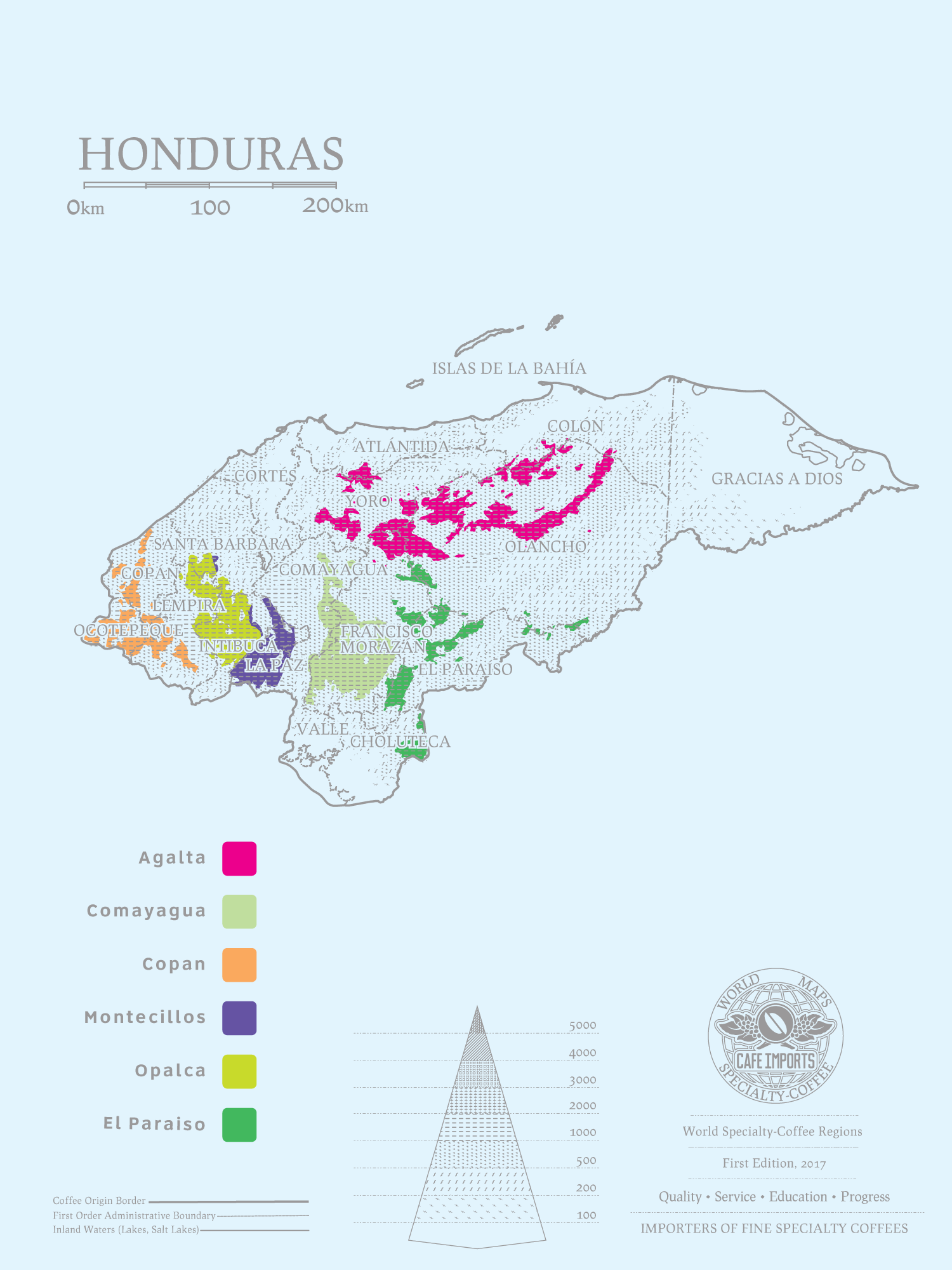
FrontStreet Coffee's Sherry coffee beans come from Moca Estate in Masaguara, Honduras. Honduras lies in northern Central America, bordered by Nicaragua and El Salvador to the east and south and by Guatemala to the west. The country is made up mainly of mountains and plateaus at roughly 1500 meters above sea level, with a tropical climate and average temperatures between 16 and 20°C. Abundant rainfall favors coffee cultivation. Honduran coffee farming is based largely on small family operations, and 70% of small farms are under 2 hectares. Honduran coffee is characterized by exotic spice in the aroma, followed by nutty chocolate richness in the aftertaste, with an overall balanced, layered presentation.
Masaguara is a municipality in the Intibucá department of Honduras, set in the southern part of the Jese Otoro valley and surrounded by mountains and hills. It is devoted mainly to coffee growers and is the main driver of the local economy, while the valley floor is used for basic grains and livestock. As for the name, according to Mr. Alberto Membreo's "Indigenous Place Names," Masaguara means "place of deer." Moca Estate is simply a small farm in the high-altitude part of Masaguara.
Caturra is a natural mutation of Bourbon, discovered in Brazil in 1937. Its plant is shorter and more compact than Bourbon. Because it descends from Bourbon it has relatively weak disease resistance, though it yields more than Bourbon. Although it was discovered in Brazil, Caturra does not grow well there, so it was never widely planted in the country; instead it became popular across Central and South America, in places such as Colombia, Costa Rica, and Nicaragua.
Catuai is a variety created by artificially crossing Caturra with Mundo Novo. Catuai resists natural hazards well, particularly wind and rain. The trees are relatively short, and compared with other coffee trees the fruit attaches more firmly and is harder to harvest. The cherries come in both red and yellow types.
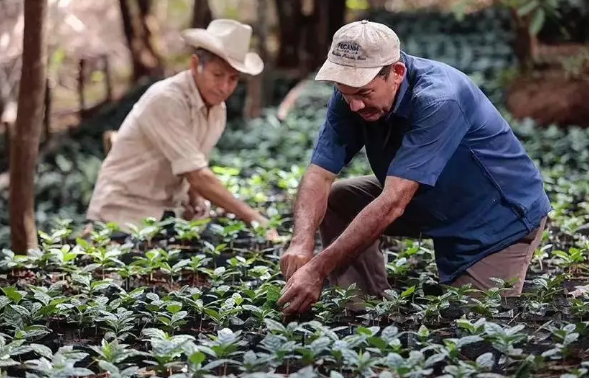
Pacas is a natural mutation of Bourbon. Like other widely planted low-Bourbon varieties, Pacas is a single-gene mutation. Its main advantage is that the tree is small, has relatively high yield potential, and can be interplanted with other fruit plants, which raises the total coffee yield. The variety was discovered in 1949 on a farm belonging to the Pacas family in the Santa Ana region of El Salvador. In 1960, the Salvadoran Coffee Research Institute (ISIC) began a pedigree selection project for Pacas, selecting individual plants through successive generations, also known as single-plant selection. It is popular in Central America and widely planted in El Salvador, where it accounts for about 25% of production. In 1974, the Honduras Coffee Research Institute introduced the variety and began cultivating it in Honduras.
FrontStreet Coffee Roasting Records
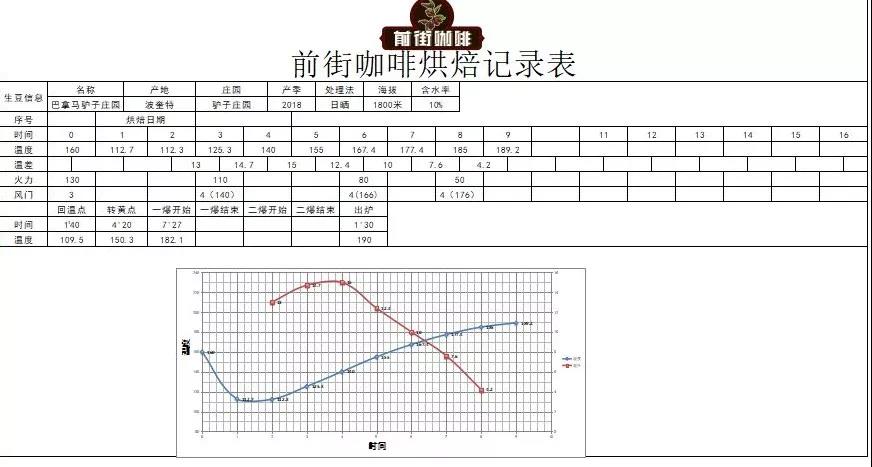
FrontStreet Coffee's roaster uses a Yangjia 800N machine with a 300g batch size. Charge temperature was 190°C, heat 140, damper at 3. The return point came at 1'42"; when the temperature reached 140°C the damper was opened to 4 and the heat left unchanged. When the temperature reached 151.8°C the bean surface turned yellow and the grassy smell disappeared completely, marking the start of the dehydration stage. At 150°C the heat was adjusted to 120 with the damper unchanged; at 8'38" the bean surface showed ugly wrinkles and black spots, and the toast aroma clearly shifted into coffee aroma, which can be taken as the prelude to first crack. At that point, listen carefully for the first crack. At 9'07" first crack began, the damper was opened to 4, and after 2'10" of development the beans were dropped at 195°C.
FrontStreet Coffee Cupping Report
FrontStreet Coffee cups sample beans within 8 to 24 hours after roasting. Its baristas typically use 200ml ceramic cupping bowls marked with 150ml and 200ml lines. Following SCAA standards, water TDS is around 150ppm; too low a TDS easily causes over-extraction, while too high a TDS affects taste and easily causes under-extraction. Cupping water temperature is 94°C. Grind size follows SCAA cupping standards, controlled so that 70% to 75% passes through a #20 standard sieve (0.85mm). The ratio is 11.1g of coffee to 200ml of hot water, or 1:18.18, which brings the extracted concentration into the 1.15% to 1.35% golden cup range. Steeping time is 4 minutes.
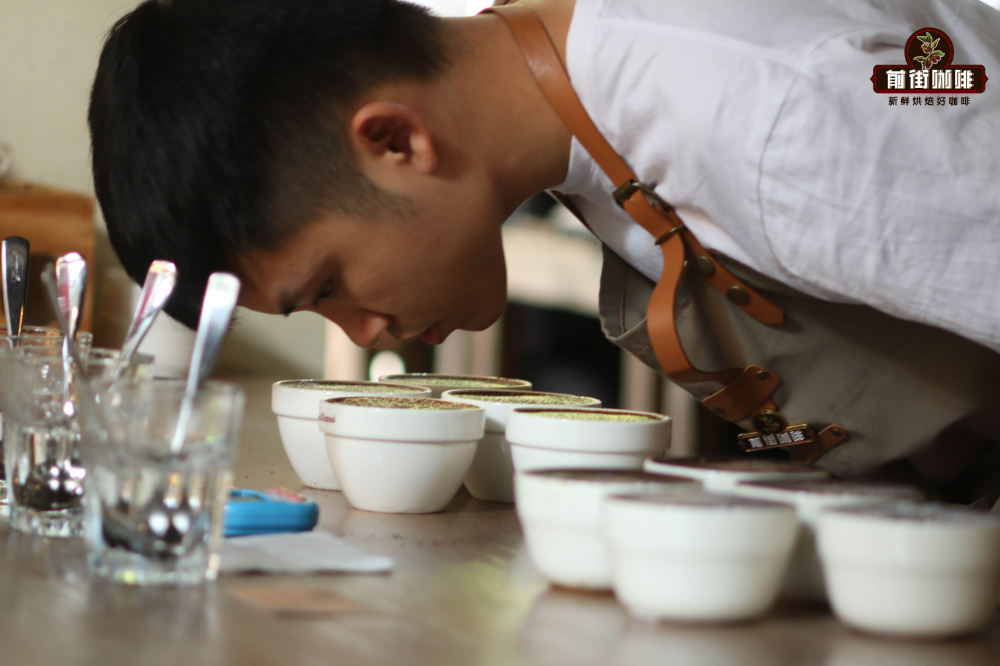
FrontStreet Honduras Sherry coffee beans show a rich whiskey aroma in the dry fragrance and a vanilla aroma in the wet fragrance. On the palate there is whiskey, a smooth vanilla cream texture, and berry acidity, with black chocolate and honey in the aftertaste.
FrontStreet Coffee Brewing Experience
Water Temperature: 90°C
Dose: 15g
Ratio: 1:15
Grind Size: 80% passing through a #20 sieve (medium-coarse)
Brewing Method: Bloom with 30g of water for 30 seconds, then pour in a slow circle to 125g for the first stage. When the water level drops and the coffee bed is about to be exposed, continue pouring to 225g and stop. When the water level drops again and the bed is about to be exposed, remove the filter cup. (Timing starts from the bloom.) Extraction time: 2'00".
Hario V60
The V60 has three defining structural features: the 60-degree conical shape, clockwise spiral ribs, and a single drain hole. The ribs create space between the filter paper and the dripper, and together with the single drain hole they help water flow through quickly.
Brewing Flavor of FrontStreet Honduras Sherry Coffee Beans: aromas of vanilla and cream, with whiskey, berry, almond, and black chocolate on the palate and maple sweetness in the aftertaste.

Cake Filter Cup
The cake filter cup, also called a wave dripper, has a flat bottom. That flat-bottom design keeps the flow rate even and improves the extraction rate. With only three small holes at the bottom, the flow is relatively slow, allowing the grounds to be fully soaked and producing a more balanced cup.
Using folded filter paper that does not sit directly against the dripper wall also creates the largest possible extraction area. This encourages concentrated extraction, lets hot water filter through evenly and smoothly, and slows heat loss at the same time.
Brewing Flavor of FrontStreet Honduras Sherry Coffee Beans: rich whiskey aroma, gentle acidity, liqueur chocolate mid-palate, and a vanilla cream smoothness.

Kalita Filter Cup
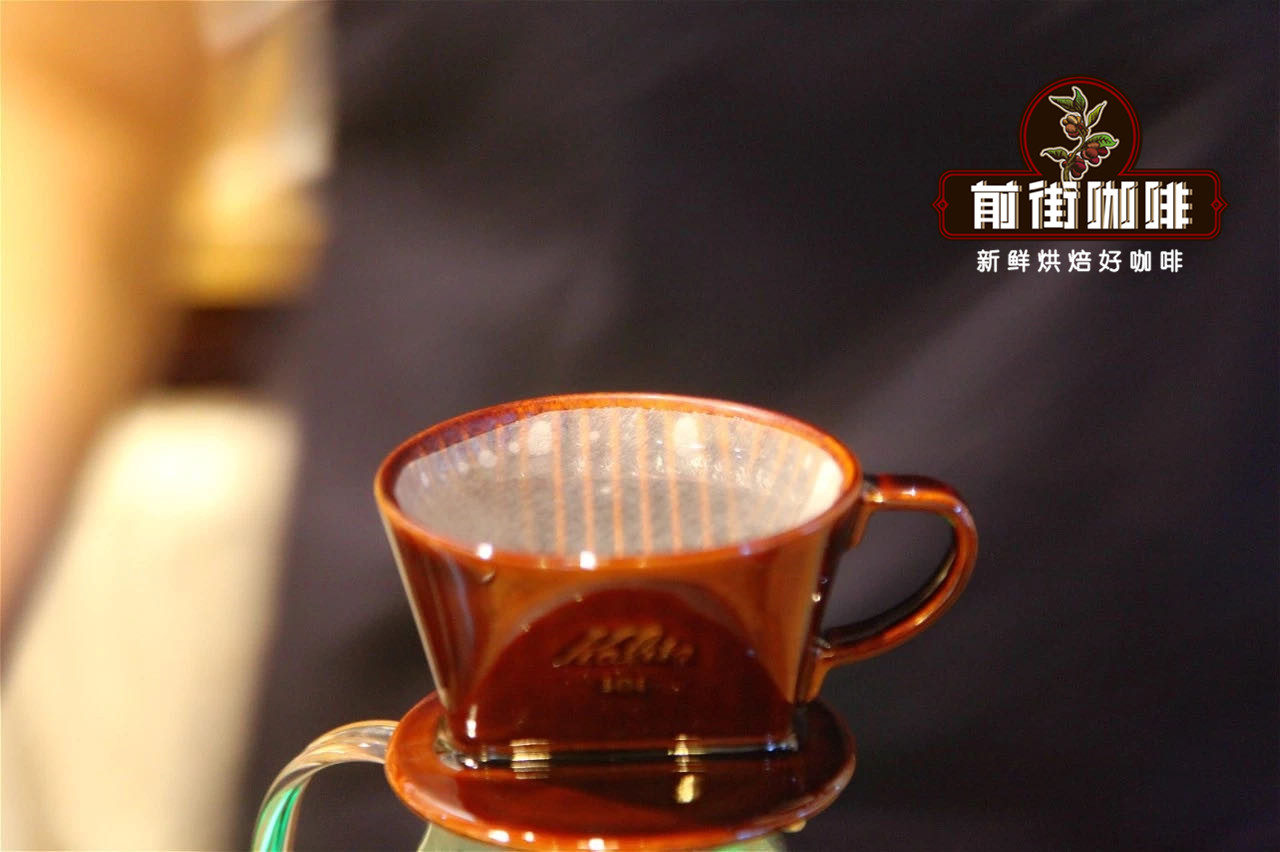
Seen from the side, the Kalita is wide at the top and narrow at the bottom, which helps concentrate the water. The circular top creates a broader area that spreads the coffee particles evenly and reduces stacking. The Kalita's walls carry many straight-line ribs at consistent spacing, designed to improve exhaust and flow speed. Its flow rate is still relatively slow, relying mainly on immersion extraction.
Brewing Flavor of FrontStreet Honduras Sherry Coffee Beans: rich whiskey aroma, liqueur chocolate and black chocolate on the mid-palate, roasted nuts, and a vanilla cream smoothness.
FrontStreet Coffee Recommendation
If barrel fermentation has you curious about what a filter cup can do with a bold, wine-like coffee, the same principle works beautifully with a classic V60 and one of FrontStreet Coffee's fruit-forward lots. FrontStreet Coffee's Yirgacheffe Gidding has long been the first stop for people discovering specialty coffee, with bright citrus, berry, and floral notes and a green-tea sweetness in the finish; the V60's fast, even extraction keeps that acidity soft and lively. For something more tropical, FrontStreet Coffee's Flower Queen brings ripe strawberry, passion fruit, and even jackfruit aromas with very little bitterness.
And if you want to taste the very top of the Geisha spectrum through the same V60, FrontStreet Coffee's Panama Esmeralda Red Label Geisha is the benchmark, delivering elegant jasmine florals with citrus, bergamot, and black tea in a clean, transparent cup. As this Sherry bean shows, matching the dripper to the coffee is half the pleasure of brewing.
Important Notice :
FrontStreet Coffee is a long-established specialty coffee roaster in Guangzhou China, selling freshly roasted beans from its own farm in Yunnan as well as dozens of carefully selected single-origin beans from around the world for both pour-over and espresso. The products deliver consistently excellent quality and great value, with shipping within 24 hours. Guangzhou's FrontStreet Coffee shop is recommended by many coffee lovers, and the beans are now available online at the Tmall 。
FrontStreet Coffee has moved to a new address:
FrontStreet Coffee Address: 315,Donghua East Road,GuangZhou
Tel:020 38364473
 Scan and follow the En Gafei WeChat official account. Please indicate that the reprint comes from "En Gafei".

![Alcohol in Coffee? [Honduras Sherry] New Arrival 50% Off Tasting! Jamaica Blue Mountain 50% Discount](https://en.gafei.com/uploads/allimg/190818/3-1ZQR3241L35.jpg)