What Coffee Growing Regions Does Tanzania Have? Introduction to Tanzanian Coffee Bean Flavor Characteristics and Stories
When people think of African coffee, the first names that come up are usually Ethiopia and Kenya. Tanzania rarely gets mentioned. So is Tanzanian coffee any good? Tanzania grades its coffee the same way Kenya does -- by bean size, with AA as the top grade -- and FrontStreet Coffee has brought in a Tanzania AA to answer the question. In this article, FrontStreet Coffee shares the flavor characteristics and the story behind this Tanzania AA.

FrontStreet Coffee: Tanzania Kilimanjaro AA Coffee Beans
Country: Tanzania
Region: Northern Highlands, Kilimanjaro Volcano Region
Altitude: 1300-2000m
Variety: Bourbon
Grade: AA
Processing: Washed
Flavor: Citrus, berries, honey, tea-like sensation
As mentioned above, these beans come from the Kilimanjaro volcano region. Coffee is an agricultural crop, and its flavor is inseparable from the growing conditions of the producing region. Geographical factors such as altitude, climate, and soil all change how a bean tastes, and variety and processing method matter too. Next, FrontStreet Coffee breaks down how this Tanzania bean's flavor is formed using those three factors.
Tanzania Coffee Bean Growing Conditions
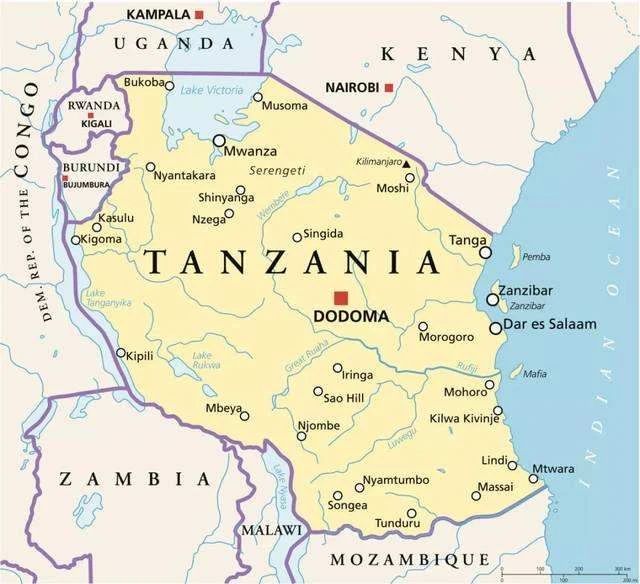
Tanzania lies close to Ethiopia and borders Kenya, so part of its population has a long historical and cultural connection with coffee. Commercial coffee cultivation, however, did not begin until the early 20th century, when German colonists required local farmers to grow Arabica as a cash crop. That push spread the plant across Tanzania and built an industry around Mount Kilimanjaro.
Although Tanzanian beans are not as famous as Kenyan beans, annual production is close to Kenya's, reaching 50,000 tons. The earliest Arabica seeds were introduced from the French island of Reunion and planted in the Bayamoyo and Mogoro regions. In 1893, beans planted on the slopes of Mount Kilimanjaro proved the most successful. Other varieties were gradually introduced from neighboring Burundi in the 1950s and planted in western Tanzania. Today, 75% of the crop is grown in high-altitude regions, and local wild coffee still turns up.

So what defines the Kilimanjaro coffee region?
Mount Kilimanjaro is the highest mountain on the African continent. Beans from this region are mostly planted on slopes between 1300-2000m. The mountain has rich volcanic soil, which suits high-quality Arabica very well. Kilimanjaro is also Tanzania's largest coffee-producing region, and Kilimanjaro coffee is an important lifeline of the Tanzanian economy.

Tanzania Coffee Bean Varieties
As noted above, this Kilimanjaro coffee is the Bourbon variety, which is also the most widely planted variety in Tanzania. Bourbon was introduced to the Kilimanjaro region by Catholic missionaries in 1898, and the Kent variety followed in 1920. So to this day, Tanzanian coffee is mainly Bourbon and Kent. What, then, are the flavor characteristics of Bourbon?
Bourbon Coffee Beans:
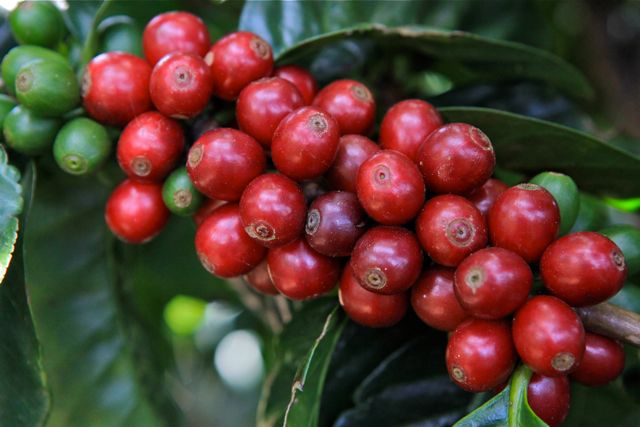
Bourbon is an old variety, an Arabica like Typica and many others. It was originally cultivated on Reunion, which was called "Ile Bourbon" before 1789, and the variety took its name from the island.
Although both are old varieties, the difference FrontStreet Coffee observes is that Bourbon leaves are wider and denser than Typica's, and production runs 30% higher than Typica. The beans are relatively round and short, with rich berry acidity, noticeable cream and fragrance, a strong acidic aroma, and obvious fruit acidity -- but the same weakness, poor disease resistance.

Put simply, Bourbon is a coffee tree belonging to a branch of the Arabica species. It generally bears red fruit, called Red Bourbon, and there are also Yellow Bourbon and Pink Bourbon.
Tanzania Coffee Bean Processing Method
As mentioned above, these beans use the washed processing method, which is also the method Tanzanian farmers use most. The biggest advantage of washed processing is that it keeps the bean's original flavor fresher and brighter, and the cup very clean.
Steps of the Washed Processing Method:

- Screen and remove impurities mixed in with the coffee fruit.
- Remove the coffee pulp and outer skin.
- Send to fermentation tanks and ferment for 18-36 hours to remove the mucilage layer attached to the inner pericarp.
- After cleaning, proceed with drying.
Tanzania Coffee Grading
As FrontStreet Coffee mentioned above, Tanzania uses the same grading method as Kenya, based on bean size. During screening, raw beans pass through screens with fixed-size holes. The larger the screen number, the larger the raw bean.

AA Grade: Particle size (Screen Size) between 17-18 mesh (7.20mm screen)
AB Grade: Particle size (Screen Size) between 15-16 mesh (6.8mm~6.2mm screen)
PB Grade: Round raw beans, accounting for about 10% of all coffee beans
C Grade: Particle size (Screen Size) between 12-14 mesh (4.8mm~5.6mm screen)
The Tanzania bean FrontStreet Coffee is introducing here is AA grade, the country's highest. So how does it taste as pour-over? Next, FrontStreet Coffee shares the pour-over parameters and flavor.
FrontStreet Coffee's Pour-Over Recommendations for Tanzania Kilimanjaro Coffee Beans
FrontStreet recommends a V60 conical dripper. The V60 has a larger opening, and its spiral rib design lets air escape more easily, which improves extraction. The body may not be especially rich, but its higher concentration brings out Kilimanjaro's sweet-and-sour character with a clear aroma -- which is the coffee's main strength.

Water Temperature: 90-91C
Grind Size: Fine sugar size / 80% through the #20 screen sieve
Coffee-to-Water Ratio: 1:15
Coffee Amount: 15 grams
Brewing Method: Segmented Extraction
First, bloom with 30g of water for 30 seconds. For the second pour, use a small stream to circle to 125g and stop. Wait for the water level to drop, then pour slowly again at an even speed, keeping the water level from rising too high. Pour to 225g and stop. Extraction time: 2 minutes 3 seconds, including the bloom.

Brewing Flavor: Berry aroma, soft citrus acidity on entry, nuts in the middle, and a honey-like aftertaste.
The above is what FrontStreet Coffee has compiled on the flavor characteristics and story of Tanzania AA coffee beans. We hope it helps coffee lovers understand Tanzanian coffee better, so you can choose beans that suit your own taste.
So how much does a cup of Tanzania Kilimanjaro AA cost? According to FrontStreet Coffee's pricing, a cup of Tanzania Kilimanjaro pour-over coffee costs 30 yuan. We hope that price gives coffee lovers a useful reference.
FrontStreet Coffee Recommendation
Tanzania's clean washed cup has a lot in common with the other great East African origins, so if you enjoy this profile, FrontStreet Coffee's washed Yirgacheffe from Ethiopia is the natural next step: clear jasmine florals and bright citrus acidity, light and elegant with a tea-like body, drinking like a clean, refreshing lemon tea.
For a village-level washed reference, look for FrontStreet Coffee's Gudingding cooperative from the Worka area at the southeastern end of Yirgacheffe. It was originally part of the Worka cooperative under the YCFCU alliance, and in 2012, with roughly 300 member farmers, it became its own cooperative. Because the fruit is removed before drying, its citrus and lemon notes and elegant white florals come through especially clearly.
If you want to compare washed against natural, FrontStreet Coffee's Yirgacheffe Natural Red Cherry is dried on raised beds for about two weeks with the fruit intact, letting the sugars soak into the bean. Expect peach, cocoa, honey, and lemon.
For a darker, wilder African pour-over, FrontStreet Coffee's Hambella Huakui from Guji in Sidamo is grown on a 200-hectare farm and dried for 21 days on raised beds, then roasted light-to-medium for a gently fermented wine aroma with florals, citrus, and mango.
Important Notice :
FrontStreet Coffee is a long-established specialty coffee roaster in Guangzhou China, selling freshly roasted beans from its own farm in Yunnan as well as dozens of carefully selected single-origin beans from around the world for both pour-over and espresso. The products deliver consistently excellent quality and great value, with shipping within 24 hours. Guangzhou's FrontStreet Coffee shop is recommended by many coffee lovers, and the beans are now available online at the Tmall 。
FrontStreet Coffee has moved to a new address:
FrontStreet Coffee Address: 315,Donghua East Road,GuangZhou
Tel:020 38364473
 Scan and follow the En Gafei WeChat official account. Please indicate that the reprint comes from "En Gafei".