Characteristics, Flavor Profile, and Brewing Methods for Tijuco Preto Estate Semi-Sun-Dried Coffee Beans from Minas Gerais, Brazil
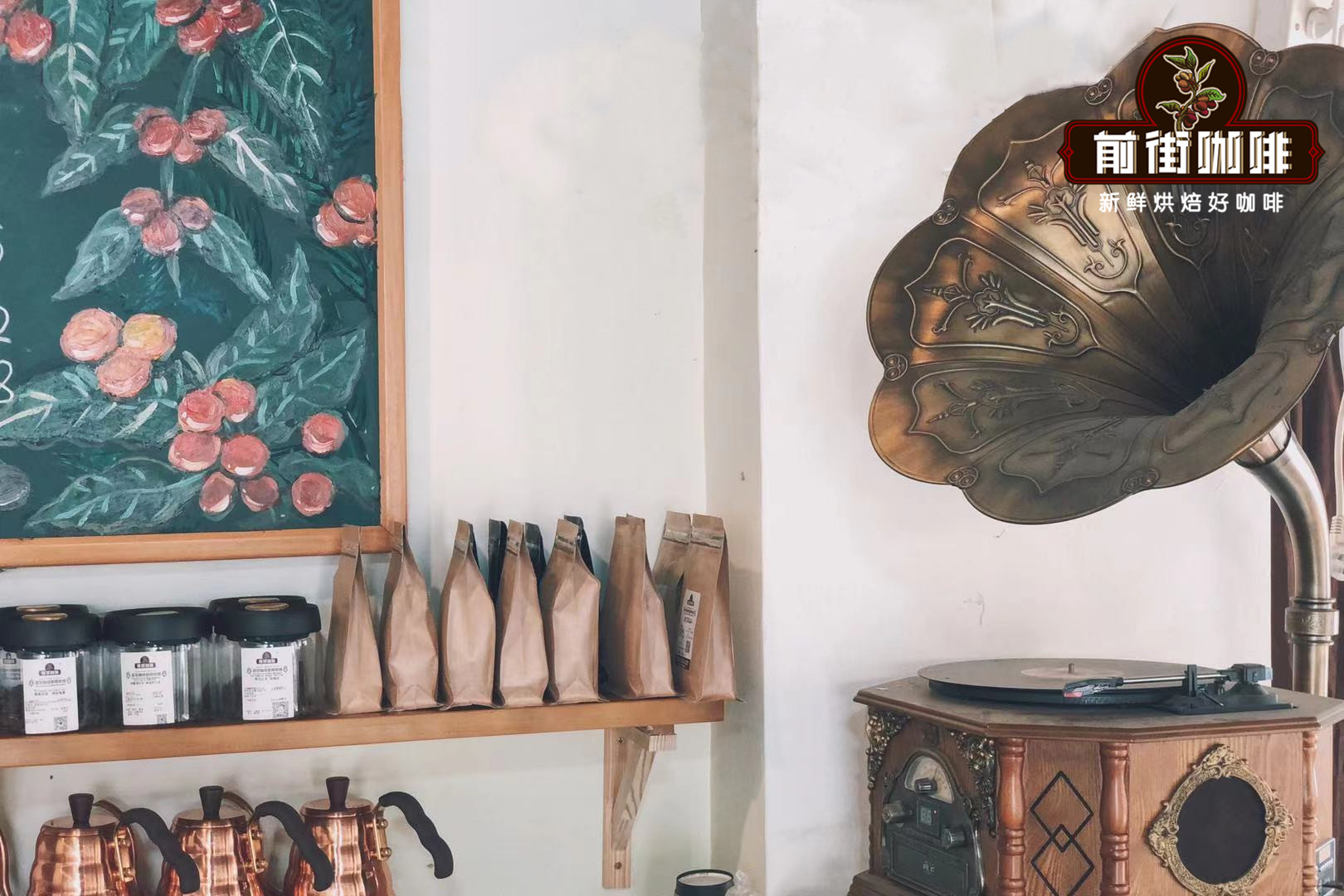
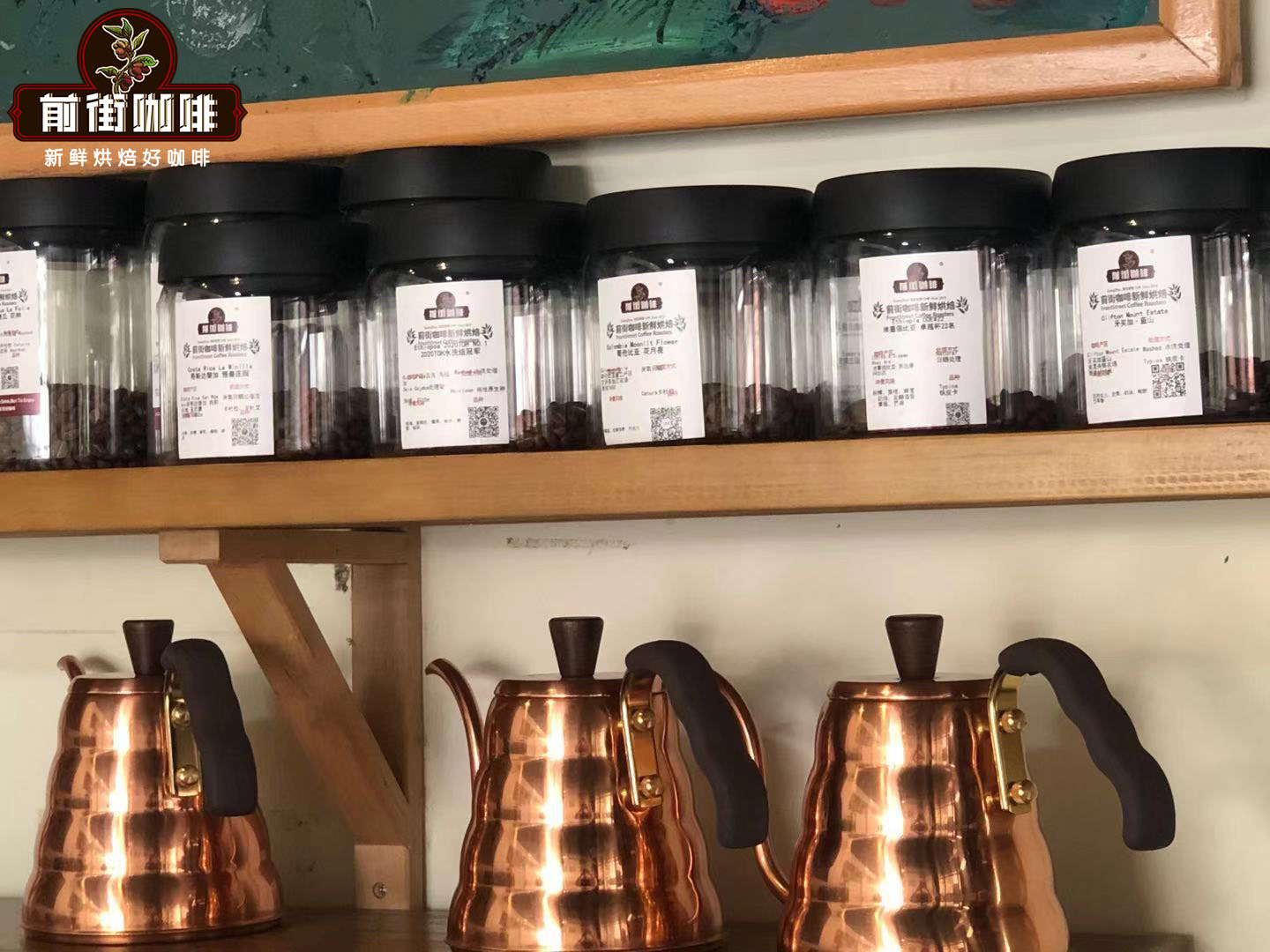
FrontStreet Coffee often fields the question of how to choose coffee beans, because its physical stores currently display more than 30 varieties, each with its own flavor character. With so many choices, selecting can be a challenge - or a customer settled on a favorite may simply want to try something new. When recommending, FrontStreet Coffee sorts beans into two directions - acidic or mellow - according to the customer's taste. Speaking of nutty and chocolate flavors, one must mention Brazilian coffee. And when it comes to Brazilian coffee, everyone knows Brazil is the world's largest coffee producer and also the world's second-largest coffee consumer. So where does Brazilian coffee come from? What are its production regions and famous estates? What processing methods does it use, what varieties are grown, and how is it graded?
Brazil Coffee History
Brazil's coffee was introduced from French Guiana in 1729. Admittedly, intensive cultivation and improved processing can raise coffee quality to a point, but Brazil's natural conditions cannot rival those of the regions producing the world's finest coffee: despite good soil and a humid climate, its altitude is not high.
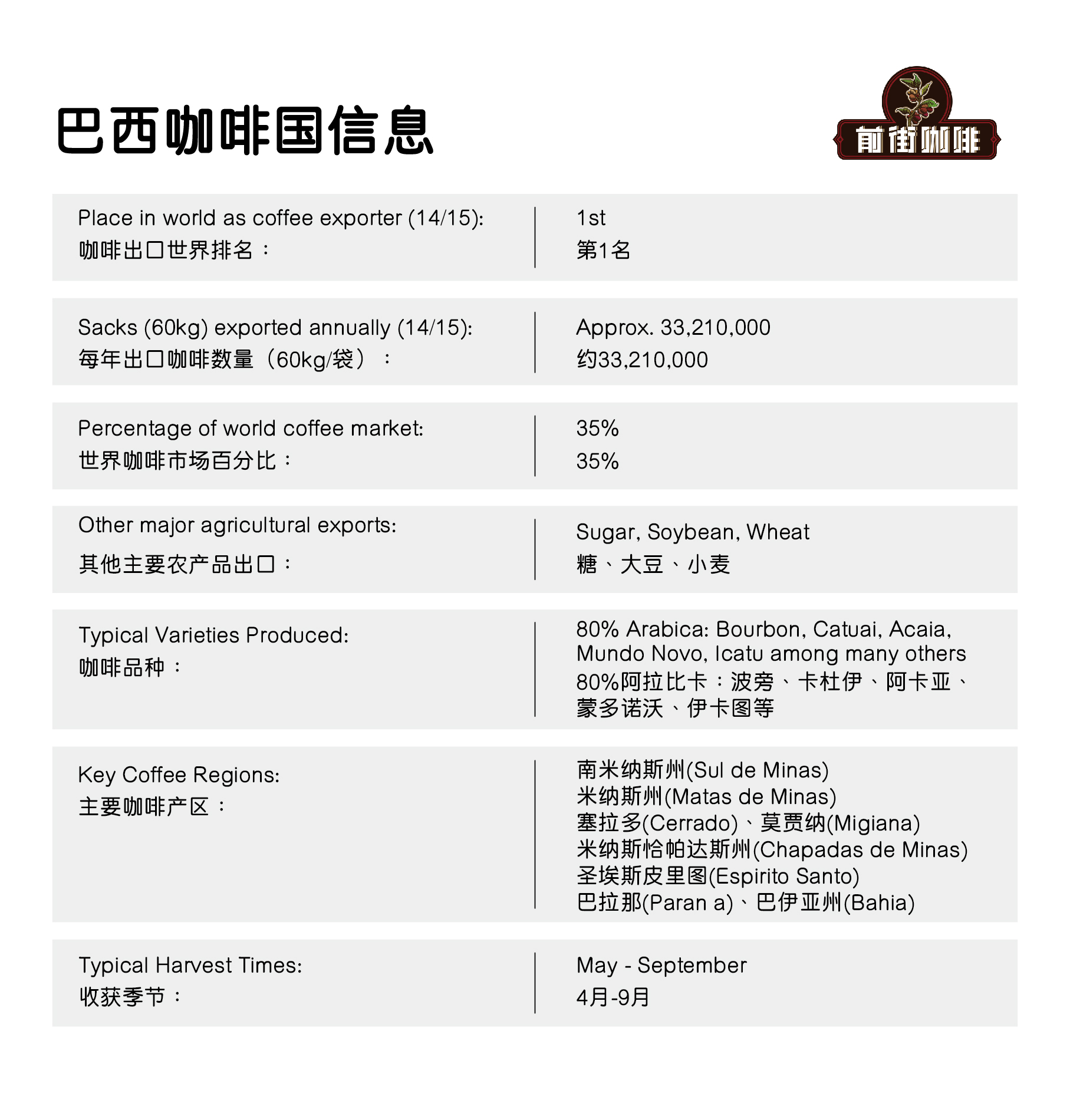
Brazil is the world's largest coffee producer, accounting for about 1/3 of global output, with production concentrated in the central and southern provinces. The regions suitable for coffee have relatively flat terrain, with most plantations below 1200 meters and no large shade trees. Because ripe and unripe berries are often harvested together, much of it fails to qualify as specialty coffee. Average Brazilian coffee rarely reaches excellent grades; the beans are relatively soft and clearly cannot take much heat during roasting. Among the various types, Santos is the most famous, named after its export port. Brazilian beans are neutral in character - enjoyable as single-origin (if somewhat monotonous) and prized as the indispensable base of blends.
Geographical Conditions
Brazilian coffee is generally grown in relatively flat areas. To adapt, estate operators developed, decades ago, improved Arabica trees that need neither high altitude nor shade - trees that can be planted on plains or grasslands, fully exposed to the sun, unlike traditional high-altitude shade cultivation.

Most Brazilian plantations sit at only a few hundred meters, and even flat land is pressed into cultivation. Sun-grown cherries mature faster with less complete flavor development; bean density - the so-called hardness - falls short of high-altitude beans, fruit acidity is markedly lower, and the flavor plainer. Coastal Rio coffee even shows iodine and salty notes, attributed to certain microbial action, though even on the same soil the flavor does not appear every year. Most enthusiasts dislike it; only a few Middle Eastern countries, with their traditions of sugar-heavy boiled coffee, particularly suit this Rio flavor.

Brazil Coffee Processing Methods
Brazil uses natural, pulped natural, and washed processing side by side. The choice is mainly dictated by the dry or humid conditions of farms across the producing regions, each method presenting its region's best flavors - great diversity indeed!
But why do most people still think Brazil relies mainly on natural processing?
The main reason is that before 1990, almost all Brazilian regions used crude natural processing, which easily left earthy and woody flavors in the green beans, damaged their reputation, and severely hurt Brazil's image.

After 1990, however, Brazil developed the pulped natural method, which shortened processing time, boosted fruit aroma and sweetness, and reduced the chance of off-flavors - a significant quality leap that made Brazilian beans very suitable as single-origin brews.
FrontStreet Coffee · Brazil Tijuco Preto Pulped Natural Coffee
Origin: Brazil
Region: Carmo De Minas town, Minas Gerais state
Farm: Tijuco Preto
Coffee Variety: Bourbon
Altitude: 1140 meters
Green Bean Processing: Pulped Natural
Coffee Flavor: Sweet, with stone fruit, lime peel, and cooking chocolate flavors.
Dry Aroma: Red wine aroma, nuts, sweetness, spices, slight floral notes, sweet pepper
Wet Aroma: Sandalwood, red wine aroma, mango, passion fruit, malt aroma, nuts, hawthorn
Sipping: Light passion fruit juice, oily texture, sweet pepper aroma, pepper, an aftertaste of tropical fruit sweetness, spicy lift, smoky aroma; as the cup cools, the oiliness becomes obvious and the sweet aftertaste carries ripe fruit acidity.

FrontStreet Coffee · Brazil Minas Tijuco Preto Estate Pulped Natural Processing Flavor?
The Tijuco Preto estate, at 1140 meters in southern Minas, took 7th place in the 2005 coffee competition. It grows traditional Bourbon trees and harvests ripe cherries by hand rather than machine, avoiding uneven maturity. The pulped natural method dries the beans in parchment on the drying field until moisture falls below 11%. Compared with other Brazilian beans the structure is relatively solid and the bean body more substantial, allowing a wider, more flexible roasting range and more layered flavors, with fruit aroma surpassing the cocoa-chocolate note. Because it lacks the typical Brazilian flaw of soft beans that roast poorly, Tijuco Preto shows no bitter throat irritation while keeping a mellow sweetness.
Since 1999, Brazil's specialty coffee competition has been held for 7 years. This grand event of the coffee world is called the Brazil Cup of Excellence(R) Competition. Started by Brazil, it has profoundly influenced the specialty community: Central American countries have successively launched national competitions, and even South American neighbors and Ethiopia in Africa have followed, adopting coffee competitions and online public bidding. It has opened direct dialogue between producers and bean merchants, and through cupping and collaboration deepened work on variety research, production improvement, and the impact of processing methods on taste and quality.
In the 2005 Brazil national COE competition, many award-winning estates displayed delicate pulped natural processing and even boldly entered smaller-yield but superior varieties.
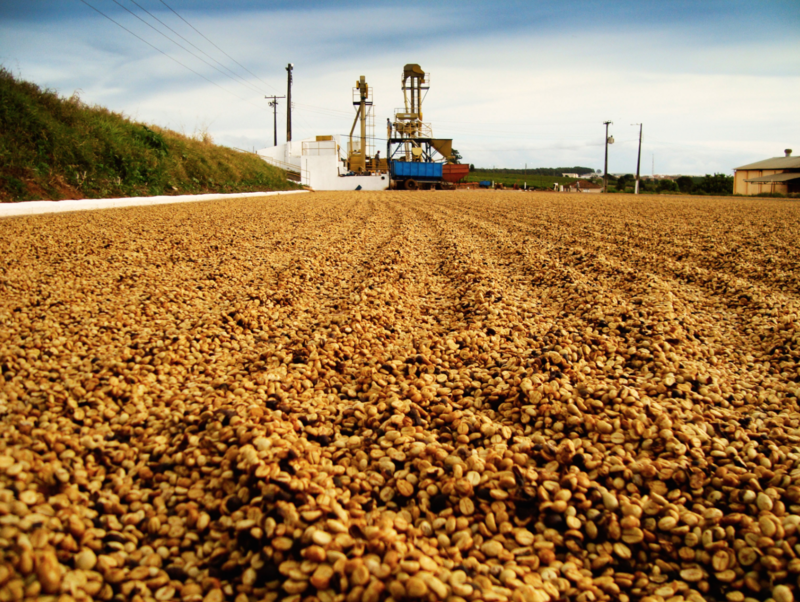
Although Tijuco Preto sits at high altitude, its cultivation terrain is quite gentle and the surrounding scenery beautiful. The estate's grounds include primitive forests, mountain springs, and waterfalls, reflecting great care for environmental and wildlife protection. Of its 346-hectare territory, only 70 hectares are used for coffee. In pursuit of better flavors and to meet demand for specialty Brazilian coffee, the estate grows a very diverse set of varieties: MUNDO NOVO, ACAI, CATUAI, ICATU, and YELLOW BOURBON (the famous Yellow Bourbon). Below are the lovely green bean bags of Fazenda Tijuco Preto and its famous pulped natural beans:
Fazenda Tijuco Preto's harvesting and processing system is quite thoughtful. The model they developed is called PWP - pulped natural process (PWP stands for: picked, washed, pulped). Where many Brazilian estates harvest mechanically, and Central American specialty estates pick cherry by cherry by hand - a practice rare in Brazil - Tijuco Preto's harvest is soaked and cleaned the same day, then immediately peeled and pulped, and laid on drying racks for natural sun drying. This trilogy is what the estate calls the PWP process.

The parchment beans are laid out on the terrace from the next day, turned an average of 20 times per day, until moisture drops to 11%... after which they are sent to storage for 60 days of resting.
When the parchment beans are ready for export, they pass through four dry-milling steps: dehulling, bean selection, grading, and packaging. Examining this batch of green beans, one finds a typical pulped natural Brazilian specialty. The estate's award record is brilliant: representing COCARIVE (Cooperativa dos Cafeicultores de Carmo de Minas), the coffee growers' cooperative of the Carmo de Minas region, it won the silver medal in the natural Arabica coffee category at the French IVPA competition - and 7th place in the 2005 Brazil national competition! 7th Winning farm of 2005 Brazil Cup of Excellence(R) Competition
Brazil Pulped Natural Processing Method (Honey Processing Method)
The pulped natural method is an improvement on natural processing. The key difference: the skin and pulp are removed before sun drying, while the mucilage layer is retained for direct drying. Costa Rica's famous honey process is likewise considered a form of pulped natural.

Processing Steps
1. Remove floating beans (same as natural processing)
Pour the coffee into a large water tank. Underdeveloped inferior beans float to the surface while mature, full fruits sink; skim off the floaters to complete this step.
2. Remove skin and pulp (same as washed processing)
A pulping machine removes the skin and pulp of the fruit, leaving mucilage, parchment, and silver skin.
3. Sun drying
Spread the mucilage-coated beans directly on the drying field until moisture drops to 10-14%.
4. Remove mucilage and parchment
Special machines strip the remaining mucilage and parchment to finish the process.
Advantages
1. As an improvement on natural processing, the pulp is removed at the start, so there are no mold problems.
2. It requires no large quantities of fresh water, keeping costs low.
Disadvantages
Among all methods, its steps are arguably the most complex and labor-intensive.
Flavor
Honey-processed beans show better flavor, with acidity and sweetness in balance. As with natural processing, sun exposure amplifies the bean's own aromas, giving rich, mellow flavors.

Brazil Coffee Growing Varieties
Brazil grows numerous varieties, both Arabica and Robusta. Smoothness, low acidity, slight sweetness, and balance define Brazilian Arabica. Though Brazilian coffee is seldom praised for standout flavors, its beans are the most suitable choice for blends: for an elegant yet affordable blend, Brazil is an excellent supporting player, tempering more strongly flavored coffees. The well-known Mamba blend, among others, relies on Brazilian coffee, and Brazil is also one of the most widely used components in espresso recipes.
Brazil currently focuses on Red Bourbon, Yellow Bourbon, Mundo Novo, and Catuai, with Catuai, Acaia, Obata, Aramosa, Laurina, and others also cultivated and studied. The Campinas Agricultural Research Institute in Sao Paulo is Brazil's famous variety-improvement arsenal, and Catimor - the most widely planted coffee variety in the world - is the joint masterpiece of Portuguese and Brazilian scientists.

Brazil Coffee Classification by Region
Strictly Soft: Southern Minas, Cerrado, Mogiana, Bahia Diamond Plateau.
Soft: Bahia, Minas southeastern mountain forests, Parana, central-west Sao Paulo, Espirito Santo mountainous areas.
Softish: Eastern and northeastern Minas.
Hardish: Low altitude areas of Parana, Espirito Santo.
Rioy: Flat areas of Espirito Santo, lower altitude areas of southeastern Minas.
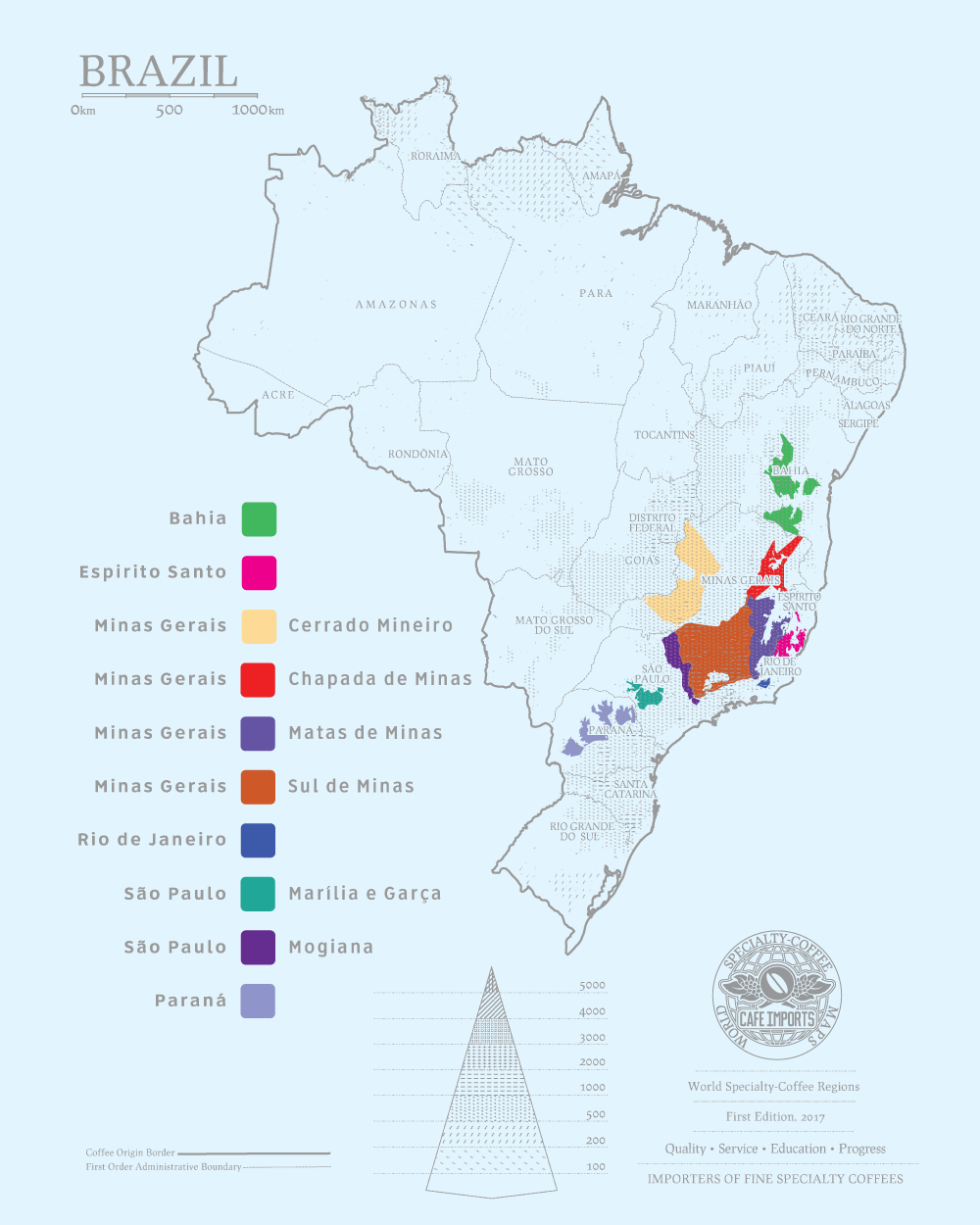
Coffee Producing Regions
Brazil's main producing regions include Minas Gerais, Sao Paulo, Bahia, and Espirito Santo - together accounting for 90% of the country's total exports. The commonly seen Santos and Mogiana come from Sao Paulo. Cerrado and Sul de Minas in Minas Gerais, at higher altitude, produce most of the specialty Brazilian beans. Cerrado lies in western Minas Gerais, a flat plateau at 750-1200m.
Sul de Minas is hilly land at 700m-1200m, Brazil's earliest coffee production area and the first to be commercialized; rising labor costs mean most harvesting is now mechanical, and many large exporters are established here. The Bahia region in northern Brazil mainly produces washed Brazilian coffee, while coastal Espirito Santo is the main export area for Brazilian Robusta.
Sao Paulo State
Mogiana
This area lies very close to southern Minas. Coffee grows among bushes, grasslands, and other vegetation, tended by many farming families - some running traditional large farms, others small-scale modern operations. Modern technology mixed with a mountain coffee-growing culture yields the region's highest quality green beans.

FrontStreet Coffee · Brazil Queen Estate
Region: Mogiana
Estate Name: Queen Estate (Fazenda Rainha)
Owner: Regina Helena Mello de Carvalho Dias, of the Carvalho Dias family
Variety: Yellow Bourbon
Processing: Natural processing
Altitude: 1400-1950m
Roasting Analysis
The green beans have solid texture and excellent flavor performance, with slight orange peel and spice notes; green bean moisture content is 9.9%.
This batch of FrontStreet Coffee Brazil Queen Estate beans has relatively low moisture, giving the beans strong heat absorption. FrontStreet's roasting plan therefore starts at 200 degrees C, using high heat and small airflow to speed dehydration, then switching to medium airflow and medium heat for the Maillard reaction without rushing the time, and dropping the beans near the end of first crack.
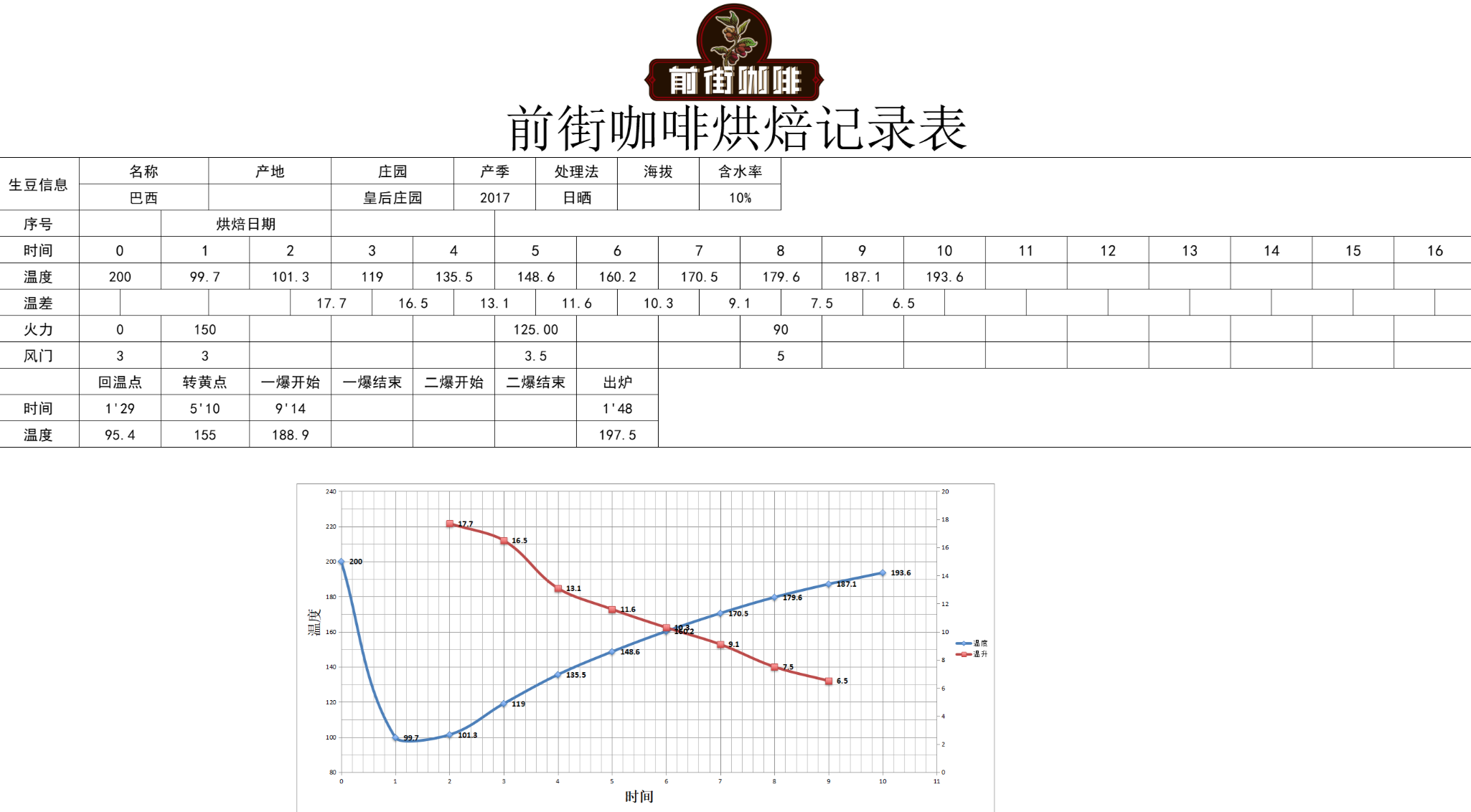
FrontStreet tested roasts four times and finally chose 1 minute 45 seconds to 2 minutes after the end of first crack as optimal. The flavor shows obvious sweetness - but not a boring sweetness - with light lemon aroma in the background, more prominent in the wet aroma stage. The later stage brings clear dark chocolate and an overall rounded feel, reflecting the essential character of Brazilian coffee without losing liveliness.
Brewing Parameters
Dripper: Hario V60
Water Temperature: 86-88 degrees C
Coffee-to-Water Ratio: 1:15
Grind Size: Medium grind
Brewing Method
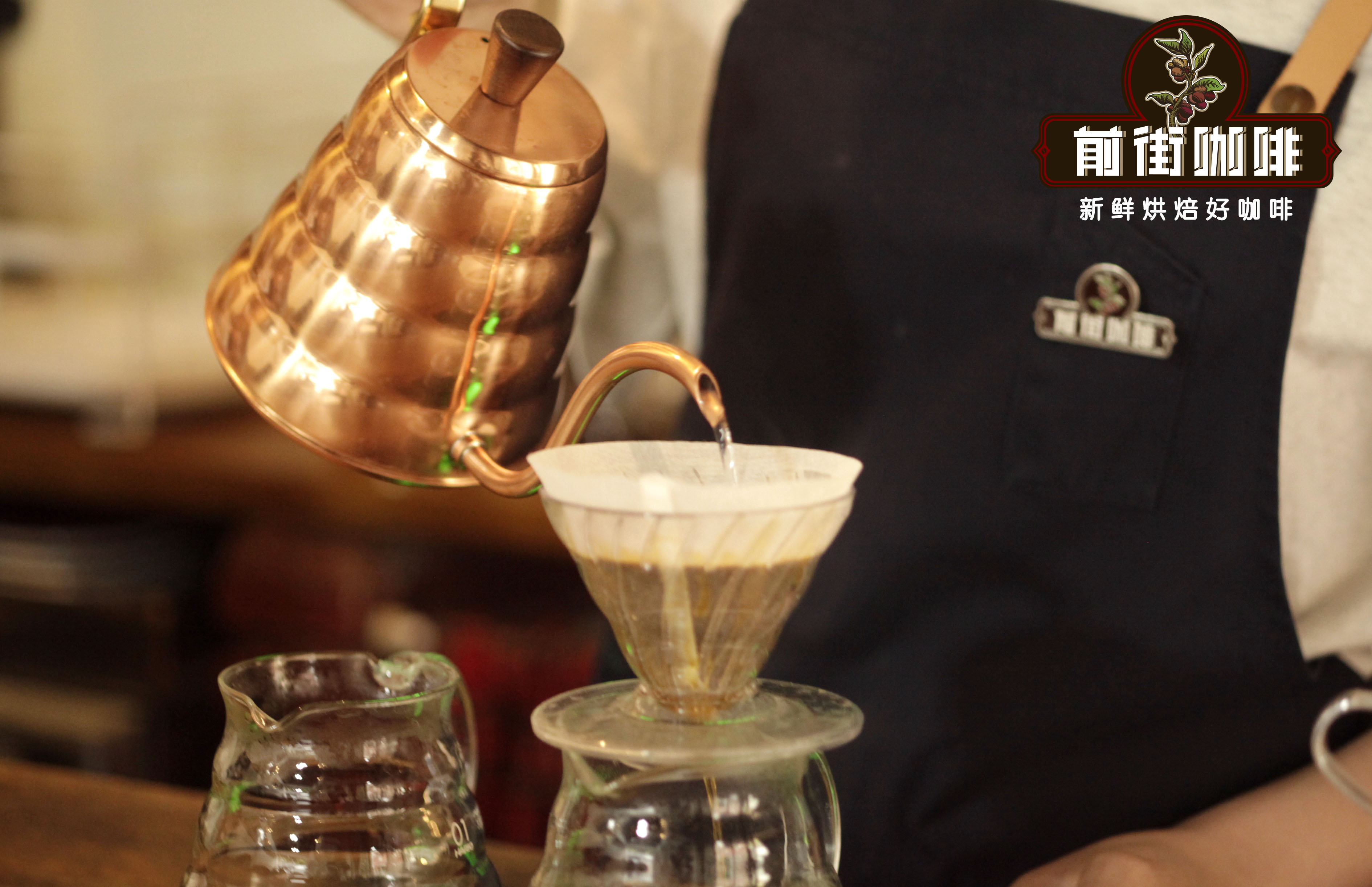
First pour: 30g of water for blooming, about 30 seconds. Second pour: in segments up to 125g. When the water level drops and is about to expose the coffee bed, continue with a third pour up to 225g to finish. Remove the dripper when the level again nears the bed (timing starts from the bloom). Extraction time is 2'00".
Flavor Description
A sweet, clean bean: pulped natural keeps its acidity slightly bright yet balanced with sweetness, some lots even showing tropical fruit aroma - especially the overflowing fragrance during brewing. Expect the fresh sweetness of sugarcane juice, black tea, mellow fruit sweetness, clear nuttiness, balanced and smooth acidity, weak clean bitterness, and rich chocolate and nut notes in a bright, smooth, delicate cup.
Central West / Garea, Marilia and Piraju
Coffee cultivation here generally combines large estates with traditional production lines. Although output seems to be decreasing, there is a growing pursuit of higher quality green beans.

Parana State / Norte Pionerio do Parane
This state was once Brazil's largest production area and retains its own production technology. After noticing that unit yields of coffee forests were declining, Parana producers created a new "closed planting system" - dense plantings of coffee trees per hectare that better resist cold winds while ensuring more regular output.
Bahia State / Bahia
Bahia / Atlantico Baiano: mainly Robusta beans from large farms.
Chapada / Planalto da Bahia: in central Bahia, producing mainly hand-selected Arabica, mostly washed.
Bahia Cerrado / Cerrado da Bahia: in western Bahia, generally considered Brazil's newest coffee growing area, with modern irrigation and harvesting technology in wide use.

Espirito Santo State / Espirito Santo
The state divides into two regions: the north, both large and small estates, grows Robusta; the south produces typical mountain-grown coffee in smaller quantities. Both washed and natural processing are used here.
Minas Gerais / MinasGerais
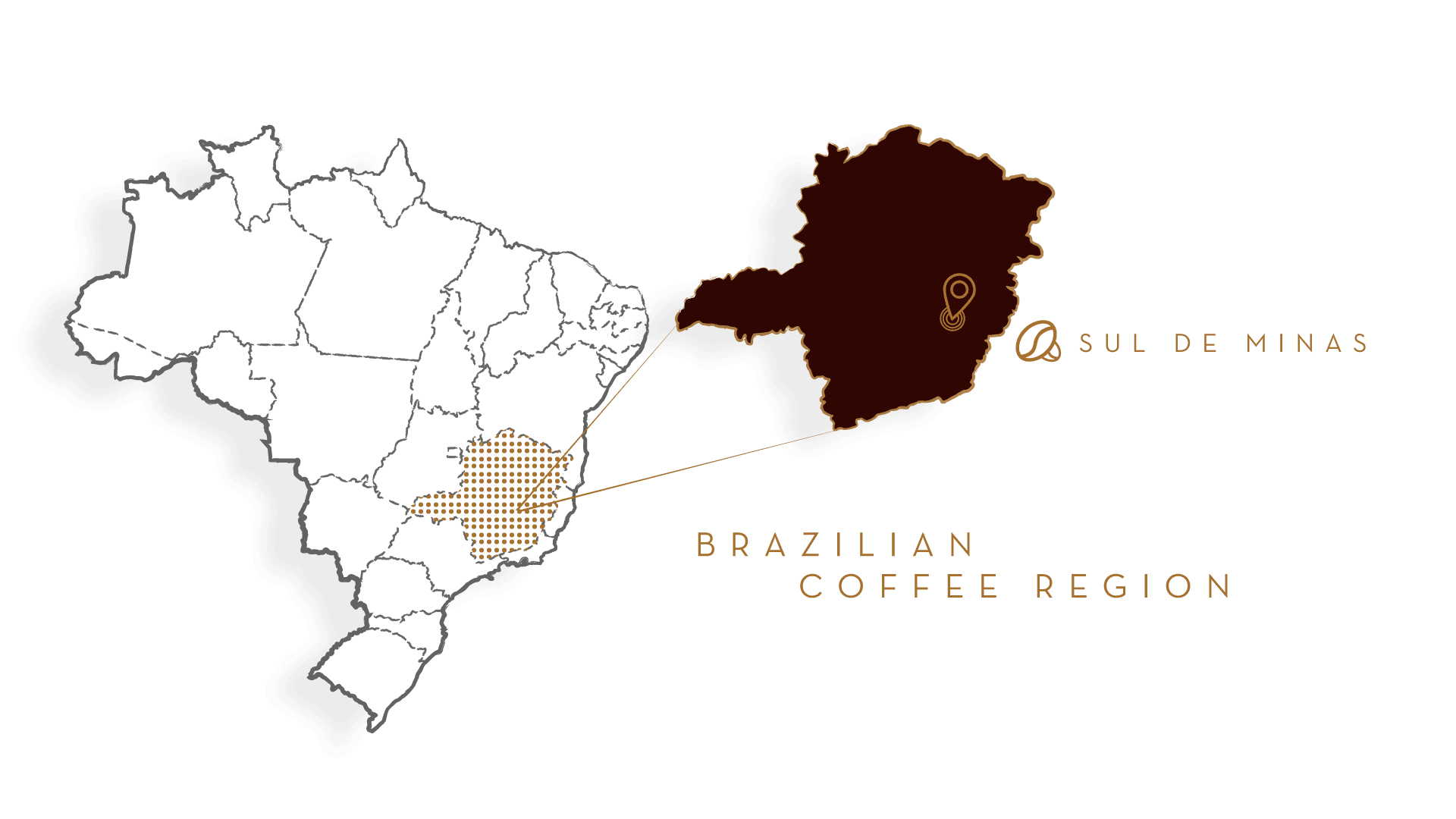
Sul de Minas / Sul deMinas
A small-estate area producing about 8-10 million bags of mountain-grown beans. Suitable altitude, undulating terrain, and a climate conducive to coffee: rainfall concentrates in the months when the fruit needs to grow, and the weather dries out for harvest.
FrontStreet Coffee · Brazil Red Bourbon
Region: Sul de Minas region
Variety: Red Bourbon
Processing: Pulped natural processing
Altitude: 1000m

Brewing Parameters
Dripper: KONO
Water Temperature: 88-90 degrees C
Coffee-to-Water Ratio: 1:15
Grind Size: Medium grind
For darker roasts meant to highlight mellow texture, FrontStreet Coffee chooses the KONO dripper. The KONO's signature is its immersion function, extracting more of the coffee's substances and enriching body. Its few ribs sit only at the bottom, so the filter paper clings closely to the walls and restricts airflow, slowing the water flow and extending water-coffee contact - suitable for FrontStreet Coffee Brazil Queen Estate, FrontStreet Golden Mandheling, and other medium-dark roasted beans.

Brewing Method
First pour: 30g of water for blooming, about 30 seconds. Second pour: in segments up to 125g. When the water level drops and is about to expose the coffee bed, continue with a third pour up to 225g to finish. Remove the dripper when the level again nears the bed (timing starts from the bloom). Extraction time is 2 minutes.
Flavor Description
Overall: nuts, chocolate, cream, peanuts, caramel, fruit acidity, and sucrose flavors.
Cerrado / CerradoMineiro
Growing coffee in Cerrado (also called savannah) is a triumph of Brazilian coffee technology. More and more of its large plantations use high technology in production, a situation few regions can match. The highland climate has four distinct seasons, fruit matures very steadily, and the harvest season sees no rain. Savannah coffee generally uses the natural method - the current processing trend there.
Chapada de Minas /Chapada de Minas
In northern Minas Gerais, a very small area, but its green bean quality is world-class.
Matas de Minas /Matas de Minas
A very large area with highly diverse ecosystems, and Brazil's oldest coffee growing region. Its highest-altitude zones are the best areas for coffee processing.

Rondonia State Rondonia
Located in the western Amazon forest region bordering Bolivia, this area mainly produces Robusta coffee.
Rio de Janeiro State Rio deJaneiro
Mainly grows Arabica varieties and enjoys excellent port transportation advantages compared with other producing regions.
That completes FrontStreet Coffee's tour of Brazilian coffee - its history, regions, processing methods, varieties, grading, and the estates that make it worth brewing.
FrontStreet Coffee Recommendation
If you only want a first taste of Brazil, FrontStreet's pulped natural Cerrado Red Bourbon is the classic pick. Cerrado is celebrated for high-quality beans, and this Red Bourbon lot - medium roasted - pours out creamy peanut, toasted bread, caramel, and hazelnut with a rounded, non-acidic mouthfeel and only a faint bitterness. It works as pour-over and equally well in a moka pot, siphon, French press, or as an espresso SOE.
For something rarer, try FrontStreet's Brazil Queen Estate Yellow Bourbon from Mogiana, where fertile red volcanic soil feeds the cherries. Yellow Bourbon arose as a natural mutation of Red Bourbon and tastes cleaner and fruitier: brew it by hand drip, moka pot, or home espresso machine and you'll find a sugarcane sweetness no other origin quite matches, alongside fruit and chocolate notes. Roasted medium it also makes an especially rich, sweet americano or latte, with a lingering sweetness that lingers after the cup cools.
Brazil's low acidity and balance also make it the backbone of great espresso blends. FrontStreet's Classic Blend, nutty Signature Blend, balanced Black Cocoa Blend, and shop-oriented Commercial Blend all contain Brazilian beans, which lend chocolate and cream aromatics, a gentle sweet-sour-bitter structure, and a stability that makes extraction forgiving - exactly why Brazil remains the most indispensable bean in blending.
Important Notice :
FrontStreet Coffee is a long-established specialty coffee roaster in Guangzhou China, selling freshly roasted beans from its own farm in Yunnan as well as dozens of carefully selected single-origin beans from around the world for both pour-over and espresso. The products deliver consistently excellent quality and great value, with shipping within 24 hours. Guangzhou's FrontStreet Coffee shop is recommended by many coffee lovers, and the beans are now available online at the Tmall 。
FrontStreet Coffee has moved to a new address:
FrontStreet Coffee Address: 315,Donghua East Road,GuangZhou
Tel:020 38364473
 Scan and follow the En Gafei WeChat official account. Please indicate that the reprint comes from "En Gafei".