Is Starbucks Hawaii KAU Coffee Delicious? What Does Starbucks Hawaii KAU Coffee Taste Like
For professional coffee knowledge exchange and more coffee bean information, please follow Coffee Workshop (WeChat official account: cafe_style).
The History of Coffee in Hawaii
Coffee was first introduced to Hawaii in 1817, during the reign of King Kamehameha, by Don Francisco de Paula Marin, the first Spanish advisor. The initial cultivation was unsuccessful. It was not until 1825, when Oahu Governor Chief Boki imported coffee from Brazil and successfully cultivated it in Manoa Valley, that coffee growing began to spread throughout the islands.
Around 1828, Bourbon variety coffee was introduced to the Big Island. By 1836, large-scale cultivation had begun on Kauai. Pests and diseases in 1858 wiped out the entire crop, however, leaving only the Kona region on the Big Island.
Hawaii is a beautiful island with abundant agricultural products, cultivating various fruits, cocoa, hazelnuts and coffee. Among these, coffee commands the highest price and yields the greatest return for farmers. Hawaii began growing coffee as early as the 18th century, mostly on Kauai and the Big Island. The ideal island climate, fertile volcanic ash soil and meticulous processing give Hawaiian beans that are uniformly whole with minimal defects and chipped beans. Limited cultivation area and expensive American wages keep Hawaiian coffee prices high, yet the perfectly clean, uniquely tropical-fruited Hawaiian beans are irreplaceable by other coffees.
Comparison with Jamaican Blue Mountain Coffee
Compared with Jamaican Blue Mountain, Hawaiian coffee shares a mild, suitable acidity and a delicate fruitiness with a tender sweetness. Hawaiian beans' strict quality control and advanced low-temperature storage equipment, however, keep their quality consistently high with little negative feedback, unlike Blue Mountain, which occasionally draws poor evaluations.
The KAU Coffee Region
The southernmost part of Hawaii's Big Island is the KAU coffee region, considered a newly emerging Hawaiian growing area that began in the 1990s. These lands were previously sugarcane plantations, but market factors drove sugarcane profits down. As many plantations were abandoned, farmers were displaced and left without a livelihood - until coffee cultivation brought hope. Despite ideal growing conditions, they initially worked hard to escape the shadow of the established Kona beans.
In 2007, coffee from Hawaiian KAU made a splash as a dark horse, taking excellent sixth and ninth place results in the SCAA coffee competition run by the American Specialty Coffee Association. Then in 2011 it again won the World's Best Coffee of the Year award.
The region had previously received little attention. Through local coffee cultivation supporter Chris Manfredi, agronomy experts and consultants were brought in to help local small farmers succeed. After several consecutive years of awards at American Specialty Coffee Association competitions, Hawaiian KAU beans are now regarded as among the world's finest coffees.
Brewing Recommendations
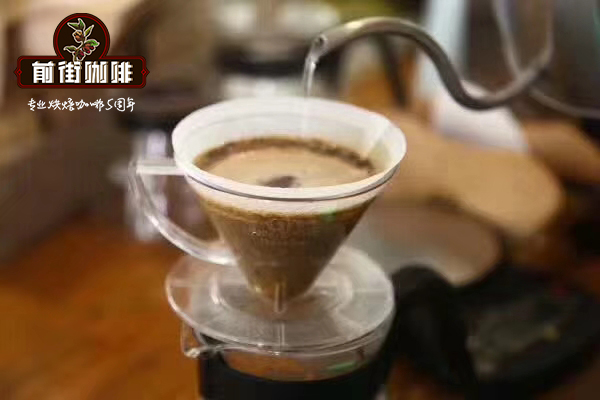
FrontStreet Coffee suggests brewing with 89-91°C water for approximately one minute and fifty seconds. It features cream, milk chocolate and almond sweetness.
Related recommendations: Introduction to Hawaiian Kona coffee, How to brew Hawaiian Kona coffee.
FrontStreet Coffee Recommendation
Since Hawaiian coffee is so often compared with Blue Mountain, it is worth tasting the benchmark itself. The FrontStreet Coffee Jamaica Blue Mountain No. 1 comes from the historic Clifton Estate, where coffee has been grown since around 1750, at an average elevation of 4,300 feet (1,310.64 meters). Roasted medium-deep, it shows hazelnut, dark chocolate and creamy caramel over a soft sweetness, with the sour, sweet, bitter and aromatic notes in perfect balance.
FrontStreet Coffee recommends a Kono dripper for this bean: 15 g of coffee, a 1:15 coffee-to-water ratio and 87-88°C water, poured in three stages - 30 g for a 30-second bloom, then to 120 g, then to 225 g. Every lot is roasted within five days of shipping, so the beans arrive at full flavor and are ready to brew immediately.
Important Notice :
FrontStreet Coffee is a long-established specialty coffee roaster in Guangzhou China, selling freshly roasted beans from its own farm in Yunnan as well as dozens of carefully selected single-origin beans from around the world for both pour-over and espresso. The products deliver consistently excellent quality and great value, with shipping within 24 hours. Guangzhou's FrontStreet Coffee shop is recommended by many coffee lovers, and the beans are now available online at the Tmall 。
FrontStreet Coffee has moved to a new address:
FrontStreet Coffee Address: 315,Donghua East Road,GuangZhou
Tel:020 38364473
 Scan and follow the En Gafei WeChat official account. Please indicate that the reprint comes from "En Gafei".