How to Taste Colombia Tolima Triumph Estate Pour-Over Coffee_Flavor Characteristics of Tolima Coffee
For professional coffee knowledge exchange and more coffee bean information, follow Cafe Style (WeChat public account: cafe_style).
Colombian Coffee Overview
Among the many coffee-producing countries, Colombia ranks as the third-largest producer in the world (after Brazil and Vietnam), and its coffee is sold widely. The most important factor is the active volcanism that created some of the world's most fertile soil, growing sweet, rich, and very appealing beans that are easy to brew well. With Colombian coffee you can enjoy a mellow atmosphere at home without going to a cafe. Whether as a simple black coffee or as the base for various coffee recipes, Colombian beans are an excellent choice. Most well-known international coffee chains source their coffee primarily from Colombia.
Evolution of Colombian Coffee Quality
In recent years, coffee competitions have raised farmers' incomes and helped Colombian coffee shed its old image as merely a base coffee. It used to be seen as a commercial bulk bean or a base for blends, rarely standing alone as specialty coffee. Quality was judged solely by bean size, but in reality that grading only reflects bean size and has no relation to quality - it is an outdated system. Excellent Colombian coffee instead comes from high-altitude primary rainforests, where coffee grows naturally without fertilizers or pesticides, on farms or in cooperatives. These farms usually have very low yields, producing hard, dense beans that are smaller and bluish-green in color.
Triumph Estate Coffee Experience
This Triumph Estate coffee may be new to many of you. I first tasted this Colombian coffee four years ago. At the time it was medium-dark roasted, with a heavier profile, but it left a deep impression on me. This version uses a medium roast, appropriately preserving Colombian coffee's fruit acidity while increasing the coffee's smoothness and fullness. And unlike traditional Colombian coffee, it isn't bitter. I believe this coffee will win you over.
How to Brew Colombian Triumph Estate Coffee
FrontStreet Coffee Pour-Over Reference:
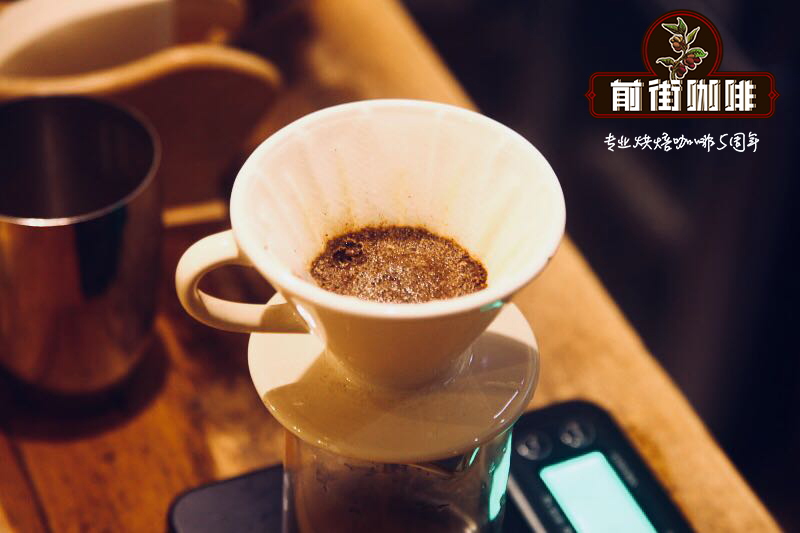
Weigh 15 g of Triumph Estate coffee and grind to medium, with the particles slightly coarser than table salt. We use a BG grinder setting 5R (60% standard sieve pass rate), water at 89 degrees C, and a V60 dripper. The recommended coffee-to-water ratio is approximately 1:15.
Pour hot water from the kettle in clockwise circles centered on the middle of the filter. Start timing when brewing begins. Within 15 seconds, brew to 30 g, then stop pouring. When the time reaches 1 minute, begin the second pour. For the second pour, as before, pour in clockwise circles centered on the filter's middle. The water stream should not hit the area where the coffee grounds meet the filter paper, to avoid the channeling effect.
When pouring around the outermost circle of the coffee bed, leave one circle empty, then work back circle by circle toward the middle. At 2 minutes and 20 seconds, the coffee should reach 220 g, completing the brew.
Japanese-Style Iced Pour-Over [Triumph Estate]
FrontStreet Coffee iced pour-over [Triumph Estate] reference:
Colombian coffee [Triumph Estate], light-medium roast, BG grinder setting 5M (67% standard sieve pass rate).
20 g of coffee, 150 g of ice, 150 g of hot water. The water temperature should be 1 degree C higher than the normal 90 degrees C recommended for pour-over. Normal grinding uses a Fuji 3.5 setting, while iced pour-over uses a slightly finer Fuji 3. The recommended coffee-to-(water + ice) ratio is 1:15.
Bloom water amount 40 g, bloom time 30 seconds.
Segmented pouring: first segment 60 g of water, second segment 40 g of water. Use a relatively fine but tall pouring column, forcefully stirring and impacting to fully tumble the coffee. Be careful not to let the liquid level get too high or hit the edge filter paper.
The entire extraction time is approximately 2.5 minutes (similar to the normal extraction time for 20 g of coffee).
FrontStreet Coffee Recommendation
Colombia is known for balance, and if that balanced, sweet-and-clean profile is what you like, Brazilian coffee is a natural companion to explore. The FrontStreet Brazil Cerrado Red Bourbon is a classic Brazilian single origin: roasted medium, it delivers rich cream, peanut, toast, caramel, and hazelnut aromas with a rounded, low-acid cup and only a slight bitterness, and it handles pour-over, moka pot, espresso SOE, siphon, and French press equally well.
For a fruitier, more distinctive Brazilian cup, the FrontStreet Brazil Queen Estate from Mogiana offers a rare Yellow Bourbon whose fruit character is cleaner than Red Bourbon. Brewed by pour-over, moka pot, or home machine, it shows the sugarcane sweetness no other region can replicate, along with fruit and chocolate notes.
And if you brew espresso, the FrontStreet espresso series leans heavily on Brazil. Its low acidity, balanced body, and friendly price make Brazilian beans the first choice for many specialty recipes - adding chocolate and cream aromas and a soft, balanced sweet-sour-bitter profile that also helps keep extraction stable.
Important Notice :
FrontStreet Coffee is a long-established specialty coffee roaster in Guangzhou China, selling freshly roasted beans from its own farm in Yunnan as well as dozens of carefully selected single-origin beans from around the world for both pour-over and espresso. The products deliver consistently excellent quality and great value, with shipping within 24 hours. Guangzhou's FrontStreet Coffee shop is recommended by many coffee lovers, and the beans are now available online at the Tmall 。
FrontStreet Coffee has moved to a new address:
FrontStreet Coffee Address: 315,Donghua East Road,GuangZhou
Tel:020 38364473
 Scan and follow the En Gafei WeChat official account. Please indicate that the reprint comes from "En Gafei".