Panama Esmeralda Diamond Mountain Washed Coffee Beans Characteristics Story - Esmeralda Estate Coffee Brand
The Gesha coffee beans from Panama's Hacienda La Esmeralda are the most renowned of all. The estate discovered Gesha precisely because this variety's flavor profile differed so dramatically from the local coffees across Panama's growing regions. So what are the native flavors of Panamanian coffee? Hacienda La Esmeralda also grows Caturra and Catuai, and from these varieties it has built two brands: Diamond Mountain and Palmira. In this article, FrontStreet Coffee takes a closer look at the characteristics of the Diamond Mountain beans.
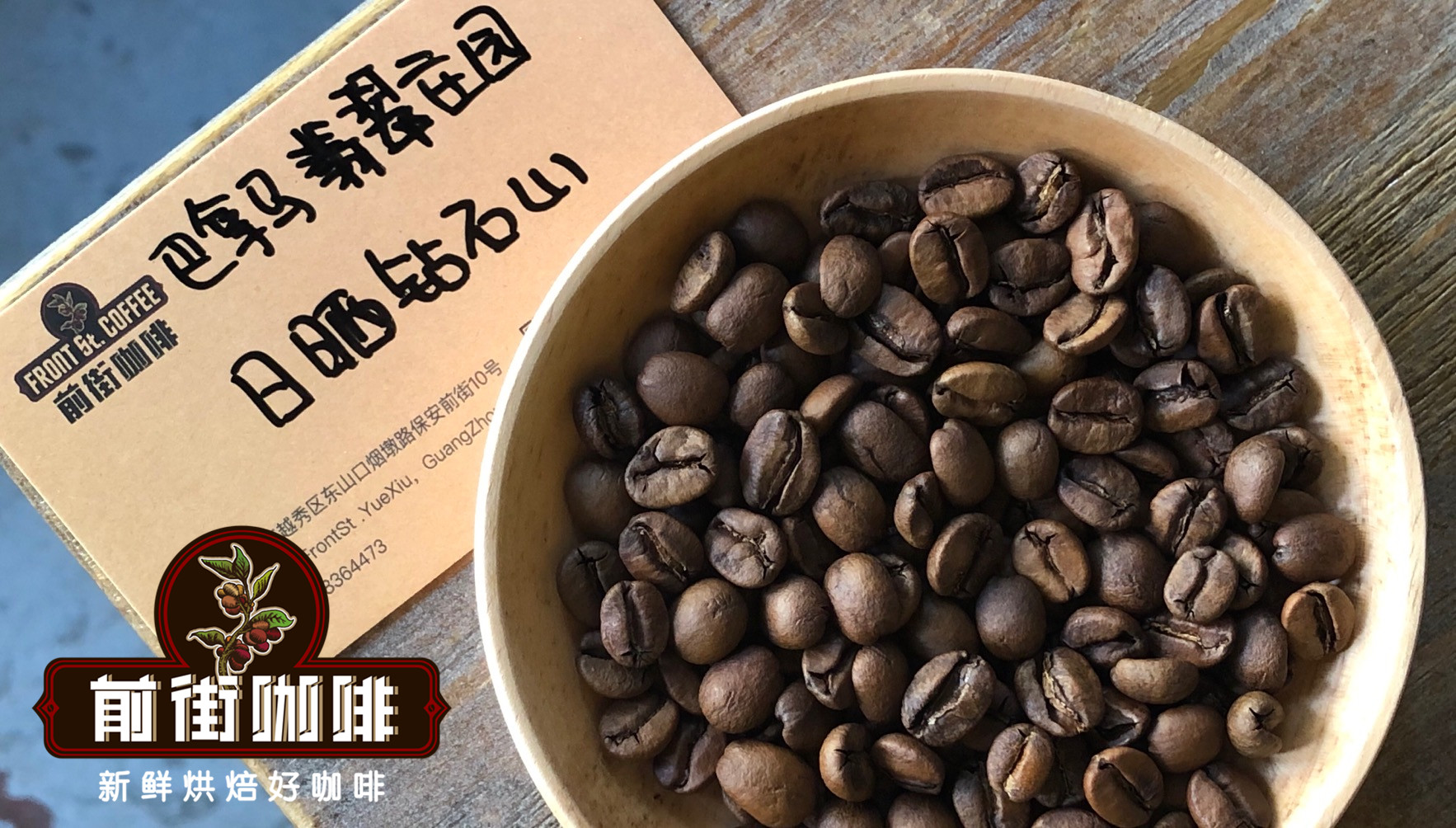
FrontStreet Coffee: Panama · Hacienda La Esmeralda Natural Diamond Mountain Coffee Beans
Region: Boquete
Estate: Hacienda La Esmeralda
Altitude: 1,400–1,700m
Variety: Catuai, Caturra
Processing: Natural process
Flavor: Citrus, bright acidity, nuts, honey, fermentation notes, cocoa
Hacienda La Esmeralda
The estate's coffee story began in 1964, when the American banker Rudolph Peterson retired, moved to Panama, and bought Hacienda La Esmeralda in Boquete — initially as a dairy operation. Later, his son Price left his medical practice to help run the farm and introduced Caturra and Catuai varieties in 1987. In 1994 the family built its own washing station, giving them full control over processing.

The discovery of Gesha was pure accident. Gesha trees yield poorly and offered little economic return, so the previous owner had used them as windbreaks, sheltering the high-yield Caturra and Catuai fields from strong winds.
Against that backdrop, harvesters picked Gesha cherries right along with everything else. During cupping, the estate owners realized this lot was exceptional — rich in citrus and floral notes. They traced it back to the Gesha trees and began taking them seriously. In 2004, Hacienda La Esmeralda entered Gesha as a separate category in competitions, and its triumph at the Best of Panama (BOP) cemented the estate's standing in the specialty coffee world.

As noted above, Hacienda La Esmeralda's product lines are divided into five major categories based on cupping performance, planted varieties, and growing plots: three Gesha lines — Esmeralda Special, Private Collection, and Gesha 1500 — and two Caturra/Catuai lines — Diamond Mountain and Palmira.
Characteristics of the Caturra and Catuai Varieties
Caturra and Catuai are now widely planted across Latin America because they resist pests and disease better than Typica, and they are extensively grown in Panama as well. Caturra is a Bourbon mutation discovered in Brazil in 1937; both its yield and disease resistance surpass Bourbon, and its shorter plants make harvesting easier. The varieties are highly adaptable, don't require shade trees, and grow anywhere from 700 meters to 1,700 meters. Higher altitudes bring better flavors, though with relatively lower yields.

Catuai was developed in 1949 as a controlled hybrid of Yellow Caturra (an Arabica subspecies) and Mundo Novo (a Robusta subspecies), initially designated "H-2077." Catuai has good disaster resistance, particularly against wind and rain. Because the plants are compact, they can be planted at double density, and their short stature makes pest and disease treatment easier. Catuai grows vigorously and stays low, but it is susceptible to leaf rust.
Panama's Coffee-Growing Regions
Panama has four main coffee regions: Boquete, Volcán, Santa Clara, and Renacimiento. Hacienda La Esmeralda sits in Boquete, the country's most famous.
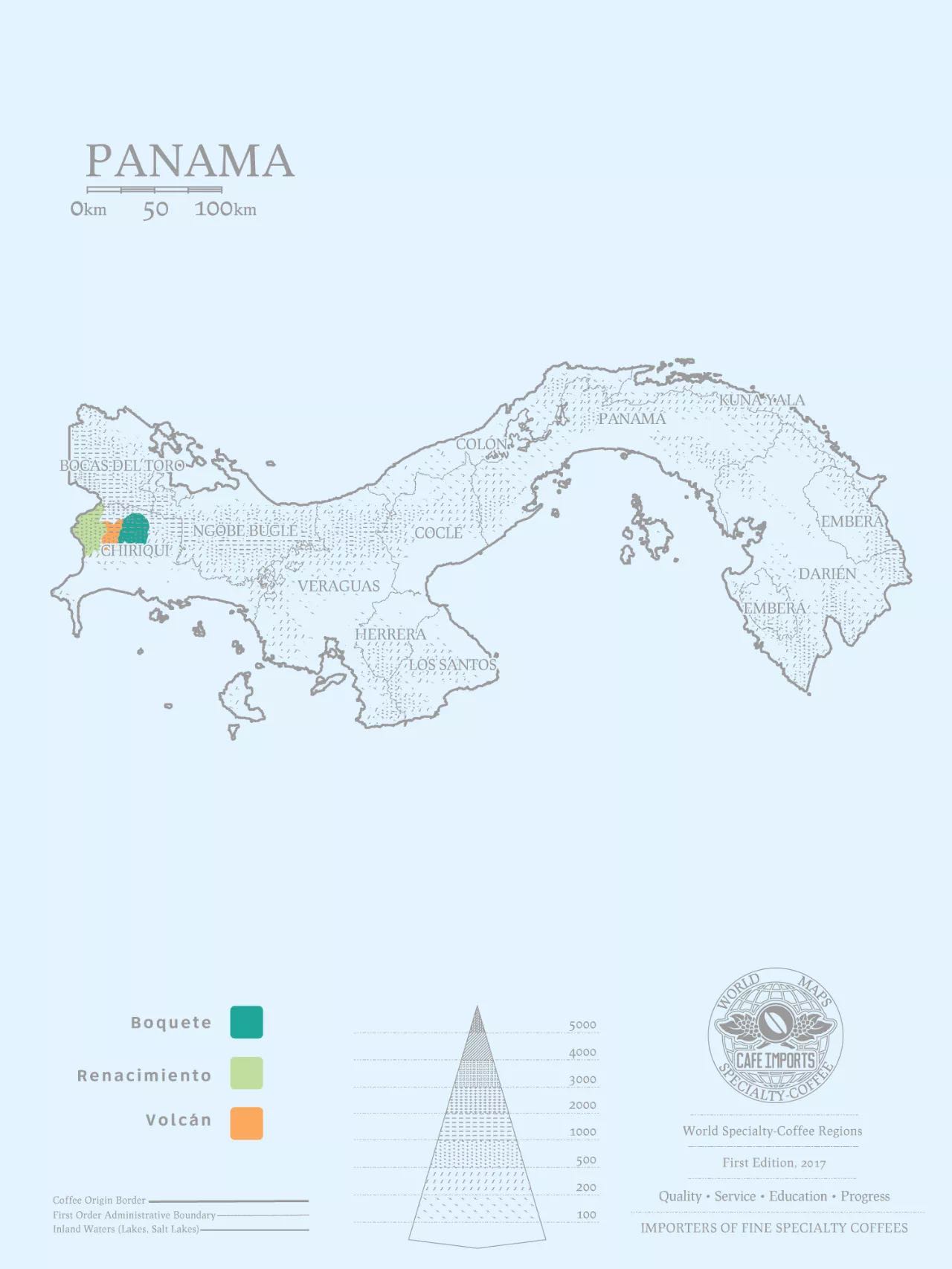
The Boquete Region
Boquete's growing altitudes range from 1,400 to 1,900 meters. It is a small town in Panama's Chiriquí province, near the Panama–Costa Rica border and close to the famous Barú Volcano. The scenery is beautiful, the soil rich and fertile, and the climate and terroir are ideal for producing high-quality coffee. Boquete is home to many excellent estates — besides Hacienda La Esmeralda, farms such as Elida Estate and Kotowa Duncan Estate also produce outstanding specialty coffee.
This is thanks not only to Boquete's mild climate and the fertile volcanic ash soil around Barú, but also to the diverse microclimates of the Boquete highlands. Panama's east–west geography channels cold air currents through the central mountain range at altitudes between 1,200 and 2,000 meters. Mountain fog, rain, and variable winds create multiple microclimates, making temperature and rainfall ideal for plant growth — coffee trees here thrive.
The Estate's Growing Plots
Hacienda La Esmeralda is a large estate, and because it grades its coffees by plot altitude and other factors, it divides its land with extreme care into three main areas — Jaramillo, Cañas Verdes, and El Velo — each further subdivided into smaller plots.
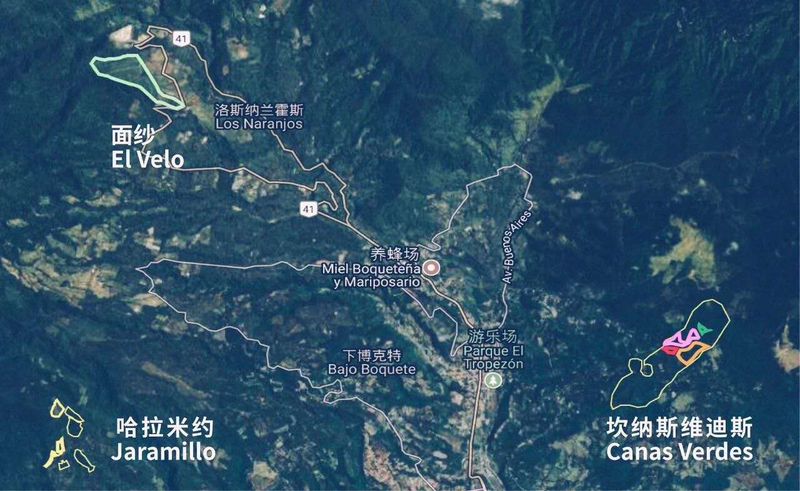
Jaramillo: Annual rainfall of 4,000mm, average daytime temperature of 19–25°C, average nighttime temperature of 11–15°C, average altitude of 1,600–1,700m. Jaramillo is subdivided into 5 small plots: Mario, Noria, Reina, Bosque, and Buenos Aires.
Cañas Verdes: Annual rainfall of 3,500mm, average daytime temperature of 16–23°C, average nighttime temperature of 10–15°C, average altitude of 1,600–1,800m. Cañas Verdes includes 9 small plots: Lino, Coronado, Fundador, León, Montaña, Trapiche, Chinta, Cabaña, and Tumaco.
El Velo: The estate's newest acquisition, with an average altitude of 1,700–1,900m. Besides Gesha and Catuai, it grows small quantities of exotic varieties such as Laurina, Pacamara, Mocha, and SL28. El Velo is divided into 7 small plots: Guabo, Portón, Durazno, Higo, Buena Vista, and Águila.

The Diamond Mountain Series
The Caturra and Catuai of the Diamond Mountain series are grown in the Cañas Verdes and Jaramillo areas, with overall cultivation distributed between 1,400 and 1,700 meters. The Diamond Mountain brand also carries Rainforest Alliance certification — no easy credential. For comparison, the Jamaica Blue Mountain coffee at FrontStreet Coffee comes from Clifton Mount Estate, Jamaica's only Rainforest Alliance-certified farm.

Diamond Mountain Processing
The Diamond Mountain beans FrontStreet Coffee acquired are naturally processed, which is why this coffee shows strong aroma and fermentation notes in the cup. In natural processing, harvested cherries go straight to the drying patios. As the cherries slowly dry, the beans inside absorb fruity, aromatic flavors. Depending on weather and patio conditions, the cherries dry on concrete patios for 3 to 5 days, 8 hours daily.

Once the cherries reach a certain level of dryness, they finish in a Guardiola dryer for 72 hours to complete drying and prevent fermentation. After drying, the cherries are mechanically hulled to remove the pulp and other layers. FrontStreet Coffee finds that natural processing boosts sweetness and lends mature red-berry flavors to the beans.
That's the rundown on Diamond Mountain. Before introducing any new bean, FrontStreet Coffee runs extensive roasting and brewing parameter tests, so here are the parameters we find best suit this Panamanian coffee.
FrontStreet Coffee Green Bean Analysis
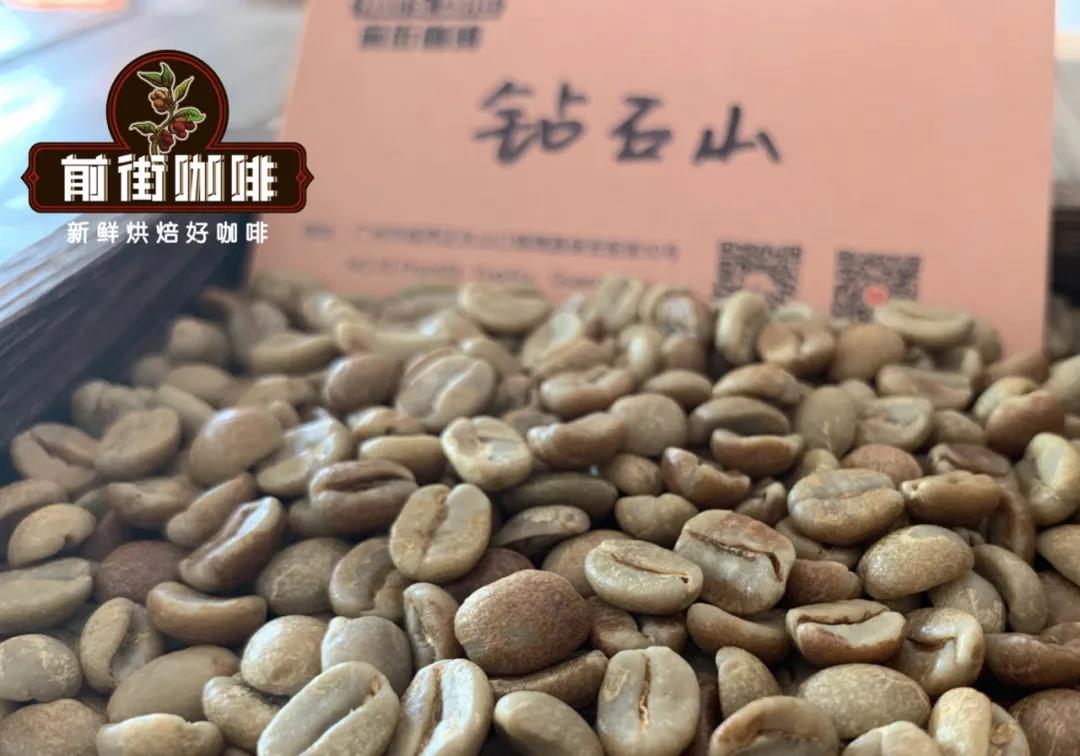
Looking at the Diamond Mountain natural green beans, FrontStreet Coffee notes they are yellowish in color, and natural-processed greens carry more silver skin on the surface. Caturra green beans have a curved tail end and a round, slender body, while Catuai beans are flat-sided with a relatively thin, long tail.
FrontStreet Coffee Roasting Record
Our roaster used a Yangjia 800N semi-direct-flame roaster with a 480g batch. The drum was preheated to 165°C before charging, heat set to 130, damper at 3. The probe returned to 150°C at 1'36", and heat was held. At 112°C, heat stayed unchanged with the damper opened to 4; at 127°C, heat rose to 140. At 6'15" the beans yellowed, the grassy aroma faded, and the drying phase gave way. At 151°C, heat dropped to 110, damper held at 4.
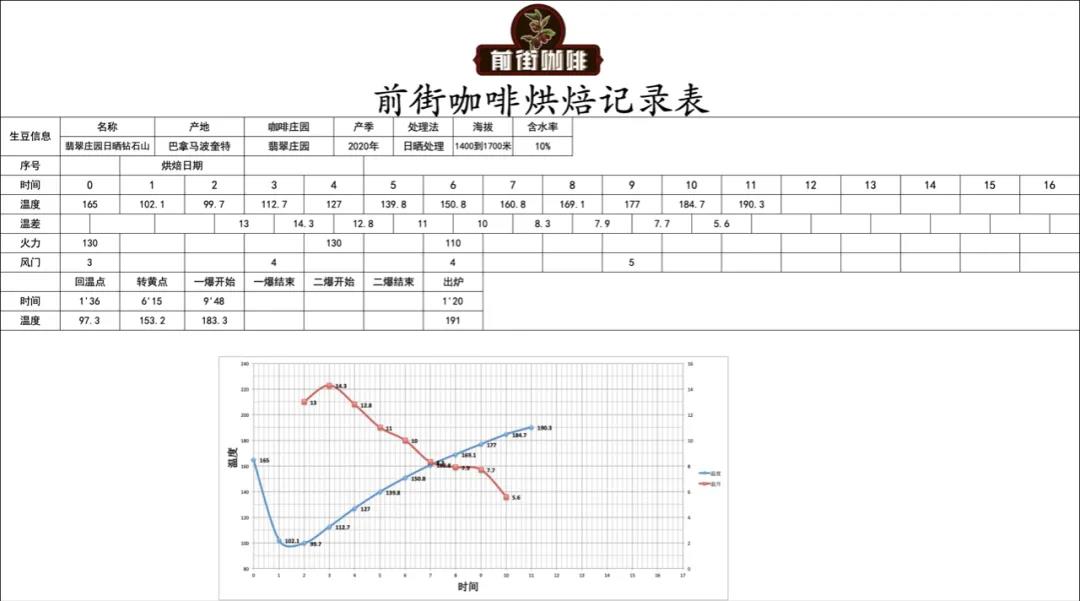
At 9'00" drying was complete: wrinkles and black spots appeared on the bean surface and the toast aroma turned to coffee aroma — the prelude to first crack. Listen carefully for it from here. At 10'48" first crack began and the damper opened fully to 5. Development after first crack ran 1'20", with the beans discharged at 191°C.
FrontStreet Coffee Cupping Report
FrontStreet Coffee cups samples within 8–24 hours after roasting, typically using 200ml ceramic cups. Cupping water temperature is 94°C, with the grind set to a 70–75% pass-through rate on a #20 standard sieve (0.85mm). The ratio is 11.1g of coffee to 200ml of hot water — 1:18.18 — which extracts a concentration within the 1.15%–1.35% Golden Cup range. Steeping time is 4 minutes.

Dry Aroma: Citrus, berries
Wet Aroma: Citrus
Flavor: Citrus, honey, cocoa, fermented wine-like notes
FrontStreet Coffee Brewing Experience

Dripper: V60 #01
Water Temperature: 90–91°C
Dose: 15g
Ratio: 1:15
Grind Size: Medium-fine (80% pass-through on the China standard #20 sieve)
FrontStreet Brewing Method: Three-stage pour
Bloom with 30g of water for 30 seconds. With a small water flow, pour in a spiral to 125g, then pause. When the water level drops and is about to expose the coffee bed, continue pouring to 225g and stop. Wait for the level to drop again until the bed is about to be exposed, then remove the dripper. (Timing starts at the bloom.) Total extraction time is 2'00".

Brewing Flavor: Citrus, bright acidity, nuts, honey, a slight fermentation note, smooth mouthfeel, and a cocoa aftertaste.
FrontStreet Coffee Recommendation
Diamond Mountain shows what Caturra and Catuai can do when they come from a world-class farm — but if you want to taste the variety that made this estate legendary, go straight to the Gesha lines. Esmeralda's Red Label, officially "Esmeralda Special," grows at 1,600–1,800 meters; every batch must cup above 90 points and comes from a single small plot with its own lot number — FrontStreet's Red Label lot, for example, comes from the Jaramillo area — letting buyers pick the micro-lot that matches their flavor preferences. The Green Label, originally "Private Collection," blends lots across multiple plots to express the estate's signature high-altitude Gesha profile, with a more accessible price and excellent value for the quality.
For newcomers curious about the famous "Gesha flavor," FrontStreet Coffee usually recommends the entry-level Panama Boquete Gesha first: at a friendly price it delivers the classic Panamanian profile of orange-blossom sweetness and honeyed aroma, with an oolong-tea texture, delicate fruity acidity, and clearly delineated layers. Brewed as pour-over, the intoxicating florals truly come alive. For brewing Gesha in general, remember it is a medium-light, floral-fruity coffee with a hard bean structure that tends to sink and clog the dripper — use a coarse grind (about 78% pass-through on a China standard #20 sieve, roughly fine sugar grain), 91°C water, 15g of coffee with a small Hario V60 at 1:16, in three stages: 30g bloom for 30 seconds, spiral to 125g, top up to 225g once the bed drains to half, finishing in about 2:10–2:20.
Want to compare Panama against the birthplace? Ethiopia's Geisha Village estate, founded 12 miles from the original Geisha forest on 475 hectares, grows Gori Gesha, Geisha 1931, and Illubabor Forest, graded into Gold Label RARITIES, Red Label GROWERS RESERVE, Green Label SINGLE-TERROIR, and Chaka lots. The Gold Label (Geisha 1931, 10% of production) is the estate's top non-auction coffee, often chosen by competition baristas; the Red Label (Gori Gesha, 15% of production, 88+ on the SCA 100-point scale) is a fully traceable single-terroir series. Compared with Panama, Ethiopian Gesha shows brighter fruit acidity — FrontStreet's Genlana Gesha from Yirgacheffe, roasted medium-light, offers pleasant white florals alongside the sweet-tart character of orange, guava, and citrus, with a clearer finish.
Important Notice :
FrontStreet Coffee is a long-established specialty coffee roaster in Guangzhou China, selling freshly roasted beans from its own farm in Yunnan as well as dozens of carefully selected single-origin beans from around the world for both pour-over and espresso. The products deliver consistently excellent quality and great value, with shipping within 24 hours. Guangzhou's FrontStreet Coffee shop is recommended by many coffee lovers, and the beans are now available online at the Tmall 。
FrontStreet Coffee has moved to a new address:
FrontStreet Coffee Address: 315,Donghua East Road,GuangZhou
Tel:020 38364473
 Scan and follow the En Gafei WeChat official account. Please indicate that the reprint comes from "En Gafei".