What Makes Yunnan Coffee Beans Special? Where Does Yunnan Coffee Rank?

A decade ago, Yunnan coffee was still stuck with an impression of "poor quality and low price," and many coffee professionals would wince at the mention. Today, however, Yunnan beans appear increasingly often in specialty coffee shops, some of them offering distinctly different flavor profiles. FrontStreet Coffee, for instance, lists two single-origin coffees from Yunnan: the washed Yunnan Baoshan Peaberry and the natural Typica.
The Development of Yunnan Coffee
Yunnan coffee cultivation began in 1904, when the French missionary Alfred Tietje introduced the first coffee tree to Zhukula Village in Binchuan, Yunnan. Yunnan's connection with coffee has thus spanned more than a century.

Commercial cultivation truly began in the 1950s, when the renowned botanist Professor Qin Renchang of the Institute of Botany, Chinese Academy of Sciences, identified red fruits found in the courtyards of Dai farmers in Luxi County, Dehong Prefecture, as Coffea arabica. On his recommendation, coffee seedlings were trial-planted at Mangshi Forest Farm and Lujiangba in Baoshan. The latter officially began production in 1955, opening a new era of coffee research and production.
Yunnan coffee truly entered the international market starting in 1988, when Nestle established a branch in China. Not only did the company introduce the high-yield, disease-resistant Catimor variety, it also promised to buy Yunnan beans as raw material at the current US futures price. Brands like Starbucks and Maxwell House then set up factories in Yunnan to buy green beans, further expanding cultivation. FrontStreet Coffee learned from relevant materials that, because farmers lacked knowledge of cultivation and used crude production methods, Yunnan green beans long served as raw material for instant coffee and were constrained by international coffee futures prices. To break free of those constraints, industrial transformation and upgrading were essential, and specialized fine coffee production became Yunnan coffee's new journey.

The Current Status of Yunnan Coffee
In recent years, with the rise of China's coffee wave and society's emphasis on the rural economy and sustainable development, coffee professionals from around the world have visited Yunnan. Everyone keeps improving local coffee quality through pest and disease control, shade trees, soil and water conservation, planting altitude, and careful picking and processing. Yunnan coffee has gradually gained attention and recognition. Domestic and international brands such as Starbucks, Blue Bottle Coffee, Luckin Coffee, and Manner have launched Yunnan products, expanding awareness of the region's flavor and quality.

Compared with the past, people are now willing to actively learn about Yunnan as a "new producing region." Many customers who visit FrontStreet Coffee stores for pour-over ask whether there are Yunnan beans on offer, showing that the efforts of the Yunnan coffee industry are paying off.
Where Does Yunnan's Specialty Coffee Come From?
Yunnan coffee is currently grown across eight regions, with six main production areas: Pu'er, Baoshan, Dehong, Lincang, Nujiang, and Xishuangbanna.

These places share the natural conditions of low latitude, high altitude, and large day-night temperature differences, making Yunnan a golden area for high-quality Arabica. Coffee is generally planted on higher-altitude hillsides. The rolling hills, fertile soil, abundant sunlight, and concentrated rainy-season rainfall let the trees quickly integrate with the local terroir. Yunnan coffee has successively obtained five geographical indication protections: "Baoshan Peaberry Coffee," "Zhukula Coffee," "Dehong Peaberry Coffee," "Pu'er Peaberry Coffee," and "Simao Coffee." FrontStreet Coffee's representative from Yunnan is the selected Baoshan Peaberry Coffee.

In recent years, as international trade has continued to expand, Baoshan's coffee cultivation has grown, with Lujiangba's peaberry coffee becoming especially renowned. Baoshan has a low-latitude mountainous subtropical monsoon climate. Being at low latitude and high altitude with complex terrain and landforms, it forms a three-dimensional climate of "four seasons in one mountain, different weather within ten li." Annual temperature variation is small while daily variation is large, with an average annual temperature of 14-17 degrees Celsius. Rainfall is abundant with distinct wet and dry seasons that are unevenly distributed, with annual rainfall of 700-2100 mm. The reasonably low rainfall is extremely advantageous for coffee fruit production, creating the unique sweet aftertaste of Baoshan peaberry coffee.
In addition, FrontStreet Coffee's bean menu features another exclusively produced Yunnan coffee: the natural Typica. Why exclusive? Because it is produced from FrontStreet Coffee's own estate. In 2013, FrontStreet Coffee established its own estate in Lincang, handling everything from site and variety selection, seedling cultivation, planting, harvesting, processing, and roasting, from which FrontStreet Coffee has summarized considerable experience and knowledge. Lincang is influenced by the Indian Ocean warm, humid air currents and the southwest monsoon, with distinct dry and rainy seasons, abundant rainfall, long sunshine hours, short frost periods, and some areas frost-free year-round. The three-dimensional climate is very obvious, making it highly suitable for coffee to accumulate nutrients and develop more flavor compounds. FrontStreet Coffee specifically chose the most original Arabica variety - Typica - produced it with natural processing, and named it "FrontStreet Coffee 2013," which has received positive feedback from many customers for its elegant, mild taste.

Yunnan Coffee Using Natural Processing Methods
Some friends told FrontStreet Coffee that after tasting a certain Yunnan bean processed with novel flavor-enhancement methods, they experienced rich floral notes and strong wine flavors. FrontStreet Coffee believes this is not the inherent flavor of Yunnan coffee. If you truly want to explore the "taste of Yunnan," FrontStreet Coffee recommends its Yunnan Peaberry daily brewer, which uses washed processing. The daily brewer carefully selects 7 classic origins, covering several highly representative producing areas and varieties, and uses the natural processing customary to each origin to present each region's unique flavor profile.
Most Yunnan coffee farmers face harsh conditions and do not own expensive processing equipment, so the vast majority of Yunnan beans are processed simply, whether washed or natural. The reason for choosing washed Yunnan peaberry is that FrontStreet Coffee believes washed Yunnan coffee not only reduces the defect rate but also yields more stable quality and higher cleanliness - a method FrontStreet Coffee particularly favors. In addition, Yunnan has abundant water resources, and the harvest season easily meets rainy days, making large-scale natural processing difficult.
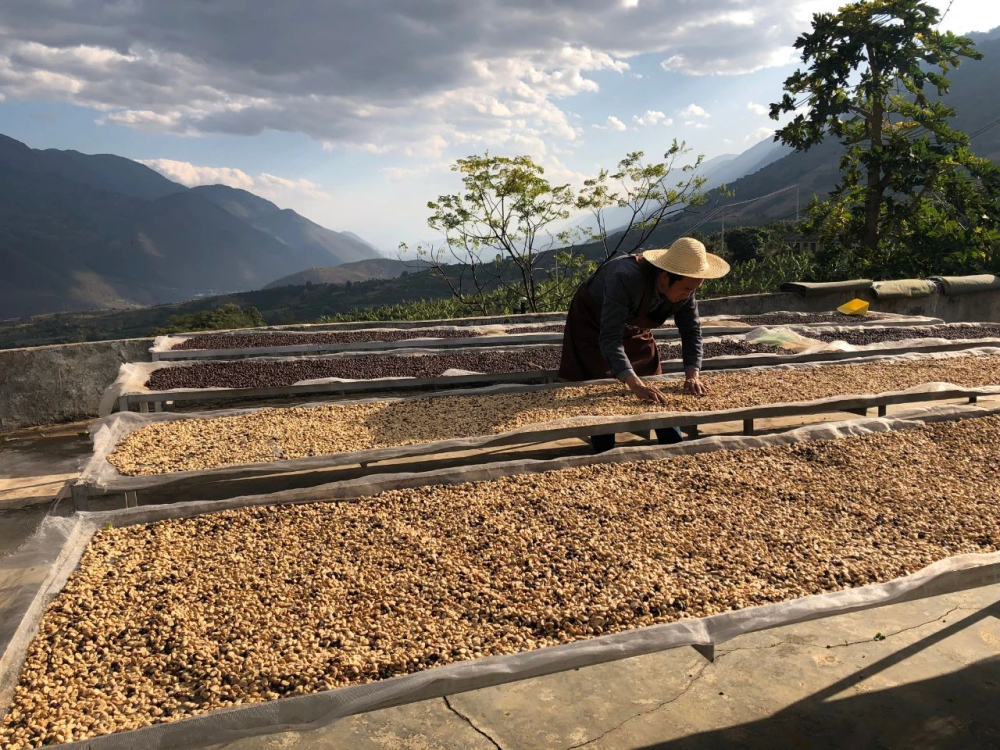
Of course, Yunnan also has many high-quality natural processed coffees. For example, "FrontStreet Coffee 2013," produced using natural drying, comes from FrontStreet Coffee's own estate in Lincang, Yunnan. Selected from the elegant Typica variety, it uses natural processing to enhance sweetness. Every November, as the coffee fruits ripen in succession, FrontStreet Coffee arranges for workers to pick red cherries one by one and spread the fresh cherries under the sun to dry naturally, turning them irregularly to ensure even dehydration. Naturally processed Yunnan coffee has richer fermentation notes and rounder fruit flavors than washed coffee.
FrontStreet Coffee believes Yunnan coffee's flavor belongs to a neutral, balanced profile - it has acidity, sweetness, and bitterness alike. FrontStreet Coffee's own roasted Yunnan coffees therefore all use medium roast. Through cupping, FrontStreet Coffee's Yunnan Baoshan Peaberry daily brewer shows notes of nuts, herbs, sweet potato, melon, brown sugar, cream, plum, and caramel, balanced in taste with a sweet aftertaste. Another coffee, FrontStreet Coffee 2013 natural Typica, cups with caramel, nuts, chocolate, fermentation notes, berries, black tea, and sugarcane: medium-high body, a clear taste, a black tea aftertaste, and rich, layered variation.

Brewing Suggestions for Yunnan Coffee
Before brewing, FrontStreet Coffee first confirms whether the beans are fresh. If the roast date is more than a month old, FrontStreet Coffee will not use them for serving. Coffee beans have an optimal tasting period after roasting; aroma accelerates its loss with storage time, and faded flavors are hard to restore during brewing. This is also why FrontStreet Coffee insists on shipping only coffee roasted within 5 days - so every customer can enjoy beans at their most complete.
Grind size and water temperature: because Yunnan coffee's profile is neutral and balanced, excessively high water temperature and too fine a grind easily cause over-extraction and release too many bitter macromolecular compounds. Conversely, too low a temperature and too coarse a grind cause under-extraction and a flat cup. FrontStreet Coffee therefore chooses a medium temperature and grind, extracting with 90 degrees Celsius water, a grind at 70% pass-through on a Chinese standard #20 sieve, and an EK43s setting of 10.5.
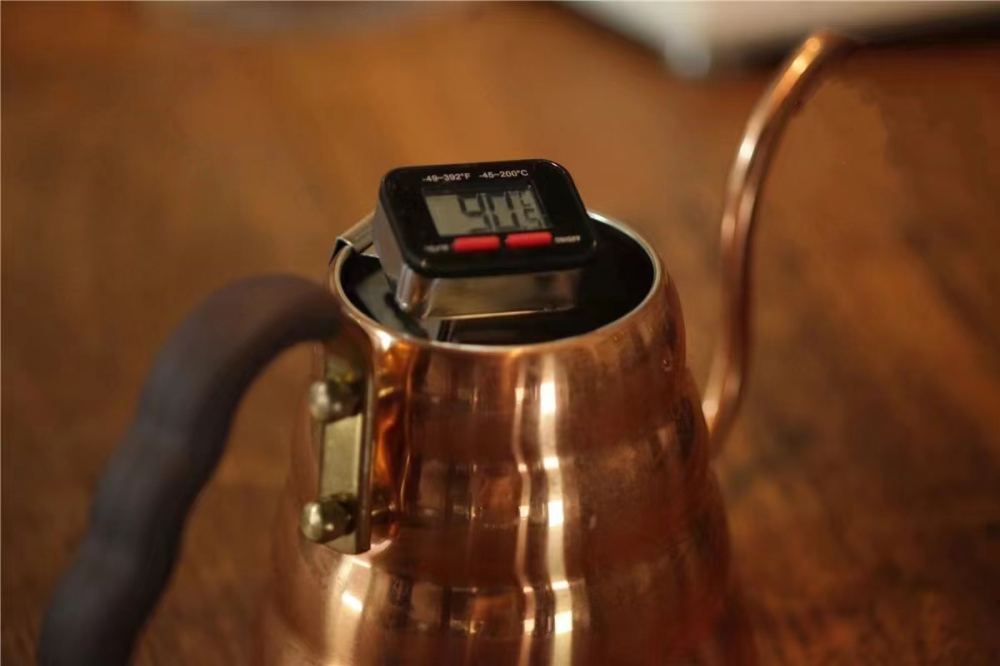
Based on past brewing experience, FrontStreet Coffee recommends the three-pour method for beginners. Three-pour extraction more fully dissolves flavor compounds, adding layers while avoiding the over-extraction that comes from soaking too long.
FrontStreet Coffee's Pour-over Parameters:
Filter: Hario V60
Dose: 15g
Water temperature: 90 degrees Celsius
Grind size: 75% pass-through on a #20 sieve
Water-to-coffee ratio: 1:15
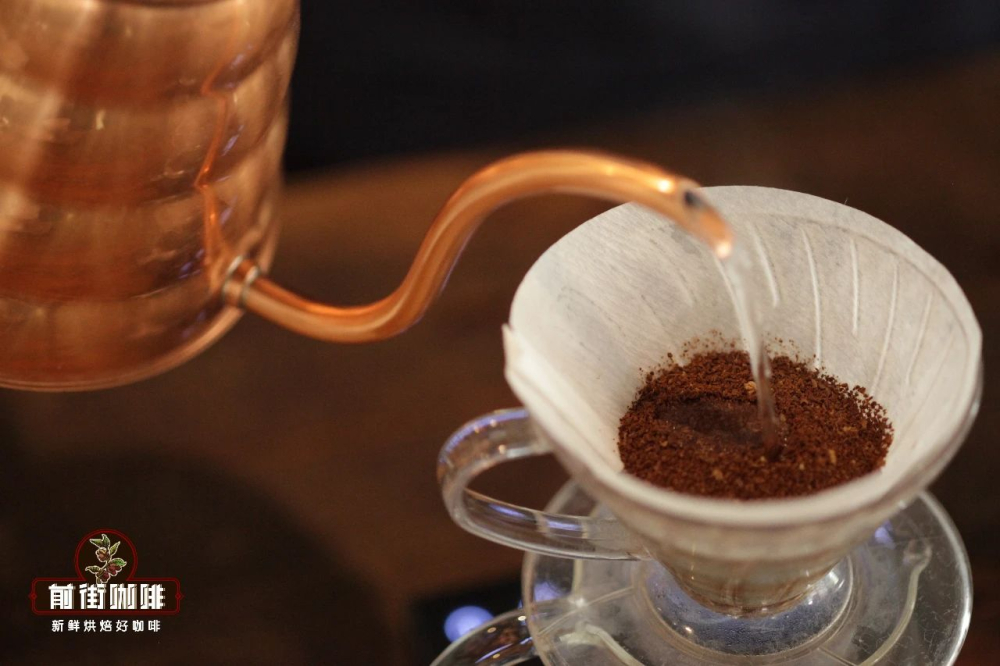
Three-pour method: use twice the coffee's weight in water to wet the bed, forming a dome for a 30-second bloom. Then use a small stream to pour in circles from inside out until reaching 125g for the first segment. Wait until the coffee bed drops to half the filter's height, then continue with the same fine stream to pour the third segment to 225g. Remove the filter when all the coffee liquid has filtered through, about 2 minutes total.
FrontStreet Coffee Recommendation
To start with Yunnan, FrontStreet's Yunnan Peaberry (also sold as Yunnan small-bean coffee) comes from the Baoshan region and uses washed processing with a medium roast. It shows soft nutty and chocolate sweetness with a light plum acidity - an approachable, affordable first encounter with Yunnan coffee that presents the region's terroir clearly, since washing ferments and rinses away the mucilage before drying to let the origin's own character come through.
For a cleaner, more defined Yunnan flavor, choose FrontStreet's 2013 Yunnan Natural Typica. Grown on the FrontStreet estate and processed with the oldest, most traditional method - natural drying - it takes on a fuller body and more prominent sweet-and-sour balance: citrus and berry tones, a hint of fermented wine, caramel sweetness, and a creamy finish.
To taste Yunnan in an espresso, FrontStreet's Black Cocoa Blend combines Yunnan small-bean coffee with Brazilian Cerrado. The Brazilian side supplies mixed-nut aroma and a balanced body, while the Yunnan side contributes chocolate and citrus notes, giving an Americano a balanced sweet-sour-bitter cup with nutty and brown-sugar sweetness, and a latte an almond and cream smoothness - very beginner-friendly.
Important Notice :
FrontStreet Coffee is a long-established specialty coffee roaster in Guangzhou China, selling freshly roasted beans from its own farm in Yunnan as well as dozens of carefully selected single-origin beans from around the world for both pour-over and espresso. The products deliver consistently excellent quality and great value, with shipping within 24 hours. Guangzhou's FrontStreet Coffee shop is recommended by many coffee lovers, and the beans are now available online at the Tmall 。
FrontStreet Coffee has moved to a new address:
FrontStreet Coffee Address: 315,Donghua East Road,GuangZhou
Tel:020 38364473
 Scan and follow the En Gafei WeChat official account. Please indicate that the reprint comes from "En Gafei".