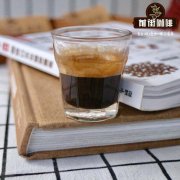
What Does SOE Coffee Bean Mean in Full? Brazil SOE Coffee Bean Brand Flavor Characteristics Description

Understanding SOE Coffee
Coffee lovers who enjoy espresso and single-origin coffee have probably heard of SOE recently. Have you ever walked into a coffee shop and been asked by a barista, "Would you like to try SOE coffee?" The first time you hear it, you might be confused: what exactly is SOE? After a brief explanation, you discover that SOE not only costs a little more than the regular options but also seems to offer more complex flavour descriptions, which tempts you into ordering a cup. Today FrontStreet Coffee explains what SOE means in the coffee industry and whether SOE coffee is worth trying.

What is SOE?
SOE stands for "Single Origin Espresso," meaning espresso made from coffee beans of a single origin. It can be used to make lattes, Americanos, and other espresso-based drinks. For example, when FrontStreet Coffee uses Golden Mandheling beans to make an Americano, the result can be called a "Golden Mandheling SOE Americano." If FrontStreet Coffee uses Brazil Queen's Estate beans to make a latte, it becomes a "Brazil SOE Latte." Likewise, using sun-dried Flower Queen beans to make a Dirty gives you a "Flower Queen SOE Dirty." Simple enough, isn't it?
SOE vs. Blend Coffee
Coffee shops emphasise SOE mainly because there is another, more common option: blended coffee. Blended beans are an artificial combination of beans from two or more origins, usually by country, with the goals of managing cost, ensuring stability, and creating specific flavour profiles. Blends also divide into espresso blends and pour-over blends, but are mainly used with espresso machines. FrontStreet Coffee recommends our Classic Espresso Blend, Premium Espresso Blend, and Basic Espresso Blend, all suitable for common coffee machines and moka pots and easily extracting rich crema and an intense coffee aroma.

The Rise of Single-Origin Coffee
Back to our topic, FrontStreet Coffee believes the rise of single-origin coffee began with the specialty coffee concept. In short, a group of industry leaders set out to solve the problem of inconsistent coffee quality at its source. They motivated farmers in producing regions to cultivate meticulously by establishing standards, teaching scientific farming methods, and buying high-quality coffee at premium prices. This improved bean quality, which naturally resulted in better-tasting brewed coffee.
In the past, our impression of espresso was of a balanced, bitter black coffee that needed milk to be enjoyable. This was not due to the extraction method but to the beans used. Espresso had to be affordable and consumed in large quantities, so cost was the primary consideration for beans, stability came second, and flavour was a distant third.

Blending became the safest approach, requiring beans with high production volumes and stable supply, so the ingredients were basically limited to the top ten coffee-producing countries. As for flavour, it was generally defined within caramel, nut, cream, and cocoa notes. To reconcile the flavour compatibility of various beans, deep-roasting everything was the easiest route, though market taste preferences also played a leading role. Traceability was poor back then, and consumers could only identify which roaster or coffee shop made good coffee.
Single-origin coffee, by contrast, emphasises the flavour characteristics of coffee regions and focuses on traceability stories. After succeeding with methods such as pour-over and siphon, it gradually applied to espresso, becoming what we now call SOE.

Choosing the Right SOE Coffee
The first requirement for a good cup of coffee is high-quality beans, and SOE should use higher-quality single-origin beans. FrontStreet Coffee's roasting philosophy is "Freshly Roasted Good Coffee," and we hope every customer can enjoy fresh, aromatic coffee at home. All coffee beans we ship are freshly roasted within 5 days.
Beyond freshness, making a delicious SOE also depends on the flavour profile of the beans themselves. In other words, we should buy SOE beans according to our taste preferences. Categorised by taste, coffee beans divide into "bitter" and "acidic" directions.
If you enjoy SOE coffee with fruity acidity and floral aromas, prioritise FrontStreet Coffee's Flower Queen SOE coffee beans, Red Cherry SOE coffee beans, and Gesha Village Chaka SOE coffee beans.

But if you dislike acidity and prefer rich, mellow coffee, we recommend FrontStreet Coffee's Queen's Estate coffee beans, Golden Mandheling coffee beans, and Huilan coffee beans.

How to Make a Brazil SOE Dirty
Let FrontStreet Coffee show you how to make a Brazil SOE Dirty using our Brazil Cerrado coffee beans.
The coffee machine at FrontStreet Coffee's store is a commercial single-group Lelit Bianca, which can adjust extraction by changing pressure, up to a maximum of 11 bar. Home coffee machines only need to reach 9 bar to cover extraction and milk frothing, paired with an espresso grinder.

SOE Coffee Extraction Parameters
- Coffee beans: FrontStreet Coffee Cerrado coffee beans
- Coffee dose: 20g
- Espresso yield: 40g
- Brew ratio: 1:2
- Extraction time: 26-33 seconds
- Grind setting: Galileo 2.0
FrontStreet Coffee uses double-basket capacity, with doses around 18-20 grams; we use 20 grams for our service.

Typically the ratio of coffee grounds to espresso liquid is between 1:1.5 and 1:2.5. FrontStreet Coffee's extraction ratio is 1:2, meaning 20 grams of grounds yield 40 grams of espresso. Time relates to the flow rate of the grounds. Generally, a single extraction is controlled within 20-35 seconds, because coffee extracted within 20 seconds usually tastes thin, while extraction over 35 seconds easily leads to over-extraction and a burnt bitterness. Most of FrontStreet Coffee's espresso extracts within 28-30 seconds.

Making the Brazil SOE Dirty
Before making the coffee, prepare a 200ml transparent glass and fill it with 160ml of fresh milk.

FrontStreet Coffee first wipes the portafilter dry, turns on the grinder, and grinds a double dose of grounds, then places them on an electronic scale and adjusts to exactly 20 grams. Use a tool to distribute the grounds evenly and tamp the puck firmly to ensure stable extraction. Next, turn on the extraction switch to run water, moistening the group head while washing away any stuck grounds, gently lock the portafilter into the group head, place the prepared fresh milk under the portafilter, and begin extraction.
When the scale shows 40 grams of espresso extracted, around 28-33 seconds, pull the extraction switch, and a Brazil SOE Dirty is complete.

This Brazil SOE Dirty delivers almond, caramel, and peanut nutty aromas from the first sip, with a silky, cream-like texture. The upper layer is warm espresso and the lower layer cold fresh milk, one bitter and one sweet, creating a very distinctive mouthfeel that is incredibly satisfying to finish.
FrontStreet Coffee Recommendation
If you like your SOE on the rich, low-acid side, a Mandheling is one of the best places to go, and FrontStreet Coffee's PWN Golden Mandheling sits at the top of the category. The PWN company buys only high-quality Mandheling green beans and, after a machine sort and a hand sort, keeps only full, defect-free beans of specialty grade. The beans are even, plump, large, and translucent, and after a medium-dark roast they carry abundant roasted aroma; brewed as black coffee they have a clean taste and a full, smooth body, ideal for anyone who dislikes acidic coffee.
For those who want an even more classic, everyday Mandheling, FrontStreet Coffee's Lintong Mandheling uses a medium-dark roast to present dark chocolate and caramel with the wild herbal character that Mandheling derives from Sumatra's growing conditions and wet-hulled process. When you brew it as a pour-over, try 87-88 degrees C, 15 grams of coffee, a 1:15 ratio, and a coarse-sugar grind, poured in three stages: a 30ml bloom to wet the grounds and let them degas, a second pour of 100ml to lift the golden foam and raise the bed, and a gentle centred 95ml finish to draw out sweetness. And if you would rather pull it on an espresso machine, FrontStreet Coffee's Classic Blend adds medium-dark Mandheling to its Brazilian base, brightening the cup with butter, roasted chestnut, and caramel and lending it sandalwood, herbal, and spice notes.
Important Notice :
FrontStreet Coffee is a long-established specialty coffee roaster in Guangzhou China, selling freshly roasted beans from its own farm in Yunnan as well as dozens of carefully selected single-origin beans from around the world for both pour-over and espresso. The products deliver consistently excellent quality and great value, with shipping within 24 hours. Guangzhou's FrontStreet Coffee shop is recommended by many coffee lovers, and the beans are now available online at the Tmall 。
FrontStreet Coffee has moved to a new address:
FrontStreet Coffee Address: 315,Donghua East Road,GuangZhou
Tel:020 38364473
 Scan and follow the En Gafei WeChat official account. Please indicate that the reprint comes from "En Gafei".