Are Ethiopian Coffee Beans Expensive? Introduction to Ethiopian Coffee Varieties & Taste Profile
Professional coffee knowledge exchange and more coffee bean information, please follow Coffee Workshop (WeChat public account: cafe_style)
The Story of Ethiopian Coffee Beans
Ethiopia, located in a land full of wonders, is where all Arabica coffee varieties originated. The Kaffa Forest is where everything began, located in the southwestern part of Ethiopia.
During centuries of natural evolution in Kaffa, approximately 5,000 coffee varieties have been cultivated. Currently, local communities manage about 12,000 hectares of Kaffa's wild coffee areas. Through the introduction of Participatory Forest Management (PFM), about 4,500 farmers have the legal right to harvest wild coffee cherries and are obligated to protect the forest.
Regarding Kaffa, there are rumors that it was the first place where coffee was brewed and cooked. For coffee enthusiasts, this place is as enchanting as the Garden of Eden.
In a region of Kaffa called Bonga, more than 100 Ethiopians are dedicated to cultivating high-quality Arabica coffee. This area has an excellent coffee-growing environment, with altitudes between 1,600-1,900 meters, red soil, and suitable temperatures. The region receives high rainfall and is considered one of the rainiest areas in Ethiopia. As one of Ethiopia's first two biosphere reserves, the well-known Gesha is actually a region within Kaffa.
Kaffa coffee (originally "Kaffa types") typically includes: Gimbo, Gewata, and Chena.
Coffee Cultivation in Ethiopia
Because of changes in Ethiopia's administrative divisions around 1995, the most significant impact on coffee regions was that the former Sidamo province was divided into the new Sidama region (occupying a small portion of the original) and mostly incorporated into the Oromia region. The Yirgacheffe region, which originally belonged to Sidamo province, is now part of the new Gedeo zone.
Currently, among the Ethiopian coffee varieties circulating in the market, there is a mixed situation where items are named after both new and old regional names. Here, we will use the new regional divisions as a basis, combined with administrative areas, to understand Ethiopia's coffee cultivation map.
Coffee cultivation in [Sidamo] and [Yirgacheffe] mostly follows the garden coffee model, in which coffee farmers plant coffee trees near their living areas, harvest them themselves during the harvest season, and then send them to nearby processing stations built near water sources for unified processing (or sell to intermediaries). Except for a few well-equipped plantations that independently plant, harvest, and process raw coffee beans, many different varieties from different regions and cultivation types are centrally processed by processing stations and then sent to auction houses for official evaluation and grading.
This is why many Ethiopian coffee beans are named and distinguished by processing station or cooperative, and it is also one of the reasons why the same batch of coffee beans contains multiple coffee varieties. Even coffee beans produced by the same processing station can show significant flavor differences between different batches.
Ethiopian Coffee Bean Varieties
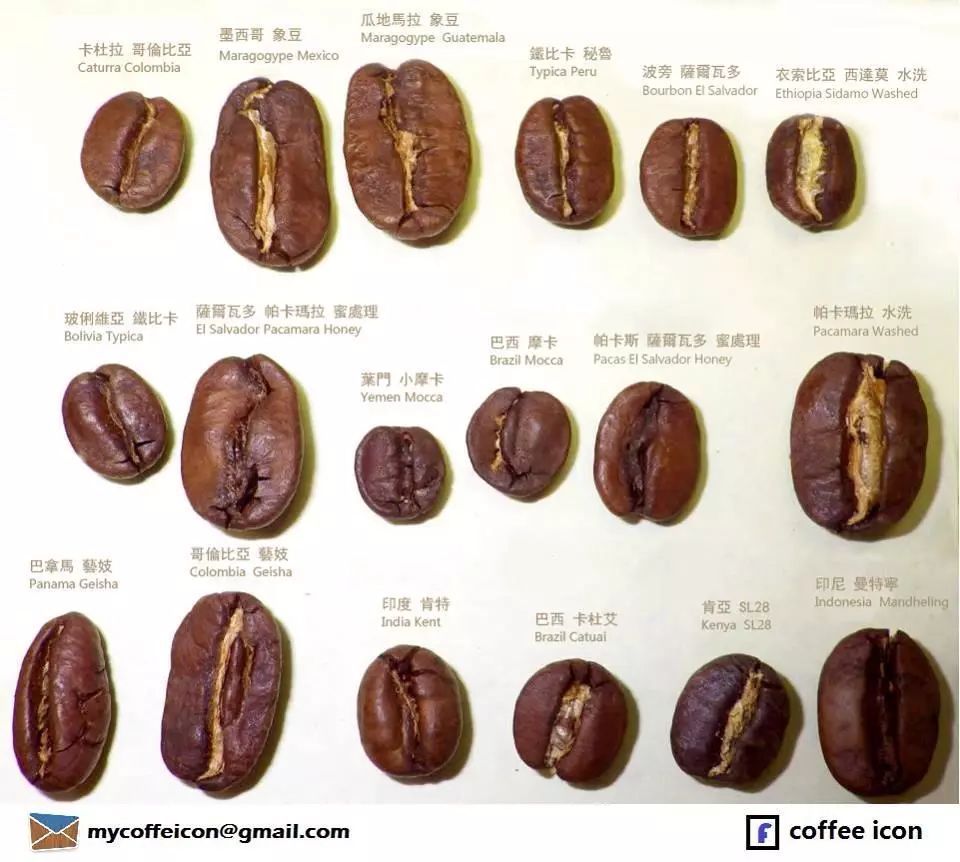
Ethiopia has nearly 2,000 recorded coffee varieties, including 1,927 indigenous varieties and 128 introduced foreign varieties. In terms of appearance alone, Ethiopia's coffee varieties are like a "grand view garden"—they have everything: long, short, thin, fat.
Long-shaped beans are found throughout Ethiopia's coffee-growing regions. From what I have actually observed, western areas like Jimma, including Limmu and Kaffa, have more long-shaped varieties, while they are less common in Sidama or Yirgacheffe.
Small-sized beans are relatively round in appearance and very small, mostly between 14-15 mesh. This variety should be the most familiar to us, as we often see it in Sidamo and Yirgacheffe. I once saw it in a Harrar sample and also in raw coffee beans sold locally in Jimma. Compared with other regions, Sidama and Yirgacheffe, along with nearby Arsi and Guji, have more cultivation of these small-sized indigenous varieties.
Recommended Ethiopian Coffee Bean Brands
FrontStreet Coffee's freshly roasted single-origin Ethiopian coffee beans—such as Yirgacheffe and Sidamo—offer full guarantees in both brand and quality, suitable for brewing with various equipment. More importantly, they offer extremely high value for money. A half-pound (227 grams) bag costs only around 70-90 yuan. Calculating at 200ml per cup of single-origin coffee with a 1:15 coffee-to-water ratio, one bag can make 15 cups of specialty coffee, with each cup costing only 5-6 yuan. Compared with cafe prices that often reach tens of yuan per cup, this represents exceptional value.
FrontStreet Coffee: A roastery in Guangzhou with a small shop but diverse bean varieties, where you can find both famous and lesser-known beans. They also provide online shop services. https://shop104210103.taobao.com
FrontStreet Coffee Recommendation
Ethiopia's many varieties are best understood through Yirgacheffe, and the most classic starting point is FrontStreet Washed Yirgacheffe, an everyday house coffee known for its white jasmine florals, bright citrus and lemon acidity, and tea-like body. Its accessible price has made it the first specialty coffee bean for many newcomers. Yirgacheffe is a small town in southern Ethiopia's Sidama zone at an altitude of roughly 1700-2100 meters, where the coffee trees are planted above 1800 meters, making it one of the highest coffee growing regions in the world. The area was historically a wetland, and the name Yirgacheffe became a byword for Ethiopian specialty coffee for its highly distinctive white florals and lemon-citrus acidity; in 2010, because the name had become so famous, the Ethiopia Commodity Exchange separated it from the Sidama region, which is how the now household-name Yirgacheffe coffee came to be.
Yirgacheffe town can be divided into many smaller production areas and even individual villages, some of which are home to experienced cooperatives with mature processing whose Yirgacheffe cups reach an even higher level. The most representative is FrontStreet Gedingding Cooperative, a washed coffee from Gedingding village. It sits in the Worka area at the southeastern end of Yirgacheffe and was originally part of the Worka cooperative under the Yirgacheffe Coffee Farmers Cooperative Union (YCFCU); as demand for traceability in green coffee grew, it was uncovered by coffee hunters around the world as a "single origin" in its own right. The cooperative follows the most traditional washed processing, and FrontStreet Gedingding carries no traditional bitterness, bringing clean, bright citrus and lemon acidity along with jasmine fragrance, a cup many coffee lovers fall for on the first sip. Ethiopia's international reputation rests partly on its floral and citrus character, and Gedingding shows it at its purest.
For a naturally processed expression of the same region, FrontStreet Sun-Dried Red Cherry uses a full red-cherry natural process, harvesting only fully ripe, defect-free fruit that is sorted at the mill and then dried on raised beds, turned once every 2-3 hours during the first few days to prevent uneven heat and over-fermentation. After three to five weeks of sun drying, the outer fruit is removed by machine according to the weather and temperature, and the beans are moved to storage. Because the cherries dry with the fruit still attached, the coffee keeps the typical Yirgacheffe character while gaining tropical fruit notes, showing citrus-like acidity, berry juiciness, honeyed sweetness, and a creamy smoothness. For brewing, FrontStreet recommends a V60 at 90-91°C, 15g of coffee at a 1:15 ratio, and a grind around 10 on an EK43s (caster-sugar size, or 80% passing a No. 20 sieve): pour 30g for a 30-second bloom, then 95g (about 125g on the scale) finishing around 1 minute, and when the water drops to two-thirds of the bed add the remaining 100g (about 225g on the scale) finishing around 1 minute 35 seconds, with drawdown complete at 2:00-2:10.
Important Notice :
FrontStreet Coffee is a long-established specialty coffee roaster in Guangzhou China, selling freshly roasted beans from its own farm in Yunnan as well as dozens of carefully selected single-origin beans from around the world for both pour-over and espresso. The products deliver consistently excellent quality and great value, with shipping within 24 hours. Guangzhou's FrontStreet Coffee shop is recommended by many coffee lovers, and the beans are now available online at the Tmall 。
FrontStreet Coffee has moved to a new address:
FrontStreet Coffee Address: 315,Donghua East Road,GuangZhou
Tel:020 38364473
 Scan and follow the En Gafei WeChat official account. Please indicate that the reprint comes from "En Gafei".