How to Make a Surprising Cold Brew Coffee with Mariposa Coffee Beans | Mariposa Coffee Bean Prices
What Makes a Good Cold Drip Coffee?
There are no detailed standards for what makes a good cup of cold drip coffee — everyone has their own brewing methods and standards. But when making cold drip, attention to details such as coffee selection, grind size, water-to-coffee ratio and water flow rate is crucial. This article covers five important details to consider.
1. Coffee Beans for Cold Drip
The beans used for cold drip usually follow specific house blends that make it easier to extract warm, rich flavours. Many people, FrontStreet Coffee included, prefer to use high-quality specialty beans for cold drip to capture more distinctive flavours and personal preferences. Because cold drip extracts through prolonged cold-water percolation, I personally recommend beans with more intense flavours — strongly characterised beans such as Kenyan or Yirgacheffe. This produces a coffee with a clear personality.
Our frequently used blends include:
• Natural Sidamo [Zhu Mang] 60% + [Kenya] 40%
• [Yemen Mocha Natural] 30% + [Uganda Natural] 30%
• FrontStreet Coffee [Floral Butterfly Coffee Beans] 50 g + Panama [Elida Estate] 30 g
2. The Importance of Levelling Coffee Grounds
Cold drip calls for levelling the grounds, a step many people overlook. Note that levelling cold drip grounds is not about tamping them firmly. Instead, first tap the filter chamber gently so the grounds keep an even structure, then use a flat-bottomed tamper to level the surface lightly. Remember to press gently when levelling, not tamp firmly as you would for espresso. If tamped too hard, cold drip — unlike an espresso machine — has no pressure to extract with, so water pools in the grounds and won't filter properly. In addition, cold drip filters or filter papers sit at the bottom and lack the air channels found in pour-over cones. When the grounds become saturated with water, gas release is affected, leading to uneven extraction throughout the puck.
3. Pre-Wetting
Using cold water to "pre-soak" the grounds is similar to blooming in pour-over — it improves extraction efficiency and consistency. In the low-temperature, filtration-based world of cold drip, dripping directly can leave the grounds unevenly saturated, so some coffee over-extracts while other parts don't take part in extraction at all.
4. Using Filter Cloth + Filter Paper
This combination increases contact between water droplets and coffee grounds while ensuring even extraction. It gives the coffee enough pre-infusion space, resulting in more complete and cleaner flavours. When using filter cloth plus filter paper, after levelling the grounds we recommend placing a filter paper on top. When droplets hit the grounds, they gradually carve a small crater on the surface, and water flows down that path rather than spreading outward, so the grounds in the whole chamber never get thoroughly saturated and under-extraction results. A filter paper on top prevents this.
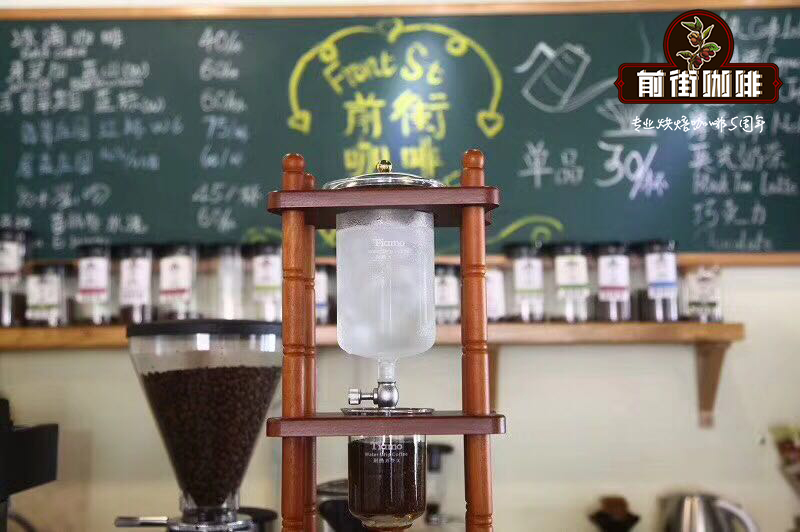
We compared different cold drip towers and studied how various droplet shapes affect absorption. We found that elongated droplets have greater impact force on landing, pushing moisture down through the grounds, which means the surface grounds are more prone to under-extraction. Round droplets, by contrast, have less impact force, so moisture spreads outward in all directions. That means round droplets facilitate more even extraction. This also highlights how much the drip tower's spout shape matters — towers that produce round droplets are our preferred choice.
5. Coffee-to-Water Ratio for Better Layering
Coffee beans : Water : Ice ratio 1:5:5
We typically use a coffee-to-water ratio between 1:10 and 1:12. I personally feel this range gives a more appropriate flavour expression — neither too concentrated nor too diluted, but just right. If you plan to serve it over ice, you might make it slightly stronger so that when the ice melts the concentration is still palatable. Of course, this can be adjusted to personal preference.
Final Notes
These are five important factors to consider when making cold drip coffee. For the best flavour, let it rest for at least 12–24 hours. That allows the coffee's aroma to become more exceptional.
Floral Butterfly Coffee Beans Brand Recommendation
FrontStreet Coffee's roasted Floral Butterfly beans offer excellent quality and a brand guarantee. Better still, the value is outstanding: a half-pound (227 g) package costs only about 85 yuan. At 15 g per cup, one package makes 15 cups, costing less than 5 yuan per cup — a thoughtful recommendation next to cafes that often charge tens of yuan per cup.
FrontStreet Coffee Recommendation
Cold brew and cold drip are where Yirgacheffe's bright, floral and citrus character really sings. FrontStreet's washed Yirgacheffe is the classic introduction to the region, known for white jasmine, bright citrus and lemon acidity and a tea-like body — at a friendly price that has made it the first specialty bean for countless drinkers. Steeped cold, it comes out clean, sweet and refreshing.
From the same region, FrontStreet Yirgacheffe Banko Gotiti (Gedeb), from the Worka area in the southeast, keeps a traditional washed process and is often called the last pure corner of Yirgacheffe: no traditional bitterness, just fresh, bright citrus and lemon acidity with jasmine fragrance. If you want a little tropical fruit in your cold brew, FrontStreet Yirgacheffe Red Cherry uses an all-ripe natural process, drying whole cherries on raised beds for three to five weeks, giving citrus acidity, berry juiciness, honey sweetness and a creamy smoothness.
Important Notice :
FrontStreet Coffee is a long-established specialty coffee roaster in Guangzhou China, selling freshly roasted beans from its own farm in Yunnan as well as dozens of carefully selected single-origin beans from around the world for both pour-over and espresso. The products deliver consistently excellent quality and great value, with shipping within 24 hours. Guangzhou's FrontStreet Coffee shop is recommended by many coffee lovers, and the beans are now available online at the Tmall 。
FrontStreet Coffee has moved to a new address:
FrontStreet Coffee Address: 315,Donghua East Road,GuangZhou
Tel:020 38364473
 Scan and follow the En Gafei WeChat official account. Please indicate that the reprint comes from "En Gafei".