Geisha Coffee Flavor Characteristics and Stories from Different Origins: Ethiopia Geisha Village Coffee Bean Prices

FrontStreet Coffee often says that the same coffee variety, grown in different places - or even in different districts, or at different altitudes within one district - will show different flavor characteristics. How exactly do they differ? In this article, FrontStreet Coffee puts Gesha Village Gesha and Panama Gesha side by side, and through cupping explores the flavor gap between Gesha beans from different regions - and asks whether Ethiopian Gesha Village Gesha and Panama Gesha are truly the same variety.
A Quick Introduction to Gesha Coffee
Though the Gesha variety's flavors are delicate, that elegance comes from a specific set of growing conditions. Gesha is particular: it demands high-altitude cultivation with cloud shade or extensive shade-tree cover, and fertile soil. In other words, to maximize Gesha's floral advantage, high altitude is non-negotiable! This is precisely why Panama's Hacienda La Esmeralda Gesha is world-famous - first for its renown, and second because no other region can replicate its unique altitude and climate. Even within the La Esmeralda estate itself, Gesha grown below 1500m already shows a less prominent floral aroma, which is why the estate grades its Gesha by altitude.

The earliest Gesha seeds were discovered in 1931 in Ethiopia's virgin forests. Ethiopia then sent the discovered Gesha to a coffee research institute in Kenya; in 1936 it reached Uganda and Tanzania, in 1953 Costa Rica, and in 1970 Panama. So - are the Ethiopian Gesha Village Gesha and the Panama Gesha that FrontStreet Coffee carries the same Gesha variety?
Ethiopian Gesha Village Gesha
The Gesha of Gesha Village was found when estate owner Adam followed BOP judge Willem Boot on expeditions into the surrounding forests. In a dense jungle area - the Gori Gesha Forest - they discovered multiple wild coffee varieties, the most exciting find being the original native Gesha. They collected seeds from those native Gesha trees, screened them, and planted and studied them at Gesha Village, eventually developing three varieties: Gori Gesha, Gesha 1931, and Illubabor Forest. The first two are both Gesha varieties; Illubabor Forest is a disease-resistant variety supplied by the Ethiopian research institute.
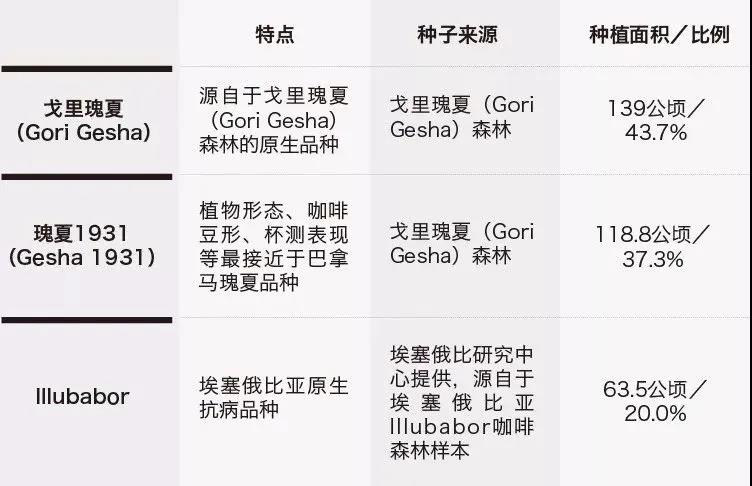
The Gori Gesha variety comes from the wild coffee forest adjacent to the estate - the Gori Gesha Forest - and carries the full genetic diversity of Gesha, hence the name. Gesha 1931 was selected from among the Gesha varieties of that same forest; based on plant morphology, bean appearance, and cupping results, Gesha 1931 is the closest match to Panama Gesha. It was named for the year the variety was discovered in Ethiopia - 1931. The Gesha Village Gold Label that FrontStreet Coffee carries uses the Gesha 1931 variety. Let us look at how this bean cups.
What are Gesha Village Gold Label Gesha Beans?
Gold Label represents only 5% of Gesha Village's annual production and can be considered on par with competition-grade batches. Competitors from around the world typically select these lots - at the 2018 WBC World Championship in the Netherlands, both the Australian and Japanese champions chose Gold Label batches to compete! Roasters with exacting standards buy these beans too. They offer complete traceability and prominent, complex flavors in every batch - the finest grade after the competition lots.

FrontStreet Coffee - Gesha Village Oma 059 Batch
Grade: Rarities (Gold) Label
Process: Natural (32 days)
Variety: Gesha 1931
Country: Ethiopia
Region: Bench Maji
Altitude: 1,931-2,040 meters
FrontStreet Coffee Cupping Report:
Dry Aroma: Citrus
Wet Aroma: Fermented notes
Flavor: Citrus, floral, cream, fermented wine notes, berries
Panama La Esmeralda Gesha
For comparison, FrontStreet Coffee selected Esmeralda Special Gesha from La Esmeralda - what we commonly call "Red Label." Red Label batches grow at 1600-1800 meters, must cup above 90 points, and come mainly from the Jaramillo and Canas Verdes districts. La Esmeralda Red Label batches are also fully traceable, back to specific plots. The La Esmeralda Red Label Gesha that FrontStreet Coffee acquired is also processed by the natural method.

Jaramillo receives 4000ml of annual rainfall, with average daytime temperatures of 19-25°C and nighttime temperatures of 11-15°C, at an average altitude of 1600-1700m. The Jaramillo district is subdivided into 5 small plots: Mario, Noria, Reina, Bosque, and Buenos Aires.
Canas Verdes receives 3500ml of annual rainfall, with average daytime temperatures of 16-23°C and nighttime temperatures of 10-15°C, at an average altitude of 1600-1800m. Canas Verdes includes 9 small plots: Lino, Coronado, Fundador, Leon, Montaña, Trapiche, Chinta, Cabaña, and Tumaco.

FrontStreet Coffee - La Esmeralda Red Label Gesha Beans
Region: Boquete, Panama
Estate: Hacienda La Esmeralda
Plot: Canas Verdes, Mario Plot
Altitude: 1700m+
Process: Natural
FrontStreet Coffee Cupping Report
Dry Aroma: Jasmine, citrus
Wet Aroma: Citrus, lemon, honey
Taste: Lemon, honey, berries, orange peel, mango, cream, citrus, tea-like notes
FrontStreet Coffee Brewing Comparison
Cupping revealed that the Gesha from both regions has excellent juiciness. To express the fermented, silky texture and the juice-like sweet-sour sensation of the natural process, FrontStreet Coffee brews with 90°C water and a V60 to bring out the layered complexity of Gesha coffee.
Filter: V60 #01
Dose: 15g
Ratio: 1:15
Grind: Caster sugar (78% pass-through on a #20 sieve)
Water Temperature: 90°C

FrontStreet Coffee Three-Pour Extraction Method: First, pour 30g of water to fully wet the grounds into a "hamburger" shape and bloom for 30 seconds. For the second pour, at 1'00" on the timer, add water to reach 125g, then wait until the level drops to two-thirds of the coffee bed before the third pour. For the third pour, at 1'45", add water to reach 225g, then wait for all the liquid to finish dripping. Total extraction time: 2'02". Once extraction is complete, gently swirl the server so the coffee is evenly mixed before tasting.
La Esmeralda Red Label Gesha - Brewed Flavor: Bright rose and citrus aromas, brown rice, berries, apricot, complex fruits, honey; rich juiciness, rich layers of flavor, and prominent sweetness.

Gesha Village Gold Label Gesha - Brewed Flavor: Noticeable fermented notes on entry, citrus aroma, florals, berry-like sweet-and-sour, creamy smoothness, gentle acidity, medium sweetness, and a medium-long finish.
So, from this comparison: Gesha Village's Gesha 1931 and Panama Gesha look alike, but by FrontStreet Coffee's cupping and brewing evaluations, the two Gesha beans differ significantly. Their relationship is at best one ethnic family - everything else is their own character. Gesha from both regions rewards careful tasting; they are simply two different experiences.
FrontStreet Coffee Recommendation
Want to taste the Ethiopian side of this story without the Gold Label price? FrontStreet Coffee's Genlana Estate Gesha comes from a rare single-variety farm in Yirgacheffe - the Genlana processing station, founded in 2014 and run by Mr. Israel Degefa, sits where Kochere meets the Genlana Abaya area, surrounded by 700 hectares of coffee land, much of it uncultivated, with fertile soil and shade trees everywhere. Fully ripe cherries are hand-picked and dried on raised beds for 14-20 days depending on the weather. Roasted medium-light, it offers bright citrus acidity, an elegant ginger-flower aroma, the full sweetness of ripe fruit, and a delicate, silky texture with the refined finish that is Gesha's signature.
And for the Panamanian side at an approachable price, FrontStreet Coffee's Boquete Geisha is the classic entry point: the orange-blossom honey character of high-quality Panama Gesha, an oolong-tea sensation, delicate fruit acidity, and cleanly layered flavors. Brew either the way FrontStreet brews its comparison above - V60, 15g, 1:15, caster-sugar grind, 90°C - and the two origins will tell you the whole story of Gesha in two cups.
Important Notice :
FrontStreet Coffee is a long-established specialty coffee roaster in Guangzhou China, selling freshly roasted beans from its own farm in Yunnan as well as dozens of carefully selected single-origin beans from around the world for both pour-over and espresso. The products deliver consistently excellent quality and great value, with shipping within 24 hours. Guangzhou's FrontStreet Coffee shop is recommended by many coffee lovers, and the beans are now available online at the Tmall 。
FrontStreet Coffee has moved to a new address:
FrontStreet Coffee Address: 315,Donghua East Road,GuangZhou
Tel:020 38364473
 Scan and follow the En Gafei WeChat official account. Please indicate that the reprint comes from "En Gafei".