Yemen Coffee Bean Brand Recommendations | Yemen Coffee Brands Introduction | Yemen Coffee Bean Prices
Professional coffee knowledge exchange.
Introduction to Yemen Coffee Growing Regions
The History of Yemen Coffee Beans
Yemen is famous for its frankincense and spice trade, and it is the world's earliest origin of cultivated coffee: Mocha.
Trace the history back far enough, and this is also the land where Noah is said to have built the ark in the Bible.
Legend has it that 3,000 years ago this land was ruled by the legendary Queen of Sheba, who led a large delegation bearing gold and spices to Jerusalem to find King Solomon and bore him a son. (The rumor goes that this son became the first king of Ethiopia.)
Whatever the truth, perhaps because of this deep history, the people of this land are said to retain a strong sense of self-esteem and fierce independence.
Yemen has preserved a way of life dating back thousands of years, and in many places the central government's authority famously struggles to reach. Ethiopia, just across the sea, also shipped its coffee through the port of Mocha, which is why Ethiopian natural-processed coffee is often labeled Mocha (as in Ethiopia Harar Mokka). Yemen Mocha is the originator of the world coffee trade. Yemen's contribution to spreading delicious coffee across the globe is undeniable: the beans were known as "Arabia Coffee," the root of the later name "Arabica."
In the 17th century, Europeans are said to have first imported coffee — and spread it around the world — through the world's greatest coffee port, the port of Mocha.
Today's "Port of Mocha" has not held on to its former glory; it has become a historic port with little more than white sandy beaches to show for it.
Even so, its name still "travels far and wide" as Yemen coffee.
Although Ethiopia was the first country where coffee was discovered, Yemen was the first to grow and produce coffee as a large-scale crop. In the early 17th century, the first shipment of Yemen coffee beans left for Europe through the ancient little port of Mocha and astonished the Europeans. Because every exported coffee bag had to be stamped MOCHA to certify it had shipped from Mocha Port, Europeans came to call the delicious coffee from that port "Mocha Coffee." That is how Mocha became an early synonym for coffee itself.
Yemen coffee grows on steep terrain with little rainfall, thin soil, and harsh sun. These unique, difficult, deeply unfavorable growing conditions are precisely what gave the world the irreplaceable Yemen Mocha. The main coffee-growing regions are Sanani, Matari, and Ismaili.
The Matari growing region sits on the highlands west of the capital at an altitude of 2,000-2,400 meters — the highest in Yemen, but also the most remote and hardest to reach. Farmers often have to wait a while after harvest before their crop can be carried out.
Processing Methods
Ancient Natural Process Yemen Coffee Beans
Yemen is the classic example of ancient natural processing and the only country in the world that produces exclusively natural-process coffee. This traditional, water-free method has remained unchanged since the 17th century, when Europeans first fell for Mocha's wild flavor — a fact tied to Yemen's extremely dry climate. Coffee is grown mainly in the central highlands, where average annual rainfall is only 400-750 millimeters, far below the 1,500-2,000 millimeters that Arabica ideally needs.
In this water-scarce environment, farmers have never been able to adopt more advanced washed processing. The wild flavor surpasses even Harar coffee, making Yemen the best place to taste coffee's ancient character.
The central highlands of Yemen are a landscape of rolling mountains and rugged terrain. Smallholders mostly plant in a scattered fashion — a few trees on steep slopes, dozens on terraces or cliff edges — with each plot having its own soil, water, and microclimate, and therefore its own aromatic profile.
Yemeni farmers' natural processing is rougher than Ethiopia's. Coffee cherries are not picked when they turn red; instead, they are left to dry on the branches until they become purplish-black and fall to the ground, and only then collected. This is quite different from the refined natural processing of Yirgacheffe or Sidamo, where ripe red cherries are picked and laid out on raised African beds — and it is the main reason Yemen's wild flavor is so intense.
In Yemen's natural process, fully ripe cherries are harvested by hand and then spread, fresh, on dedicated drying grounds or the family's packed-earth courtyard for sun drying. Throughout the drying period — much like sun-drying rice — the cherries are turned with wooden rakes so every bean dries evenly. After roughly twenty days, once drying is complete, the dried pulp and skin are milled away to extract the beans. Yemen coffee is rich, complex, bold, and mellow, with pronounced fermentation notes and lower acidity. It also carries an element of uncertainty — the timing of seasonal rains — that makes it wonderfully unpredictable; it is no exaggeration to call it the most singular coffee in the world.
Yemen Coffee Bean Analysis
Mocha Grade Classification: Sanani
Because Yemen's annual coffee production is so low, only about 35% qualifies as Mocha Sanani or Mocha Mattari — the finest tiers of Yemeni coffee.
Coffee from the Matari region has a famously homely appearance: uneven in size, with considerable color variation, looking like a jumble of small peaberry-shaped beans and hollow defect beans.
Green Bean Information:
Yemen Mocha Mattari
Country: Yemen
Region: Matari
Altitude: 1,300-1,900m
Varietal: Typica, Bourbon
Process: Natural / Sundried
Because the beans are so small, some people call this coffee "small Mocha." Mocha is a flat bean, not a round one — small, but intensely aromatic and rich.
Yemen Coffee Bean Roasting Analysis
Yemen Mocha is a relatively low-moisture green coffee. Given the uneven bean size, the drop temperature for low-moisture beans should not be set too high. Preheat for 30 seconds with the air damper at 3; once the beans turn light green or whitish, open the damper to 4, and after first crack open it to 5 (maximum).
FrontStreet Coffee recommends keeping records before roasting: bean moisture content, density, origin, processing method, roasting-room temperature and humidity, and so on, and planning your roasting curve in advance. Logging the chemical and physical changes during the roast helps you understand the final result and steadily refine your profile.
Roasting machine: Yangjia 800N, 550g green beans charged
Roasting curve:
Heat the drum to 170°C, air damper at 3. After 1 minute, reduce heat to 140°C, damper unchanged. At 5'00" and 147.2°C, the bean surface turns yellow, the grassy smell disappears completely, and drying is done. Reduce heat to 110°C, damper to 4.
At 8'00", wrinkles and dark spots appear on the bean surface and the toast aroma clearly shifts into coffee aroma — the prelude to first crack. Listen carefully from here. First crack begins at 8'23"; reduce heat to 60°C and open the damper fully (adjust the heat very carefully — never so low that the crackling stops). Drop the batch at 197.9°C.
Cupping Report:
Medium roast, City (caramel aroma): Before grinding, the beans smell of peanuts; after grinding, caramel. On the slurp, the layers are complex, with a light grape acidity emerging late in the cup. The spicy aftertaste is long, with a smooth, sweet, mouthwatering quality that lingers like a Middle Eastern milk tea. The spent grounds hold a malt sweetness. Medium-roasted Yemen Mocha keeps evolving — it is best brewed 7-14 days after roasting, when the complex wild fermentation character peaks.
Yemen Coffee Bean Brewing Analysis
The condition of the coffee bed in pour-over brewing cannot be ignored — this must be emphasized! The bed plays a subtle but vital role: it provides resistance, keeping hot water in contact with the grounds long enough to extract sufficient flavor. A medium-roast coffee bed, in particular, needs enough structural strength to do its "damming" work. To keep the bed from collapsing, you must control the water-column intensity, the pouring position, and steady circular pouring — together, a complete pouring technique.
1. Filter cup: V60
2. Water temperature: 88°C
3. Grind size: Fuji Mini Rancilio, grind level 4
4. Roast level: Medium
5. Bloom time: 25 seconds
Flavor: Balanced, chocolate, persistent caramel sweetness in the finish
FrontStreet Coffee's recommended technique: 15g of coffee, Fuji Mini Rancilio ghost-tooth burr grinder at level 4, V60 dripper, 88-89°C water. First pour 30g of water and bloom for 25 seconds, then pour to 104g and stop. Wait until the water level in the coffee bed drops to half, then pour slowly up to 220g total. Discard the last 5g. Water-to-coffee ratio 1:15, extraction time about 2:00 (counting from the end of the bloom pour).
Yemen Coffee Bean Brand Recommendations
FrontStreet Coffee's roasted Yemen Mocha coffee beans are a safe bet on both brand and quality — and they offer exceptional value. A 227-gram package costs just 85 yuan. At 15g per cup, one package brews 15 cups, working out to less than 6 yuan each. Compared with cafés charging tens of yuan per cup, it is a genuinely conscientious recommendation.
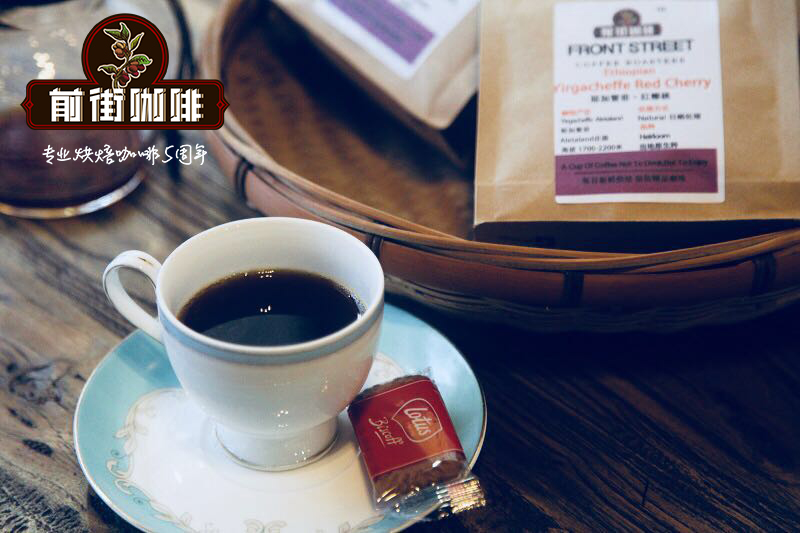
FrontStreet Coffee Recommendation
Ethiopia, coffee's birthplace, remains one of the world's great specialty coffee origins, home to countless heirloom varieties. If you love Yemen Mocha's dried-fruit depth, Ethiopian naturals are the natural next step. The FrontStreet Coffee Natural Red Cherry (Operation Cherry Red) Yirgacheffe delivers peach, cocoa, honey, and lemon — cherries are sorted, sun-dried for two weeks until moisture drops to 12%, then milled and screened repeatedly for a clean yet intensely fruity cup. The FrontStreet Coffee Natural Huakui (Flower Queen) from the Hambella district of Guji, Sidamo dries whole cherries on raised beds for 21 days with constant turning and hand-sorting every three to five days, yielding a medium-light roast with faint fermented wine notes, florals, citrus, and mango, a thick body and long finish.
For a cleaner profile, try the FrontStreet Coffee Washed Yirgacheffe — from a small southern Ethiopian town where spring-like mist and cool air nurture thousands of coffee trees — with its clear jasmine florals, bright citrus acidity, and a light, elegant, tea-like cup like refreshing lemon tea. Cooperative lots are another hallmark of Ethiopian coffee: because smallholders deliver cherries to village washing stations and sell under the team's name, you'll find coffees like the FrontStreet Coffee Idido Cooperative (independent since 2012, with about 300 member farmers in the Worka area), whose washed lots show citrus, lemon, and graceful white florals with remarkable clarity.
Important Notice :
FrontStreet Coffee is a long-established specialty coffee roaster in Guangzhou China, selling freshly roasted beans from its own farm in Yunnan as well as dozens of carefully selected single-origin beans from around the world for both pour-over and espresso. The products deliver consistently excellent quality and great value, with shipping within 24 hours. Guangzhou's FrontStreet Coffee shop is recommended by many coffee lovers, and the beans are now available online at the Tmall 。
FrontStreet Coffee has moved to a new address:
FrontStreet Coffee Address: 315,Donghua East Road,GuangZhou
Tel:020 38364473
 Scan and follow the En Gafei WeChat official account. Please indicate that the reprint comes from "En Gafei".