Is Yunnan Baoshan Coffee a Small Bean Variety? How Much Does Yunnan Baoshan Coffee Cost Per Jin?
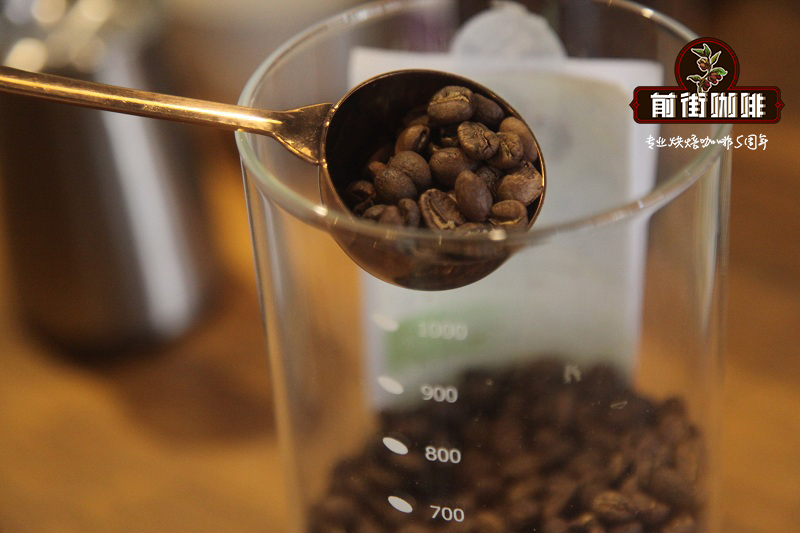
Yunnan is China's main coffee-producing province, and Baoshan is one of its most respected growing areas. This article looks at what "small-grain coffee" actually refers to, how Baoshan coffee is grown, and how the varieties planted there shape what ends up in the cup.
Yunnan small-grain coffee belongs to the Rubiaceae family and the Coffea genus. The main planting areas are spread across Lincang, Baoshan, Simao, Xishuangbanna, and Dehong. Baoshan small-grain coffee traces its roots to Ethiopia or the Arabian Peninsula.
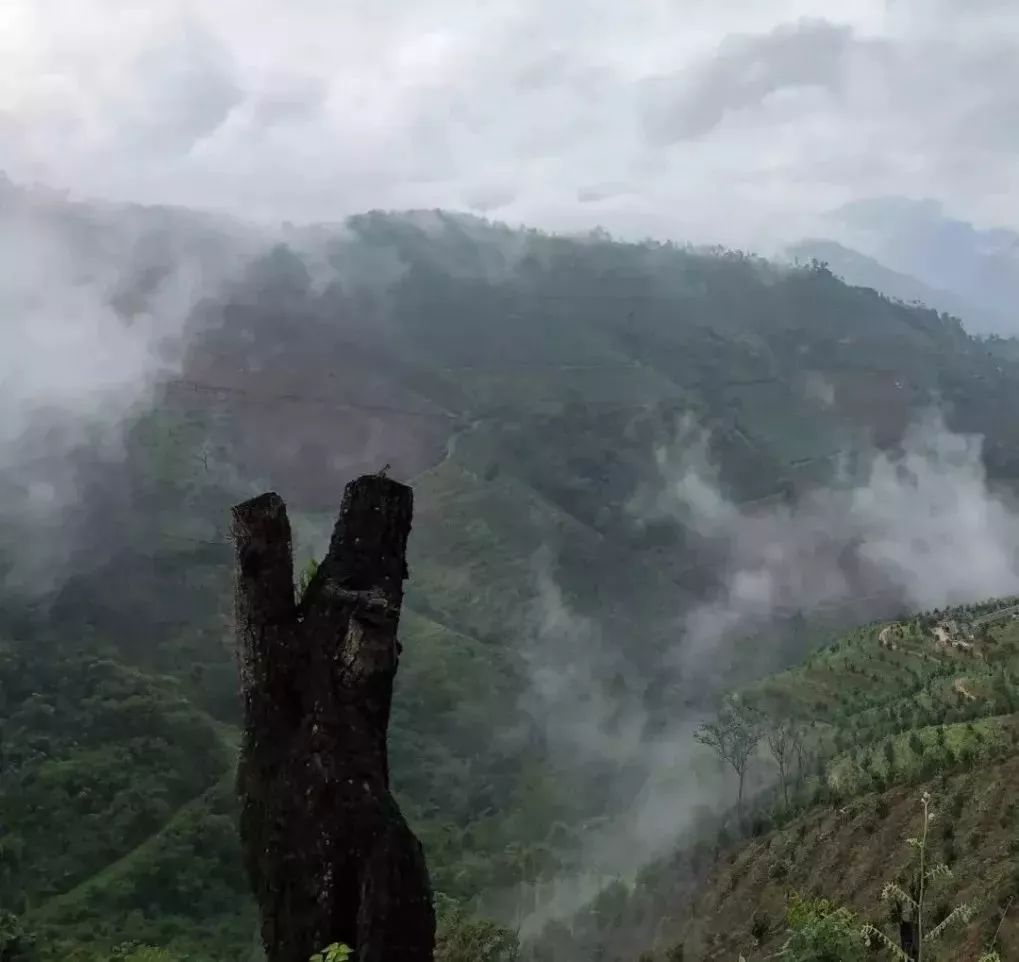
Main Growing Regions
Small-grain coffee does best on mountain slopes at 800~1800 meters. Too high and the cup turns sour; too low and it turns bitter. Most small-grain coffee is planted in dry-hot valley areas at around 1100 meters, which gives it moderate acidity, a rich fragrance, and a mellow flavor. Many parts of Yunnan offer a unique environment suited to small-grain coffee, and they produce excellent quality as a result.
The main planting areas are spread across Lincang, Baoshan, Simao, Xishuangbanna, and Dehong. Baoshan's average temperature is 21.5°C, with a maximum of 40.4°C. It is essentially frost-free year-round and is recognized as the best small-grain coffee producing area. The coffee grown here is known at home and abroad for being strong but not bitter, fragrant but not overpowering, with small and uniform beans, a rich mellow aroma, and fruity notes. Tasting experts from the International Coffee Organization have rated Baoshan coffee in the same category as Colombian wet-processed small-grain coffee, placing it among the highest quality coffees in the world.

Varieties
There is little authoritative published reporting on Yunnan's coffee bean varieties, and it is likely that many coffee farmers do not know them either, while processing plants pay little attention. Tracing the exact varieties is therefore difficult. The only practical approach is to classify by major branches, which is also the most common method. Setting Robusta aside, Baoshan's altitude means Arabica is grown almost exclusively, simply because the environment suits it. Although Arabica has less chlorogenic acid and weaker disease resistance, the altitude gives it room to grow, so there is no reason to plant Robusta, which has more chlorogenic acid, strong disease resistance, but a bitter cup. Arabica also commands a better price. Among the Arabica varieties grown in Yunnan, more farmers plant Typica than Bourbon, so when someone mentions Yunnan Arabica, about eighty percent of the time they mean Typica. Fewer people discuss the third-level branches. Some say part of the crop is Catimor, a hybrid of Arabica and Robusta; the better lots include Caturra, a hybrid of Typica and Bourbon. Where there is Caturra there is usually Catuai as well.
In reality, most of Baoshan coffee is Catimor. Typica exists too, but Catimor remains the majority.

Typica
The oldest native variety from Ethiopia, originating in southeastern Ethiopia and Sudan. All Arabica varieties trace back to Typica. It has an elegant flavor but a weak constitution, poor disease resistance, and low yield. Excellent estate beans such as FrontStreet Coffee's Jamaica Blue Mountain No. 1, FrontStreet Coffee's Indonesia Sumatra Mandheling, and FrontStreet Coffee's Hawaii Kona all belong to the Typica variety. Typica's top leaves are copper-colored, earning it the name red-top coffee. Typica belongs to the Arabica species.
Catimor
In 1959, Portuguese breeders crossed Brazilian Caturra with Timor to create Catimor, which has strong disease resistance. It is now an important variety among commercial beans.
Baoshan Coffee Growth Period
Baoshan coffee trees begin bearing fruit at 3~4 years of age.

Coffee is a short-day plant. It flowers multiple times, with a concentrated peak. Yunnan small-grain coffee flowers from February to July, peaking from March to May. Flowering is heavily influenced by climate, especially rainfall and temperature. Coffee flowers are short-lived, lasting only 2~3 days. Baoshan coffee generally begins to bloom between 3~5 AM and reaches full bloom between 5~7 AM.
Coffee fruit takes a relatively long time to develop. Baoshan coffee fruit needs 8~10 months to mature, generally ripening from October to December of the same year. Rainfall has a strong influence on fruit development, and climatic conditions directly affect the fruit.

The new leaves at the tips of the branches in the picture above are copper-colored, a characteristic of Typica coffee trees. Typica is an old variety within the Arabica species. The well-known FrontStreet Coffee's Hawaii Kona and FrontStreet Coffee's Jamaica Blue Mountain No. 1 are also Typica varieties. In a vast expanse of Catimor, Typica is actually easy to pick out once you look closely, because each variety has its own look. Catimor leaves all droop downward, and the tree looks as if it is wearing a cloak. Typica, by contrast, has branches that grow upward, with copper-colored new leaves at the tips.
Taking the overall picture, most of what is planted in Yunnan today is Catimor. This variety is a hybrid between the Bourbon-lineage Caturra of the Arabica species and Robusta. Farmers plant it because Catimor carries Robusta genes, making it more disease-resistant than the old pure varieties and higher-yielding. Compared with delicate old varieties that resist disease poorly and yield little, farmers naturally prefer Catimor, so a Catimor trend has swept through Yunnan.
Catimor beans are round and thick, while Typica beans are thin and long, and Catimor's center line is messy. Under the same conditions, Typica quality is superior to Catimor, and its price is higher as well.
FrontStreet Coffee's Brewing Suggestions for FrontStreet Coffee's Yunnan Huaguoshan
Dripper selection: V60, Kalita Wave, and cake drippers are all suitable
V60 demonstration
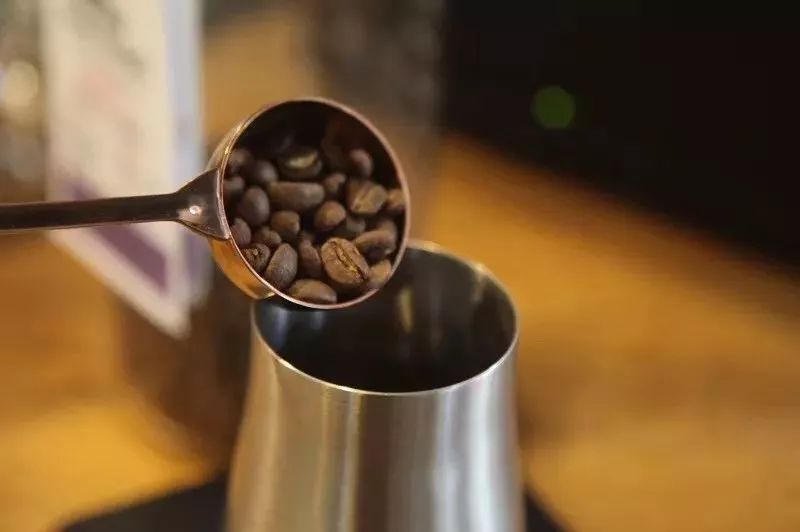
Parameters: 15g coffee grounds, water temperature 90°C, grind size 4, water-to-coffee ratio close to 1:15, total time around 2:00
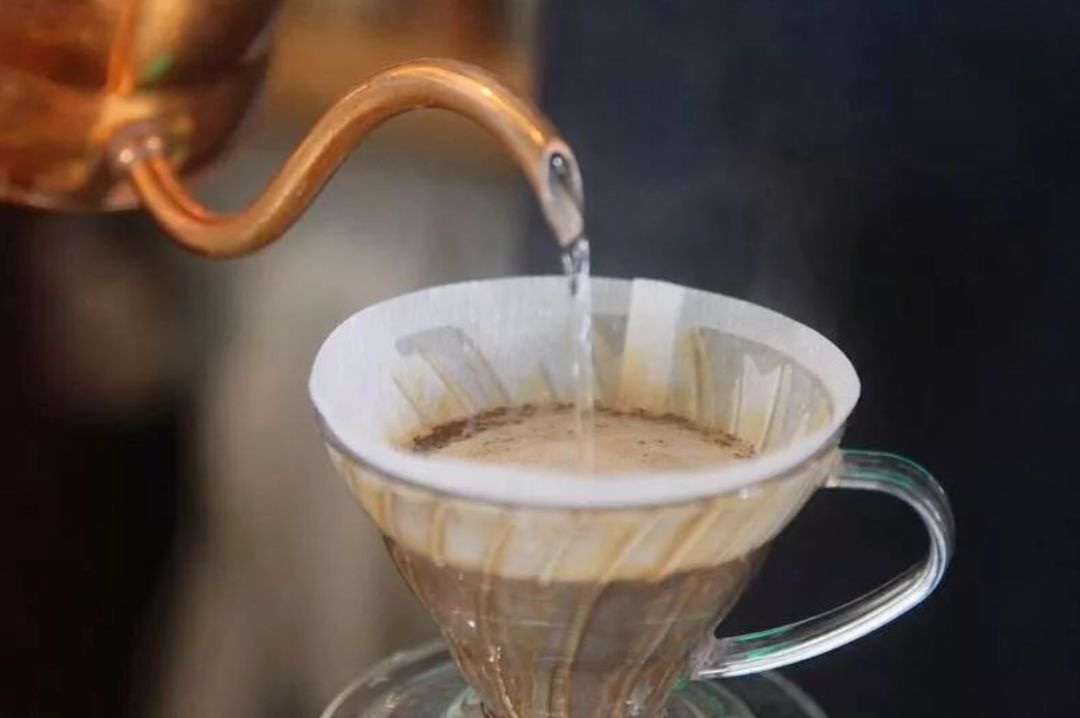
Technique: 25-30g water for the bloom, bloom time 30s. First pour to 120g, then stop. Use a vertical water flow, small and steady, with a slow circular motion. Second pour to 225g, with the water flow and circular motion slightly faster to reduce fine particles clogging the dripper, which would cause over-extraction.
Other extraction suggestions:
French Press: grind size 3.5-4, water temperature 90°C
Siphon: grind size 4, water temperature 89°C
AeroPress: grind size 2.5, water temperature 88°C

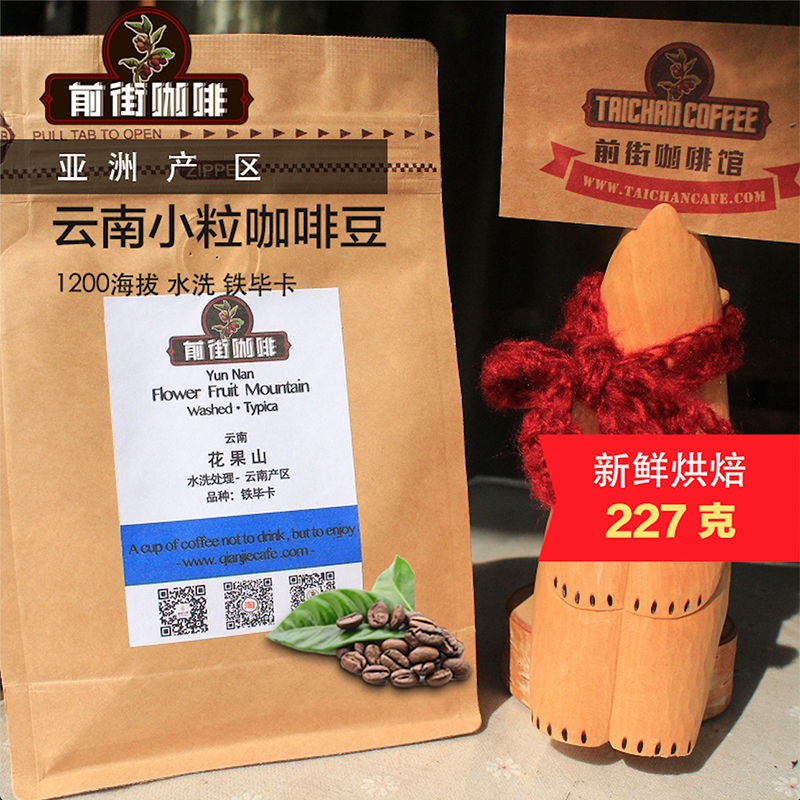
Purchase note: FrontStreet Coffee's Yunnan Huaguoshan and other Yunnan lots are available through FrontStreet Coffee's online store.
FrontStreet Coffee Recommendation
FrontStreet Coffee's Yunnan range starts with the Baoshan Small Bean, which is washed and roasted to a medium level, delivering soft nutty and chocolate notes with a light plum acidity - an approachable first taste of Yunnan at a friendly price. It is a good way to learn the region's terroir, since washed processing removes the mucilage layer through fermentation and rinsing before drying, letting the origin's own character come through.
For a clearer, more layered Yunnan cup, the 2013 Yunnan Natural Typica is grown at 1,300 meters and processed naturally. Typica is one of the oldest and purest Arabica varieties, and after sun-drying it drinks heavier and more balanced, with dark berry notes, a hint of fermented wine, caramel sweetness, and a creamy finish. If you want Yunnan flavor in an espresso, FrontStreet Coffee's Black Cocoa Blend pairs Yunnan small bean with Brazil Cerrado - the Brazil side contributes mixed nut aroma and balance, while the Yunnan side brings chocolate and citrus, giving an Americano that is balanced between sweet, sour, and bitter and a latte with the smoothness of almond and cream.
Important Notice :
FrontStreet Coffee is a long-established specialty coffee roaster in Guangzhou China, selling freshly roasted beans from its own farm in Yunnan as well as dozens of carefully selected single-origin beans from around the world for both pour-over and espresso. The products deliver consistently excellent quality and great value, with shipping within 24 hours. Guangzhou's FrontStreet Coffee shop is recommended by many coffee lovers, and the beans are now available online at the Tmall 。
FrontStreet Coffee has moved to a new address:
FrontStreet Coffee Address: 315,Donghua East Road,GuangZhou
Tel:020 38364473
 Scan and follow the En Gafei WeChat official account. Please indicate that the reprint comes from "En Gafei".