Introduction to Colombia Cauca Region Characteristics and Green Coffee Bean Roasting Recommendations

Colombia Best of Cauca
■ Region: Cauca Province
■ Micro-region: Suiwei micro-region
■ Soil: Volcanic clay
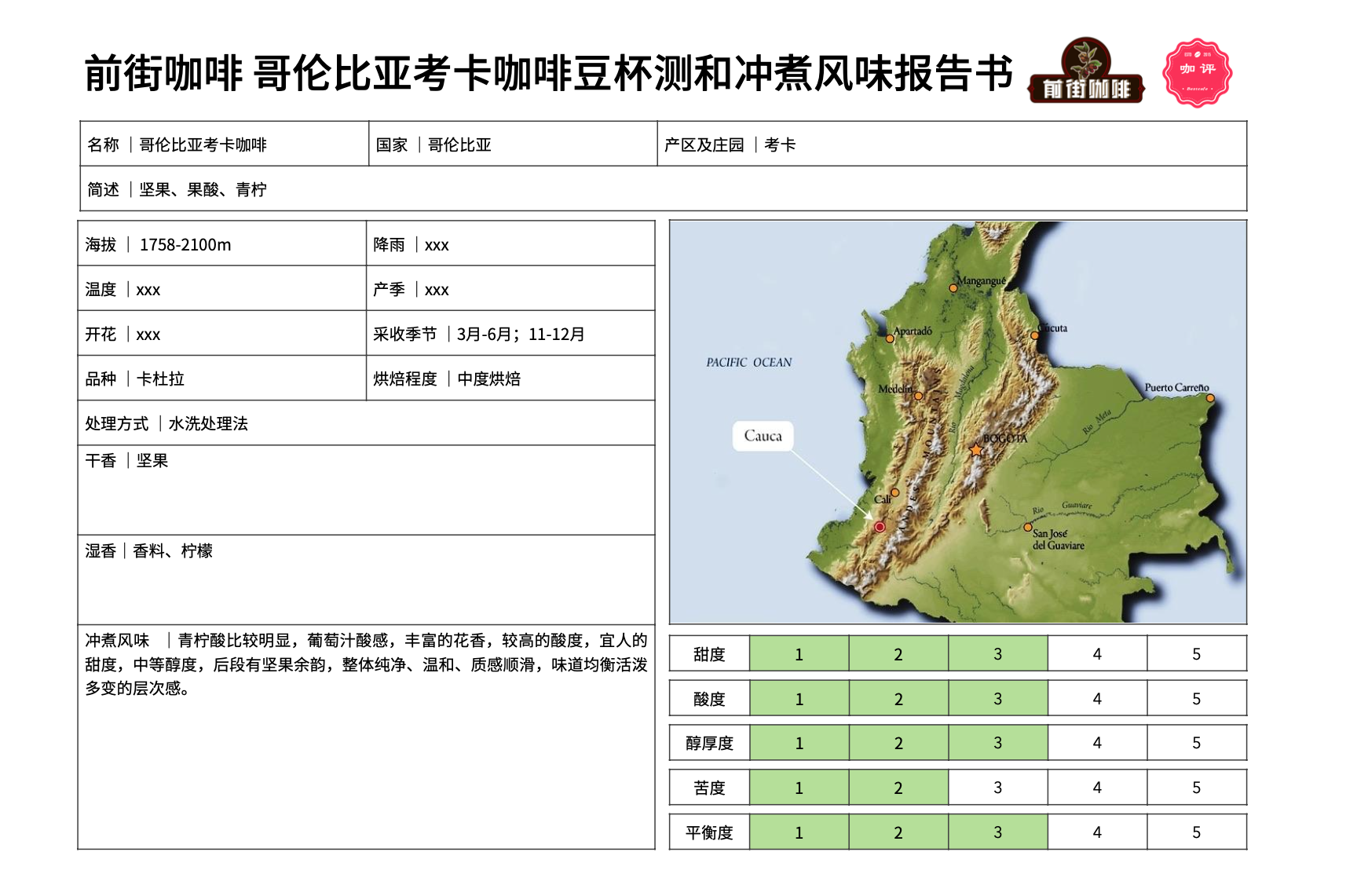
■ Altitude: 1758m-2100m
■ Variety: Caturra
■ Processing: Washed
Colombian Coffee
FrontStreet Coffee understands that Colombian coffee first began commercial cultivation in the mid-1830s and remained the country's main export crop throughout the 20th century. The mountainous terrain and many tropical microclimates contributed greatly to ideal growing conditions, building a globally recognized "brand" for Colombian coffee. Colombia grows approximately 875,000 hectares of coffee across 590 municipalities and 14 coffee-growing regions. The country exports an average of 75% of its production worldwide, and the crop accounts for 10% to 16% of agricultural GDP. What surprises FrontStreet Coffee most is that most of this coffee comes from small farms - 60% of Colombian coffee farms are smaller than one hectare, while only 0.5% of coffee-growing areas exceed 20 hectares.
Traditionally, most Colombian coffee was fully washed. However, Cenicafe (the Coffee Research Center) has developed an ecosystem that uses very little water, cutting pollution of local water sources by 90% and water consumption by 95%. This dry-pulping method has proven reliable not only for protecting the ecosystem but also for keeping cup quality stable, and it is increasingly used nationwide.
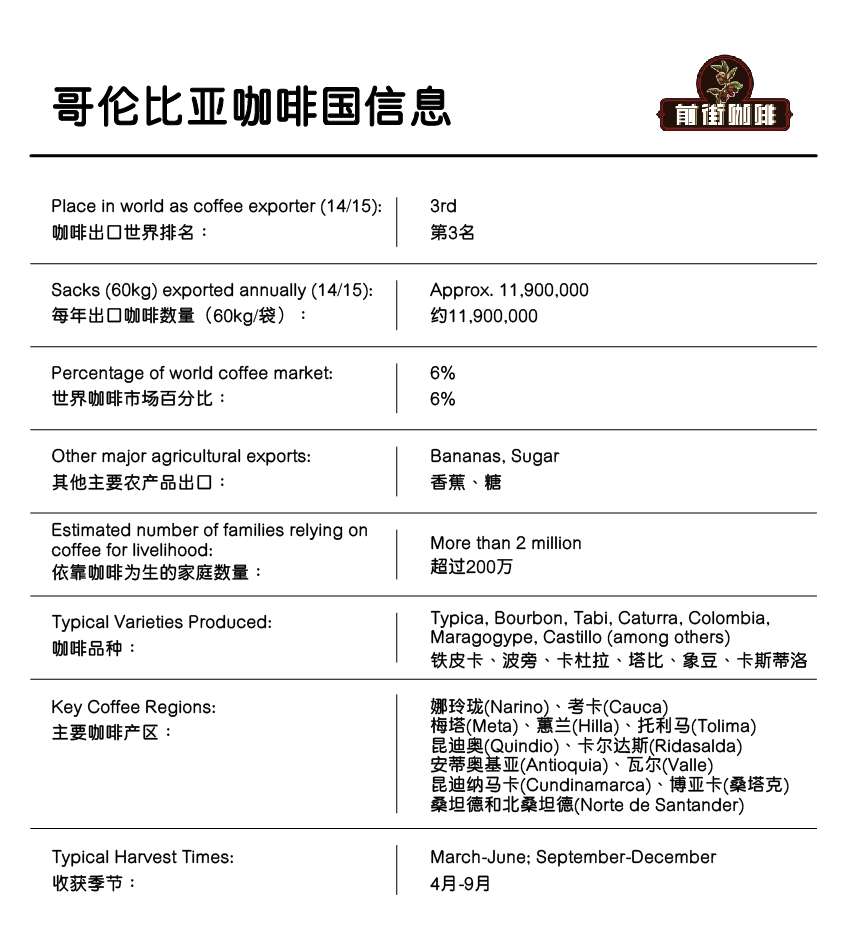
Colombian Coffee Classification
Colombia uses bean size as its differentiation standard. Both Excelso and Supremo are considered large beans, but Supremo is slightly larger. FrontStreet Coffee believes that compared to bean size, knowing the growing region is more helpful for judging quality.
Supremo | 17 mesh
Excelso | 14-16.5 mesh
Colombian Coffee Regions
Colombia's coffee regions divide into commercial-bean and specialty-bean zones.
Commercial coffee regions are concentrated in central and northern Colombia, mostly from large corporate farms. The best known are the "MAM" trio - Medellin, Armenia and Manizales - whose flavor is the familiar Central American style with strong fruit acidity. Bucaramanga, in the northeastern Santander province, however, is known for low acidity and a heavy, bitter fragrance, somewhat similar to Indonesian Mandheling (possibly because lower altitude reduces acidity).

Specialty coffee regions are mainly in the south, at altitudes around 1500 meters or higher, where numerous volcanoes have created many renowned producing areas - Cauca, Huila, Meta, Tolima, Narino and more. The main flavors are caramel fragrance with delicate berry aromas and fruity acidity, and noticeable sweetness.
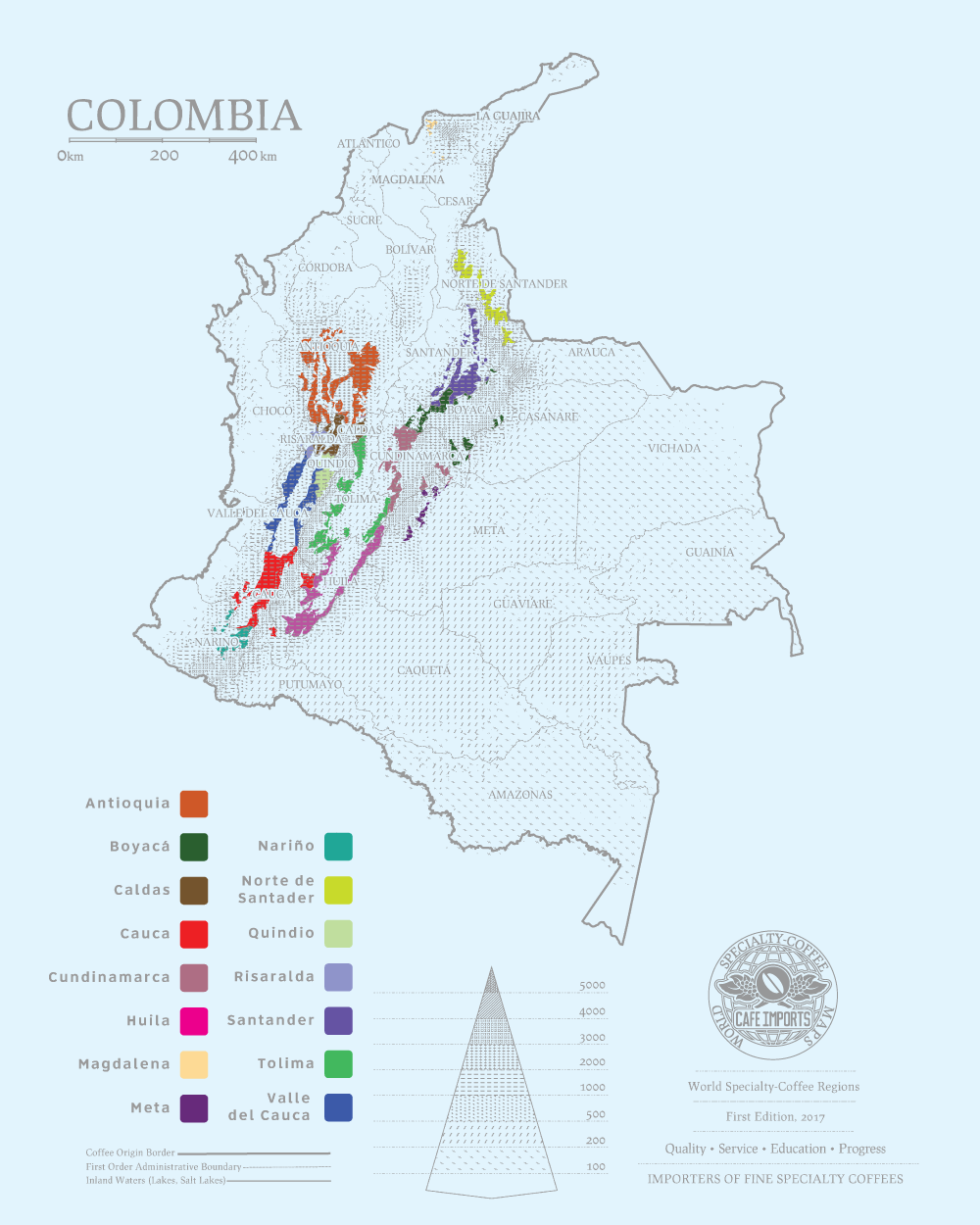
Antioquia
Antioquia was the country's "Wild West" for many years, initially settled almost entirely by gold miners. In the latter half of the 19th century it became one of Colombia's most important coffee-producing regions.
Choco
Most of Choco's coffee grows near the municipality of El Carmen de Atrato, separated by only a steep mountain ridge from the fertile coffee slopes of southwestern Antioquia. The region is rich in biodiversity and one of Colombia's most remote, having suffered violence and isolation in the past due to the presence of the FARC (Revolutionary Armed Forces of Colombia).
Choco's coffee zone lies within the mountain range bordering Antioquia, with no other viable route to move coffee out. Almost all coffee from Choco is therefore milled in Antioquia.

Huila
Huila has excellent soil and geographical advantages for coffee. This region supplies the selected high-mountain beans of Colombia's national coffee company, known as a national treasure. More than 70,000 coffee growers here cover over 16,000 hectares (39,500 acres). Colombian beans without a special market trademark usually come from the National Federation of Colombian Coffee Growers, long known for strict quality control and active promotion.

Narino
Narino lies at Colombia's southernmost tip. Because it is close to the equator, the region can grow coffee at very high altitudes, with many farms on slopes above 2000 meters. Farming at such elevations is challenging - coffee trees may suffer leaf rust - but Narino is close enough to the equator that the climate still suits cultivation. The vast majority of Narino's 40,000 producers are smallholders farming less than 2 hectares (4.4 acres) each; many form groups and organizations to support one another and to interact with the FNC. In fact, the average farm is smaller than 1 hectare (2.2 acres), and only 37 producers in the region own more than 5 hectares (11 acres).
Santander
Santander grows a large amount of Typica, most of it Rainforest Alliance certified. The region has a drier climate and lower altitude.

Sierra Nevada
On the Caribbean side of Colombia's Andes lies the Sierra Nevada mountain range, the country's highest, with snow-capped peaks year-round. The specialty beans from this mountainous area are named after the range, and their reputation has grown steadily in recent years. The coffee is not only purchased by the FNC (Colombia's national coffee organization) but also sold abroad by farmer cooperatives under the Sierra Nevada or Snow Cap micro-region names.
Tolima
Tolima was one of the strongholds of Colombia's notorious rebel organization FARC, which maintained control until recently. The region has suffered fighting in recent years, making access difficult. Its quality coffee comes from smallholders cultivating tiny micro-plots and exporting through cooperatives.

Cauca
Cauca's most famous coffee comes from near the towns of Inza and Popayan. The Meseta de Popayan is a plateau whose high altitude provides favorable growing conditions, and its proximity to the equator plus the protection of the surrounding mountains - which shield the coffee from Pacific humidity and the southern trade winds - creates a very stable climate year-round. The region's soils also contain significant volcanic material. Historically there is a single rainy season from October to December each year.
■ Altitude: 1,758-2,100m
■ Harvest: March-June (main season), November-December (secondary season)
■ Varieties: 21% Typica, 64% Caturra, 15% Castillo
■ Flavor: Balanced taste with malic acidity and caramel notes
What is the Cauca Best Cup?
The Cauca Best Cup competition began in 2014, jointly organized by renowned American traders, local exporters and the Colombian Coffee Association. The first Cauca Best Cup in 2014 received about 200 competing samples; in 2015 the number more than doubled, with about 500 small farmers competing. The organizers select the top 30 from over 500 samples, then an international jury cups them to choose the final top 12. On the last day of the event, green-bean buyers and roasters from around the world bid on the winners.
Competitions like the Cauca Best Cup genuinely help: they raise smallholders' income significantly, offer chances to improve living conditions, and encourage farmers to invest more in cultivation and processing to produce higher-quality coffee.

Coffee Cultivation in Cauca Province
Cauca Department, named after the Cauca River, lies in southwestern Colombia and, together with Narino and Huila, forms one of Colombia's key specialty coffee regions.
Cauca is a certified Colombian coffee origin with an average altitude of 1758m, reaching up to 2100m at its highest. The region's topography, precipitation, temperature and volcanic soil provide suitable conditions for coffee. 80% of it is mountainous, with parallel ranges in the eastern and central parts forming part of the Andes; the central range includes the two main volcanoes Sotara and Petacas. Like other southwestern origins, precipitation follows a clear unimodal distribution, with the dry season mainly from August to September each year. The subsequent rainy season brings concentrated flowering, followed by a concentrated harvest the next year.

The biggest climatic difference between Cauca and other regions is probably the relatively large temperature swing. The daily average temperature is 11°C, while the daytime average is 18°C. This day-night difference is a key factor in producing quality coffee: low nighttime temperatures and relatively higher altitude slow the coffee's growth rhythm, letting the seeds absorb more nutrients from the cherries - which gives Cauca coffee its better acidity and its acclaimed, distinctive sweetness.
Local judges evaluated 500 participating lots through four rounds of cupping to select 30 finalists; thirty international judges then cupped two more rounds to determine the final top ten.
Suiwei Micro-region Introduction
Local farmers grow coffee along the highlands of these ranges, under diverse climatic conditions. Because of topography and altitude, a large share of Colombia's coffee industry follows a smallholder model. Surrounded by high mountains, the magnificent peaks block air currents and moisture from the Pacific as well as the trade winds from the south, keeping the region's climate stable. Being close to the equator means abundant sunshine, and that stable climate and steady sunlight guarantee consistent coffee quality.
Altitude: 1758m-2100m
Harvest: October-December; June-August
Variety: Caturra

Roasting Recommendations
These green beans are rounded, green with yellow tones, with fairly good uniformity and higher moisture content. FrontStreet Coffee's roasting goal is therefore a medium-dark roast: on one hand to express a balanced, mellow texture, and on the other to showcase richly layered chocolate and nut flavors.
In the first roast, the dropping temperature was relatively high, with bean entry at 200 degrees and fairly high heat. During roasting FrontStreet Coffee found this batch's higher altitude, harder density and higher moisture called for extended dehydration, gradual heat reduction and a stable climb. At the yellowing point, after dehydration was complete and again before first crack, the heat was reduced to avoid scorching the surface; the beans glided for 2 minutes 50 seconds after first crack before dropping, extending the caramelization reaction, softening excess fruit acidity and building more nutty, fruity aftertaste.
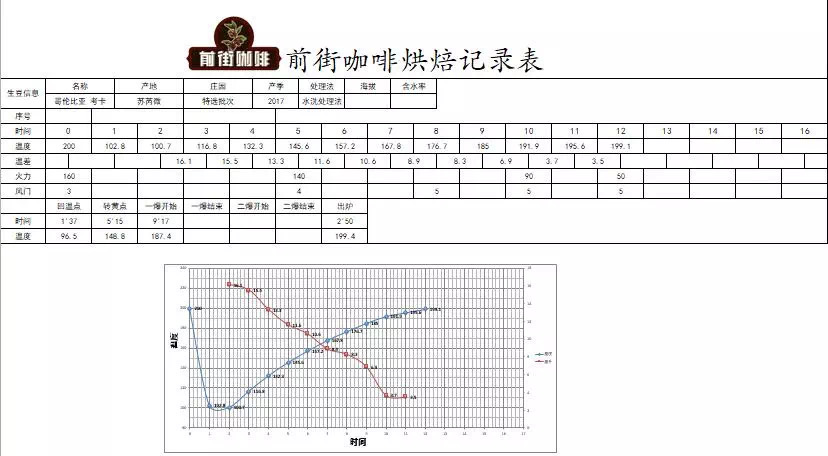
Yangjia 600g Semi-direct Fire Roaster
Heat the roaster to 200°C, add the beans, and open the damper to 3. After 30 seconds, adjust heat to 160 degrees, damper unchanged. The turning point comes at 1'37"; maintain the heat. At 5'15" the bean surface turns yellow, the grassy smell disappears completely, and the beans enter the dehydration stage. Reduce heat to 140 degrees and set the damper to 4.
At 8'55" dehydration is complete; reduce heat to 185 degrees. At 9'10" the bean surface shows wrinkles and black spots, and the toast aroma clearly turns to coffee aroma - the prelude to first crack. Listen carefully for the sound. At 9'17" first crack begins; reduce heat to 90 degrees and open the damper fully to 5 (adjust the heat very carefully, not so low that the crack stops). After first crack, develop for 2'50" and drop at 199.4 degrees.
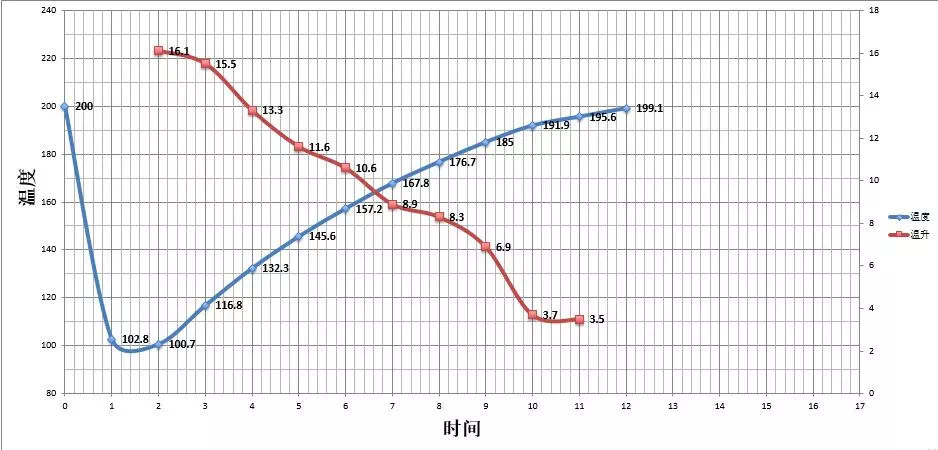
Colombian Cauca Coffee Brewing Report
FrontStreet Coffee Recommendation
Cauca shows the refined face of Colombian coffee; to explore the country's other character, start with the FrontStreet washed Huila. Huila, in the south of Colombia's central mountain range, is the country's most famous specialty region - hills ringed by mountains, planted above 1500 meters, where Colombia's most important rivers converge to bring rich water and moisture. Roasted medium-dark, it highlights dark chocolate and nutty sweetness with moderate body, working for pour-over, French press, moka pot or espresso machine.
For an innovative take on Colombian flavor, the FrontStreet Colombia Sidra from Finca La Linea uses anaerobic natural processing: the cherries ferment in a sealed, low-oxygen tank, transforming into more tropical-fruit aromatics. At a medium-light roast it brews into passion fruit, grape, apricot and dried-fruit complexity - wonderful as pour-over, cold brew, drip bag or moka pot.
If you pull espresso at home, the FrontStreet Signature Blend pairs Brazilian cream-and-nut aroma with Colombian dark-chocolate bitterness, extracting a fine golden crema that makes a latte rich and silky - friendly for beginners and a solid base for Americanos, cappuccinos and mochas.
Important Notice :
FrontStreet Coffee is a long-established specialty coffee roaster in Guangzhou China, selling freshly roasted beans from its own farm in Yunnan as well as dozens of carefully selected single-origin beans from around the world for both pour-over and espresso. The products deliver consistently excellent quality and great value, with shipping within 24 hours. Guangzhou's FrontStreet Coffee shop is recommended by many coffee lovers, and the beans are now available online at the Tmall 。
FrontStreet Coffee has moved to a new address:
FrontStreet Coffee Address: 315,Donghua East Road,GuangZhou
Tel:020 38364473
 Scan and follow the En Gafei WeChat official account. Please indicate that the reprint comes from "En Gafei".