Introduction to Endebess Estate, Kenya - Kenya Coffee Estate Introduction

Yes, we know many people shy away from coffee with particularly prominent acidity, preferring full body with nutty chocolate flavors instead. Kenyan coffee is exactly the kind that leaves a lasting impression through its acidity. And although Kenya is known as a washed-processing origin, other methods exist here too — washed Kenya is simply what most people know. So do you know what sun-dried Kenyan coffee tastes like? Let's find out.
Kenya
Kenya's climate and geography give it unique advantages for growing high-quality coffee. It sits in eastern Africa with the equator crossing its center and the Great Rift Valley running north to south, bordering Somalia to the east, Tanzania to the south, Uganda to the west, and Ethiopia and Sudan to the north, with a 536-kilometer coastline along the Indian Ocean to the southeast. The country is mostly plateau, at an average altitude of 1,500 meters.
Mount Kirinyaga (Mount Kenya) in the center rises to 5,199 meters with snow-capped peaks — Africa's second-highest mountain. The whole region lies in the tropical monsoon zone, but at its elevation the climate behaves as tropical savanna, with pronounced seasonal variation in rainfall.
The coast is hot and humid while the plateaus are mild: annual highs run 22-26°C and lows 10-14°C. Coffee is a pillar industry, with most Kenyan coffee grown at 1,500-2,100 meters and harvested twice a year.
Its signature is distinct fruit aroma — citrus most commonly. Most Kenyan coffees show multi-layered profiles with juice-like acidity, grapefruit and winy flavors, and moderate body.
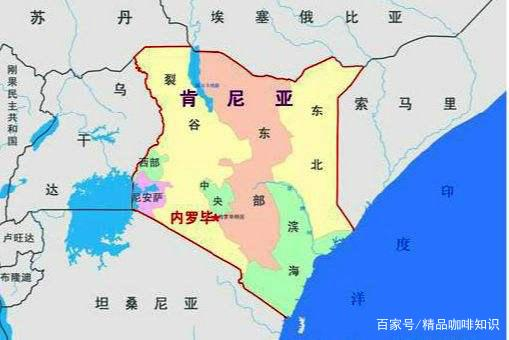
The Great Rift Valley
The Great Rift Valley of eastern Africa is a geological wonder formed 35 million years ago by movements of the African plate. This massive gash through East Africa is the world's largest fracture zone and marks a divergent plate boundary. It contains the Cherang'any Hills and a series of volcanoes, some still active; the hills are one of Kenya's five major forest and water-catchment areas, spanning three counties.
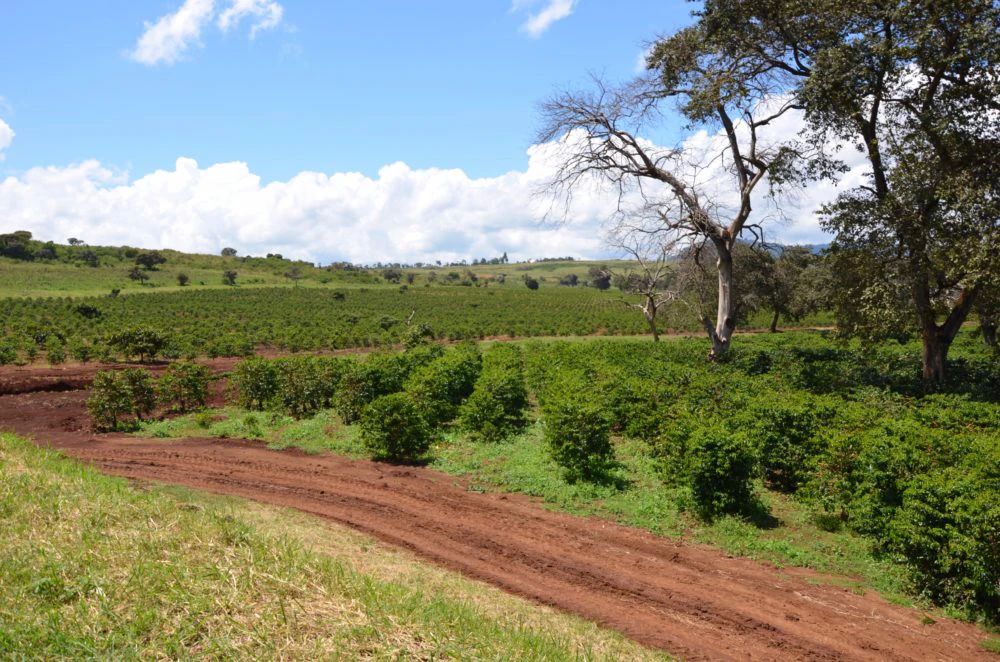
Endebess Estate lies at the foot of Mount Elgon, an extinct volcano on the Uganda–Kenya border, in the northern part of Kenya's eastern Rift Valley near the town of Kitale in Trans Nzoia County. The estate covers roughly 758 acres, of which 248 acres are planted with coffee. For natural processing, fresh water from the Koitobos River washes the cherries thoroughly before they dry on raised beds — typically 21 to 28 days depending on the weather, with the beans turned at least four times a day. The Cherang'any Hills span Trans Nzoia, Elgeyo Marakwet, and West Pokot counties.
As early as the 1940s, Endebess was processing its own coffee as well as that of neighboring smallholders. It was once owned and managed by Mr. EW D'Ollier, sold to Gatatha Farmers Co Ltd in 1976, and sold again in 2011 to its current owners and managers, Kaitet Tea Plantations. Kaitet focuses on employee welfare and social responsibility: the farm has funded 15 housing renovation projects and sponsored two high school students, and hopes to expand those programs as the farm grows more profitable. In the short term, Endebess is upgrading its infrastructure and certification status.
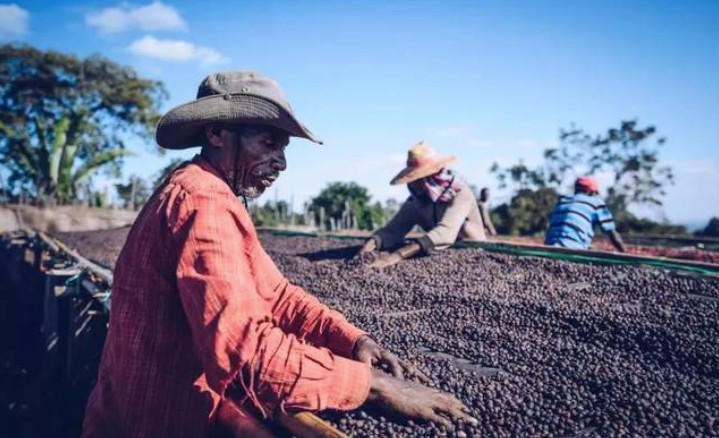
Processing Method
This micro-batch coffee is natural-processed, relying entirely on natural climate conditions. Sun-drying gives the beans a rich body and sweetness.
The natural process is the oldest and most traditional way to prepare coffee — also called "natural coffee" or "sun-dried coffee," in contrast to washed. Harvested cherries dry directly in the sun for about two to four weeks:
1. Harvest mature coffee cherries
2. Initial sorting to remove impurities and defective beans
3. Flotation screening: cherries are poured into water tanks. Mature, full cherries sink; immature or damaged ones float.
4. Sun-drying: the sunken, mature cherries are spread on drying patios, reducing moisture from 70% to about 10-12%. They must be turned several times daily for even drying and covered at night against moisture.
5. Hulling: after two to four weeks of sun, the outer layers of the seed are dry and hard. A hulling machine removes them, completing the process.
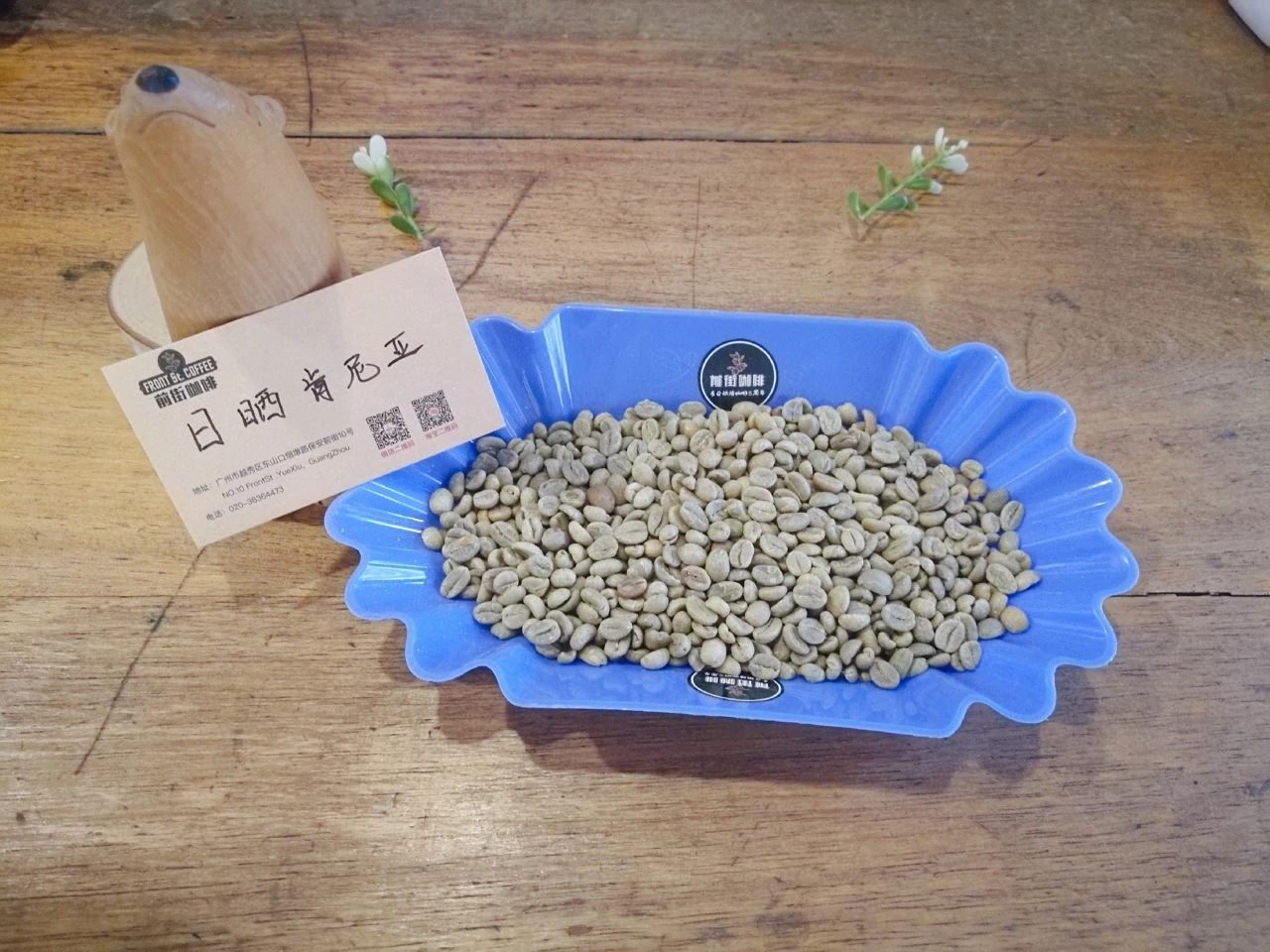
Kenyan Endebess Estate
Kenya · Endebess Estate
Region: Northern Rift Valley
Altitude: 1750-1950m
Processing Method: Natural
Grade: AA
Varieties: SL28, SL34
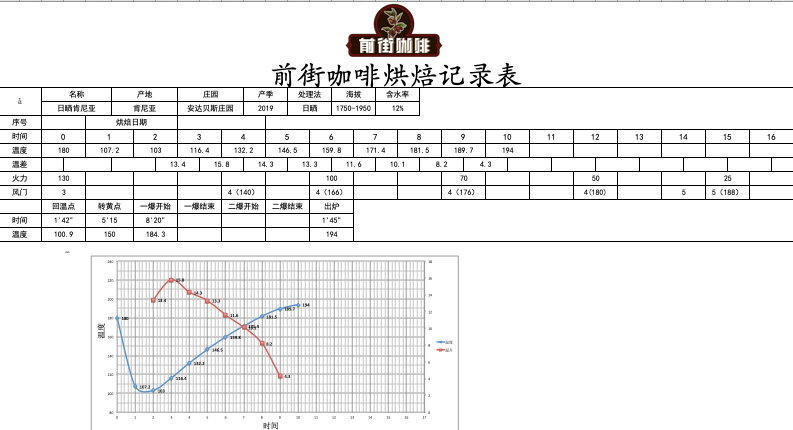
Roast Curve Analysis
Roaster: Yangjia 800N (300g batch size)
Preheat the roaster to 180°C, charge at 130 with the damper at 3. Turning point comes at 1'42". When the roaster reads 140°C, open the damper to 4. At 146°C the beans turn yellow and the grassy aroma disappears completely. At 166°C, reduce heat to 100, damper unchanged.
At 7'25", ugly wrinkles and black spots appear on the bean surface and the toast aroma clearly shifts toward coffee aroma — the prelude to first crack. Listen carefully for it. At 8'20", first crack begins: reduce heat to 70, damper unchanged. Develop 1'45" after first crack and drop at 194°C.

Agtron bean color 73.4 (top image), Agtron ground color 81.7 (bottom image), roast delta 8.3.
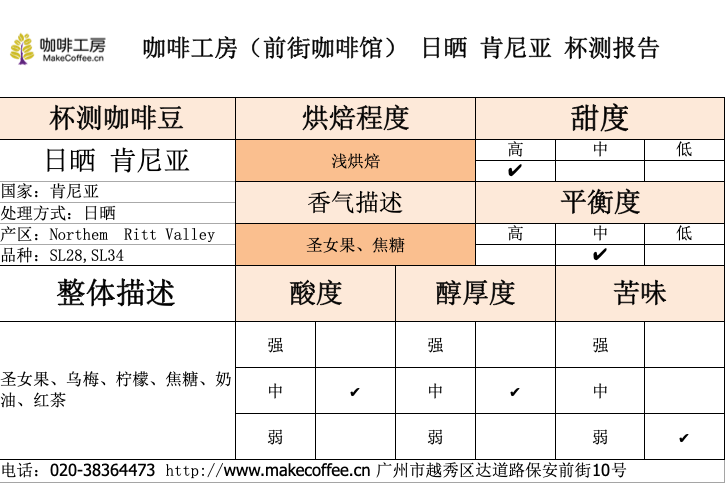
Cupping & Flavor
Flavor: cherry tomato, black plum, lemon, caramel, cream, black tea

Brewing Parameters
Recommended brewing method: pour-over
Dripper: V60
Water temperature: 90-92°C
Coffee-to-water ratio: 1:15
Grind size: medium-fine, similar to fine sugar (BG-5R, 60% pass rate on a Chinese standard #20 sieve)

Brewing technique: staged extraction. Bloom with 30g of water for 30 seconds. Pour in small circles to 125g, then pause. When the water level drops to nearly exposing the bed, pour again to 227g and stop. Once the level again nearly exposes the bed, remove the dripper (timing starts from the bloom). Extraction time: 1'54".
Flavor: caramel on the aroma, cherry tomato and black plum on entry. As the cup cools slightly, lemon acidity and creamy smoothness emerge, with black tea in the aftertaste and a sweet, lingering finish.
FrontStreet Coffee Recommendation
If Endebess' natural fruitiness has you craving more African coffee, here are FrontStreet Coffee's Ethiopian naturals we recommend, drawn from our house notes:
FrontStreet Coffee Natural Hua Kui
Our Hua Kui comes from the Hambella district of Guji, Sidamo — a 200-hectare farm processed traditionally as a natural. To keep the cherries from molding or picking up earthy odors during drying, workers lay them on raised beds for 21 days of sun, turning them constantly for even drying and hand-removing defective or moldy beans every three to five days. Once the skins dry hard they are hulled, and after the green coffee emerges the farmers run one final sort. Because the beans dry with fruit and skin intact, a medium-light roast shows a light winy ferment, florals, citrus, and mango — a denser, more complex cup with honeyed sweetness, a cocoa undertone touched with spice, thick body, and a long finish.
FrontStreet Coffee Natural Red Cherry
Naturals are the opposite of washing: blemished or moldy cherries are removed first, then the rest sun-dries for two weeks so the fruit's sugars soak fully into the beans, until moisture drops to 12%. Machines strip the hardened skin, mucilage, and pods, after which the beans face density and color checks, defective beans are culled, and workers hand-pick whatever slipped through. The result: every bean specialty grade, exceptionally clean, with rich, captivating fruit. Our Yirgacheffe Red Cherry Project natural tastes of peach, cocoa, honey, and lemon.
FrontStreet Coffee Sidamo Natural Hamasho
From the same Sidamo zone, the Hamasho washing station is a fixture on Ethiopian green-coffee competition winner lists. Its coffee centers on the JARC (Jimma Agricultural Research Center) 74-series disease-resistant varieties; the 74158 has smallish beans with prominent floral-fruity character. Our Hamasho 74158 smells of perfumed lemon, strawberry, and star fruit, opens on clear strawberry, star fruit, and green-grape sweetness, and lets a gentle floral note rise behind.
FrontStreet Coffee Kaffa Forest
Unlike the garden-farming model of coffee behind farmers' homes, Kaffa Forest is the classic home of wild coffee: trees grow entirely under shade at 1,400–2,100 meters, with pristine ecology, microclimates, red-clay soil, and abundant rain. Roasted medium-light, our Kaffa Forest shows distinct white florals after grinding, bright lemon acidity with sweet orange and bergamot, a light melon-and-nut sweetness in the return, and a green-tea texture.
Important Notice :
FrontStreet Coffee is a long-established specialty coffee roaster in Guangzhou China, selling freshly roasted beans from its own farm in Yunnan as well as dozens of carefully selected single-origin beans from around the world for both pour-over and espresso. The products deliver consistently excellent quality and great value, with shipping within 24 hours. Guangzhou's FrontStreet Coffee shop is recommended by many coffee lovers, and the beans are now available online at the Tmall 。
FrontStreet Coffee has moved to a new address:
FrontStreet Coffee Address: 315,Donghua East Road,GuangZhou
Tel:020 38364473
 Scan and follow the En Gafei WeChat official account. Please indicate that the reprint comes from "En Gafei".