How Does Blue Mountain Coffee Taste? The Unique Growing Environment of Jamaica Blue Mountain Coffee
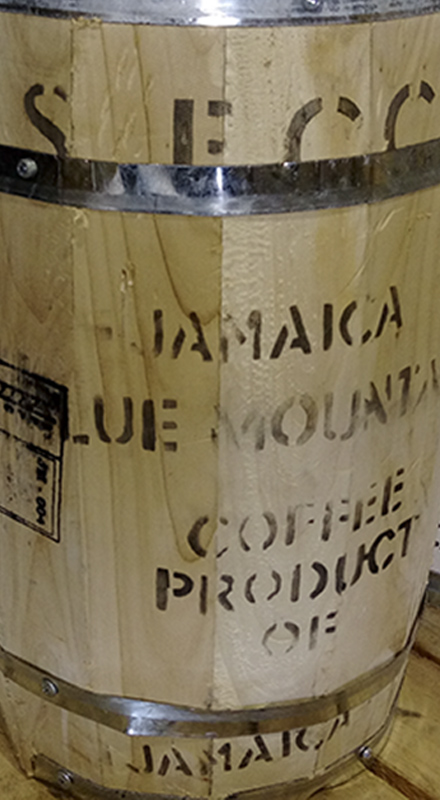
Jamaica Sherwood Blue Mountain
Sherwood Coffee Estate is a small family-run plantation located in Hagley Gap, a village in St. Thomas parish in southeastern Jamaica. Its production accounts for 2% of the total Blue Mountain coffee harvest, and its handcrafted coffee ranks among Jamaica's finest, recognized by the Jamaica Coffee Industry Board (CIBOJ) as quality-certified Blue Mountain coffee. As of 2015, Sherwood Forest became one of the estates under R.S.W. Estate, which now retains only the highest-altitude Sherwood section, allowing Sherwood to operate independently.

Estate History and Operations
The estate and its processing plant have been in operation since 1797, passing to the Deichmann family's management in the 1950s, when the current operator Charles's father purchased the land and replanted the farm, which sits at approximately 1,372 meters above sea level. In 1999, Deichmann upgraded the estate and processing equipment, processing green beans with modern facilities while preserving traditional techniques and enforcing strict environmental policies. The estate employs an equal ratio of male and female workers, with all management and staff drawn from local villages.
Unique Growing Conditions
Thanks to the high altitude, cool mountain mist often wraps the area in the afternoon, shielding the trees from harsh midday sun and creating ideal growing conditions. This ensures more complete development and nutrient absorption in the coffee cherries. The harvest runs from March to June, later than at other Jamaican Blue Mountain estates. Fresh hand-picked red cherries from the estate's own trees, along with small quantities from other renowned Blue Mountain farms such as Arntully and Moy Hall, are delivered to Sherwood's wet mill. Sherwood insists on never accepting coffee of unknown origin.
Meticulous Processing
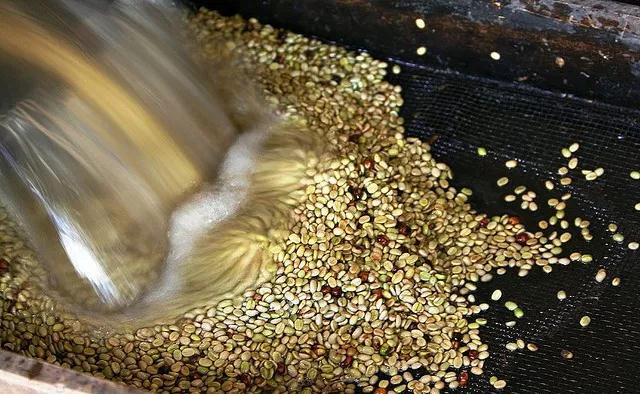
After harvest, the red cherries are depulped immediately, followed by a full 24-hour wet fermentation to deepen flavor development. During washing, Sherwood avoids machines or brushes to force pulp off, relying instead on fermentation for natural separation. The beans are then 100% sun-dried to a moisture content of 11.5%, with artificial drying abandoned entirely. This sun-drying contributes to the coffee's richer overall aroma and body. After drying, the parchment beans rest in underground storage with temperature and humidity control for at least eight weeks before hulling. The warehouse is fitted with two commercial dehumidifiers and two tons of air-conditioning equipment, holding the environment at 19.4°C and 52% humidity. To guarantee quality, Sherwood sells only small batches of hand-picked, properly stored green beans and never warehouses coffee for future sales.
Quality Assurance and Distribution
During dry milling, the green beans are moved to warehouse storage the night after processing until delivery to the Jamaica Coffee Industry Board (CIBOJ), which conducts color inspection and cupping to evaluate bean size, defects, and moisture. Finally, these meticulously processed Sherwood green beans are exported under the "SFCC" (Sherwood Forest Coffee Co.) barrel trademark.
Currently, Sherwood Blue Mountain is sold exclusively to single companies in the United States, Europe, Japan, and China, with small quantities reserved for personal use and limited edition releases.
Sherwood Blue Mountain No.1 Specifications
■ Country: Jamaica
■ Region: Sherwood
■ Altitude: 1,200-1,600 meters
■ Processing Method: Washed
■ Grade: No.1
■ Variety: Arabica
■ Flavor Notes: Floral, toffee, smooth mouthfeel, high body
Sherwood Blue Mountain Peaberry Specifications
2017 Sherwood PB green beans image
Sherwood Blue Mountain Peaberry
■ Country: Jamaica
■ Region: Sherwood
■ Altitude: 1,200-1,600 meters
■ Processing Method: Washed
■ Grade: PB
■ Variety: Arabica
■ Flavor Notes: Floral, bright, lemon acidity, milk candy, excellent body
FrontStreet Coffee's Roasting Recommendations
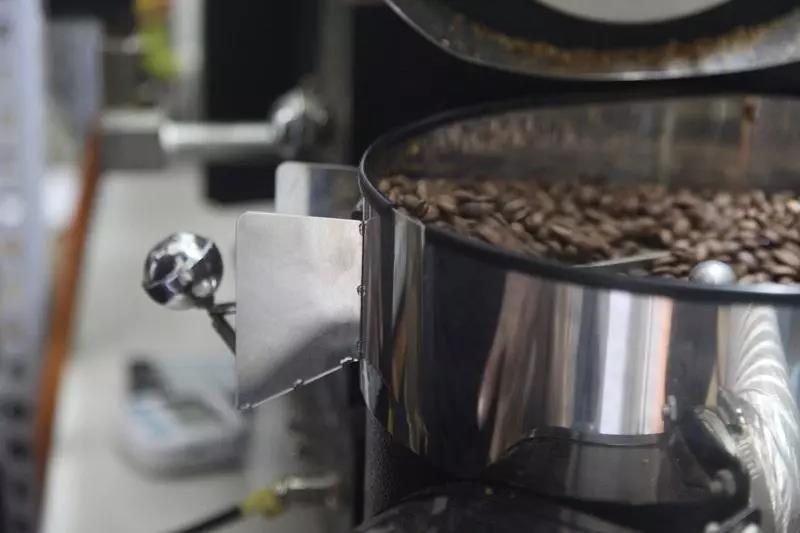
Simply put, roast Blue Mountain coffee "thoroughly," from the inside out, layering superior roasting technique on a proper roast foundation to express this bean's flavor character in full.
Caramelization is the single biggest factor shaping coffee flavor. After six to seven minutes of roasting, the beans have absorbed substantial heat energy, initiating pyrolysis and producing first crack. Some sugars convert to carbon dioxide, moisture continues to evaporate, and new aromatic compounds develop, forming the so-called coffee oils, which combine with hundreds of aromatic substances including nicotinic acid, citric acid, quinic acid, malic acid, and acetic acid, along with caffeine.
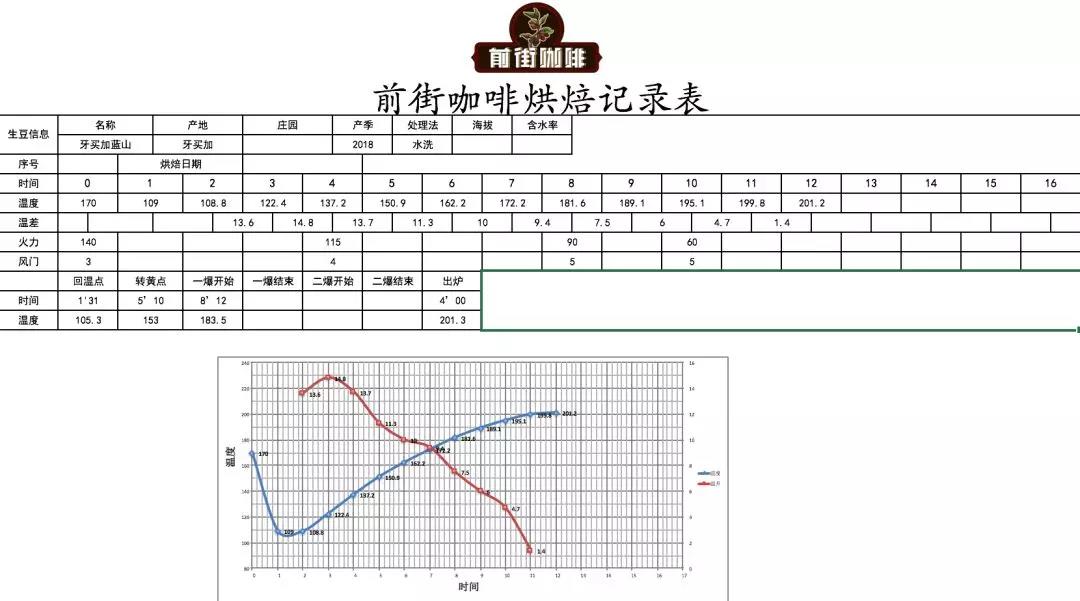
Roast profile: preheat the roaster to 170°C and charge with the damper at 3. After 1 minute, reduce heat to 140°C with the damper unchanged. At 5'10" the temperature reaches 153°C, the bean surface yellows, the grassy aroma disappears completely, and drying is complete. Reduce heat to 115°C and the damper to 4.
At 8'00", wrinkles and black spots appear on the bean surface and the toast aroma distinctly transforms into coffee aroma, definable as the prelude to first crack, so listen carefully. At 8'12" first crack begins; reduce heat to 90°C with the damper fully open (adjust heat very carefully, never so low that the cracking stops). Drop the beans at 201.3°C.
Cupping Notes
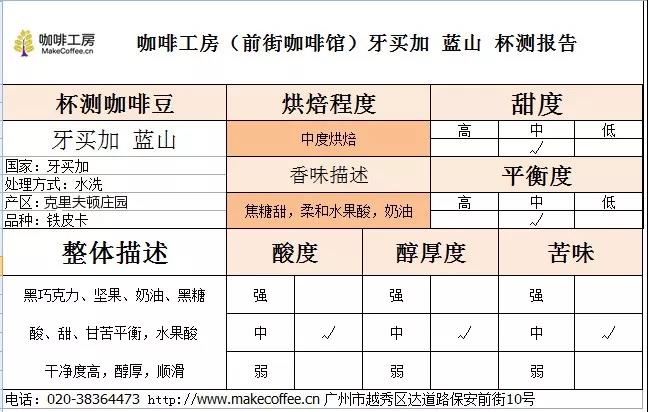
A perfect, subtle balance of acidity, body, and aroma. The acidity is bright and delicate, the body velvety smooth, and the aroma gently penetrating, accompanied by floral, spicy, and citrus notes, with a subtle cocoa aftertaste on the palate.
The flavor is exceptionally clean, complex, and very mild, with chocolate sweetness and a very strong body. The taste is rich and mellow, with the sweet, sour, and bitter elements in perfect harmony: no harsh bitterness at all, only moderate, flawless acidity, and a persistent fruity finish.
Dry Aroma: Roasted peanut, hazelnut, melon, chocolate-like
Wet Aroma: Oolong tea, caramel, honey, dark chocolate, almond skins, silky mouthfeel, brightness
FrontStreet Coffee Recommendation
If Sherwood has whetted your appetite for Jamaica's finest, FrontStreet Coffee's Jamaica Blue Mountain No.1 is the top grade of the region, sourced from the historic Clifton Estate, which has grown coffee since around 1750. Its fields sit at an average of 4300 feet (1310.64 meters), where ample altitude, gentle afternoon mists, forest shade, generous sunshine, and mineral-rich soil prolong cherry maturation and deepen the cup. Jamaica's Blue Mountain range tops out at 2256 meters, the island's annual Blue Mountain output falls short of 2500 tons, and Japan has historically bought more than 70% of it, which is why authentic beans are so scarce.
FrontStreet Coffee roasts its Blue Mountain No.1 medium-dark to highlight the classic balance, so the brewed cup unfolds in layers of nuts, dark chocolate, cream caramel, and gentle sweetness. For best results at home, rest the beans 4-7 days from roast date, grind to a white-sugar coarseness slightly coarser than for light roasts, and brew on a Kono dripper: 15g of coffee, water at 87-88°C, a 1:15 ratio, and a three-stage pour of 30g to bloom for 30 seconds, 120g to pause, then 225g to finish, keeping the stream small and slow in the middle stage and slightly faster at the end to avoid clogging and over-extraction.
Important Notice :
FrontStreet Coffee is a long-established specialty coffee roaster in Guangzhou China, selling freshly roasted beans from its own farm in Yunnan as well as dozens of carefully selected single-origin beans from around the world for both pour-over and espresso. The products deliver consistently excellent quality and great value, with shipping within 24 hours. Guangzhou's FrontStreet Coffee shop is recommended by many coffee lovers, and the beans are now available online at the Tmall 。
FrontStreet Coffee has moved to a new address:
FrontStreet Coffee Address: 315,Donghua East Road,GuangZhou
Tel:020 38364473
 Scan and follow the En Gafei WeChat official account. Please indicate that the reprint comes from "En Gafei".