Ethiopia Washed Sidamo G2 Specialty Coffee Beans: Growing Conditions, Geographic Location, Climate, and Altitude Overview
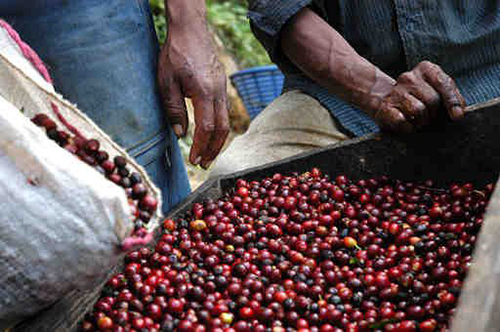
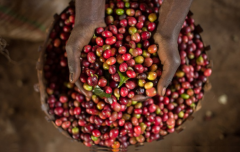
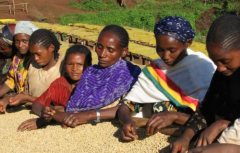
Ethiopian farmers harvest vivid red coffee cherries daily, and every two days' harvest forms a lot of fruit that is sent or sold to washing stations for processing. Cherry that doesn't reach a washing station typically gets about 12 hours of natural fermentation before being sun-dried and hulled. Either way, farmers with the means will always try to route their coffee through a washing station to capture the premium attached to the "washed" designation. At the stations, cherries are soaked and fermented for about 12 hours to soften the pulp, then pushed through water channels where agitation separates the beans from the fruit; the pulp is flushed out through sluice gates.
Ethiopia's washing stations continue to grow in number. Smallholders sell their harvested cherry to processing plants, where it is hulled and resold through the auction system, then shipped to the Red Sea port of Assab in Eritrea and the port of Djibouti on the Gulf of Aden. Coffee is the country's main agricultural export, but domestic consumption is remarkable too — roughly 1,500,000 bags (60kg each), about 50% of total production. Wild coffee grows in the tropical rainforests of the southwestern highlands and is mostly hand-picked. Precisely because of that, some locals deliberately cut or burn the natural rainforest to reach rugged, hard-to-access mountain areas, doing real damage to the ecological balance.
Both washed and sun-dried green coffee bound for export is sent to the capital Addis Ababa and to Dire Dawa in Harar province for auction and shipment. The Dire Dawa auction center typically handles the sun-dried Harar lots from that region. At the auction house, daily information on coffee from different farms is posted for traders, and government inspectors move through the center daily, randomly sampling 3 kilograms of green beans from each shipment for grading.
Variety
Local native (heirloom) varieties
Flavor Notes
Honey, citrus, lemon
Wild Arabica still grows across large parts of Ethiopia, typically at elevations between 4,200-6,800 feet, and cultivation is gradually shifting toward smallholder plots, usually interplanted with banana trees for shade. Lacking modern agricultural inputs, growers use little in the way of herbicides or pesticides. Coffee is Ethiopia's leading economic crop, its largest agricultural export, and a cornerstone industry: it accounts for 60% of the country's total export value and sustains countless small farms. Other crops include sugarcane, bananas, and cotton. It is Ethiopia's most important commodity export after petroleum, and the country is Africa's largest Arabica exporter, with total export value of about $300 million in 1997. By volume, 94% of production comes from small farms and 6% from government institutions. Because so many plots are scattered and intercropped, precise statistics are hard to compile, but official figures put coffee cultivation at no less than 400,000 hectares. The government actively encourages farmers to raise quality and productivity to expand commercial scale, capacity, and exports.
The Sidamo Growing Region
Sidamo, situated at 1,400-2,200 meters, is a celebrated specialty coffee region in southern Ethiopia bordering Kenya. Washed Sidamo beans are light green, modest in size, and oblong, with full-bodied fruit; average quality is excellent, aromatic and mellow — one sip and the long finish reveals a wild beauty. Sidamo's flavors are extraordinarily diverse: different soils, microclimates, and countless native varieties give each town's coffee its own signature. From 2010-2012 the region consistently scored 92-94 on the respected American review site Coffee Review, underlining the quality of its green beans.
The landscape is a patchwork of towering mountains, highlands, plateaus, valleys, and plains. The underlying geology is fertile, free-draining volcanic soil nearly two meters deep, dark brown to brown at the surface. The region's greatest asset is fertility sustained by organic cycling — fallen leaves from surrounding trees and plant residues serve as natural fertilizer.
Distinctive Characteristics
Unlike many African coffees, Sidamo pairs clear fruit acidity with a smooth mouthfeel, plus refined floral and herbal aromatics. Washed Sidamo is elegant yet playful: the entry is mild and pleasant, followed by a bright lemon acidity that lands with real impact, a uniquely mellow texture, and a distinctive, pleasing aftertaste. The finish rises slowly with its own sweetness. The green beans carry a slight grayish tint, with sizing that varies from area to area. The acidity is soft yet intense, the body sits just right between heavy and light, and the cup is sweet with spicy aromatics — a true garden coffee of the Ethiopian southern highlands.
Sidamo G2 Washed
Country: Ethiopia
Grade: G2
Region: Sidamo
Roast Level: Light roast
Process: Washed
FrontStreet Coffee Recommendation
Ethiopia is the birthplace of coffee, and its thousands of native varieties make it a treasure trove for specialty drinkers. For a gentle introduction, FrontStreet Coffee's washed Yirgacheffe delivers clear jasmine florals and bright citrus acidity over a light, tea-like body — often described as a refreshing, clean lemon tea. Then step up to the FrontStreet Guodingding cooperative lot: since 2012, when roughly 300 member farmers formed their own cooperative in the Worka area at Yirgacheffe's southeastern edge, its pulped-then-dried coffees have shown exceptionally clear citrus, lemon, and elegant white-floral character.
For a fuller expression of Sidamo's fruit, try the FrontStreet sun-dried Hambella "Huakui" from the Guji zone of Sidamo. The 200-hectare estate dries whole cherries on raised beds for 21 days, turning them constantly and hand-sorting out defective beans every three to five days. Roasted medium-light, it shows a faint winey fermentation, florals, citrus, and mango, with honeyed sweetness, cocoa, and a touch of spice over a thick, long-lasting body — the richer, wilder side of Ethiopia.
Important Notice :
FrontStreet Coffee is a long-established specialty coffee roaster in Guangzhou China, selling freshly roasted beans from its own farm in Yunnan as well as dozens of carefully selected single-origin beans from around the world for both pour-over and espresso. The products deliver consistently excellent quality and great value, with shipping within 24 hours. Guangzhou's FrontStreet Coffee shop is recommended by many coffee lovers, and the beans are now available online at the Tmall 。
FrontStreet Coffee has moved to a new address:
FrontStreet Coffee Address: 315,Donghua East Road,GuangZhou
Tel:020 38364473
 Scan and follow the En Gafei WeChat official account. Please indicate that the reprint comes from "En Gafei".