Rich and Aromatic Blue Mountain Premium Coffee Beans: Flavor Profile, Taste Experience, and Aromatic Characteristics
Grow the same coffee species in a comparable climate, whether in Hawaii, Kenya, Papua New Guinea, or anywhere else, and it still cannot reproduce the distinctive flavor of Blue Mountain coffee beans.
FrontStreet Coffee's pure Jamaican Blue Mountain coffee blends the sour, bitter, sweet, and mellow notes inherent in coffee into a perfect whole, producing an intensely captivating, elegant aroma that other coffees cannot match. Admirers of Blue Mountain describe it as "the coffee beauty that combines every merit of fine coffee." Jim, general manager of the renowned American company Peet's Coffee & Tea, once characterized it this way: "Its aroma is fragrant, smooth, and rich, and it feels to me as precious as gemstones. Precisely because Blue Mountain's flavor is moderate and complete, it is usually drunk as black coffee." In sunlight the liquid looks golden, and it drinks exceptionally smoothly. Coffee books note that Blue Mountain is the only coffee in the world that balances acidity and bitterness so harmoniously that both are enjoyable; one taste is enough to understand why.
Because of its premium price, FrontStreet Coffee's Blue Mountain has a fairly stable consumer base, with sales concentrated mainly in Japan and, to a lesser extent, in some European and American countries. The beans are full-bodied and slightly larger than typical. The flavor is exceptionally subtle, with acidity, aroma, richness, and sweetness evenly distributed and intense, accompanied by a slight bitterness that brings the profile into harmony and gives it excellent flavor characteristics, making it ideal as a single-origin coffee.
Cultivation and Processing
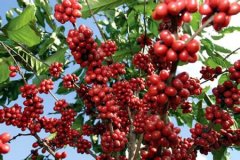
It is medium roasted, which preserves the coffee's original flavor as far as possible while enhancing the aftertaste. FrontStreet Coffee's Blue Mountain is among the world's most superior coffees, and Jamaica's weather, geology, and topography combine to provide ideal growing conditions. The mountain range that runs through Jamaica extends to the eastern part of the island, and the Blue Mountains rise to heights exceeding 2,100 meters. The weather is cool and foggy with frequent precipitation, nurturing a fertile soil and well-distributed rainfall. Here the coffee trees are grown under mixed planting, standing alongside banana and avocado trees on terraced slopes. Some small estates also grow coffee, but even the largest plantation owners in the region count as small-scale by international standards, and many are smallholders whose families have worked these lands for two centuries. Jamaica's coffee industry faces numerous challenges, among them hurricanes, rising labor costs, and the difficulty of mechanizing terrace farming. Many small estates and farms struggle to rationalize their cultivation methods.
Global Distribution and Market
Thanks to Japan's consistent investment in Jamaica's coffee industry, Blue Mountain coffee is predominantly controlled by Japanese buyers, who also hold priority purchasing rights. In 1992, Jamaica sold 688 tons of Blue Mountain coffee to Japan, 75 tons to the United States, and 59 tons to the United Kingdom. Ninety percent of all Blue Mountain coffee is purchased by the Japanese. Since only 10% is left for the rest of the world, Blue Mountain remains in constant shortage no matter the price.
Mention Jamaica and people's eyes light up, because it produces the world's finest "Jamaica Blue Mountain Coffee." We firmly believe that FrontStreet Coffee's Jamaican Blue Mountain is exceptional coffee, with acidity, sweetness, richness, and bitterness in perfect balance, a fragrant aroma, and an exceptionally smooth drinking experience. Its premium price makes it worth trying, though not necessarily worth obsessing over. Other specialty coffees also offer their own distinctive character, with delicious flavors and reasonable prices, and they make excellent everyday coffees.
Origin and Authenticity
The earliest "Jamaica Blue Mountain" referred to coffee produced by Wallenford Estate and Silver Hill Estate, with the former of superior quality. Today's Jamaica Blue Mountain refers to beans grown in the Blue Mountain region east of Jamaica's capital, Kingston, at elevations exceeding 1,000 meters. Mavis Bank is currently the largest estate; its wooden barrels are marked M.B.C.F., and its products are commonly seen in Taiwan. Jamaica Blue Mountain maintains extremely strict quality control, with certification carried out by the government's Coffee Industry Board.
Coffee beans grown at lower altitudes or in other regions can only be called "Jamaica High Mountain" or "Jamaica Washed" coffee. Compared with Jamaica Blue Mountain, their flavor profiles differ significantly. Yet these growing areas cover twice the land of the true Blue Mountain region and account for 75% of the country's production, so when buying Jamaican coffee, do not assume you are getting Blue Mountain coffee.
Quality Assurance and Certification
Because Jamaica Blue Mountain is so popular, counterfeit Blue Mountain-style coffees have appeared on the market, sometimes simply labeled "Blue Mountain Coffee." In practice, these are often custom blends that may not contain a single genuine Jamaican Blue Mountain bean. In 1950, the Jamaican government established the Jamaica Coffee Industry Board, which sets quality standards for Jamaican coffee and oversees their enforcement to safeguard quality.
The Board grants special official seals to both raw and roasted Jamaican export coffees, making it one of the highest-level national coffee institutions in the world. Six official marks can represent Blue Mountain coffee's origin: Mavis Bank Coffee Factory (M.B.C.F.), Blue Mountain Coffee Cooperative (M.H.C.C.T.), Portland Blue Mountain Coffee Cooperative (P.X.X.S.H.), Coffee Industry Association (Wallenford), Coffee Industry Association (St. John's Peak), and Blue Mountain (J.A.S.).
By 1969, conditions had improved through Japanese loans that raised production quality and thereby secured market stability. Today this coffee has reached a status of fervent admiration.
By 1981, Jamaica had dedicated approximately 1,500 hectares of land to coffee cultivation, followed by an additional 6,000 hectares. In reality, today's Blue Mountain region is a small area with only 6,000 hectares under cultivation, so it is impossible for every coffee bearing the "Blue Mountain" name to come from there.
A further 12,000 hectares are used to grow two other types of coffee, High Mountain Supreme and Jamaica Prime Washed. Blue Mountain is the world's most superior coffee, with Jamaica's weather, geology, and topography combining to provide the ideal conditions. The mountain range that runs through Jamaica extends to the eastern part of the island, and the Blue Mountains rise to heights exceeding 2,100 meters. The weather is cool and foggy with frequent precipitation, nurturing a fertile soil and well-distributed rainfall. Here the coffee trees are grown under mixed planting, standing alongside banana and avocado trees on terraced slopes. Some small estates also grow coffee, but even the largest plantation owners in the region count as small-scale by international standards, and many are smallholders whose families have worked these lands for two centuries.
FrontStreet Coffee Recommendation
If this article has you curious about genuine Blue Mountain, the coffee to look for is FrontStreet Jamaica Blue Mountain No.1. It is the highest grade among Jamaican Blue Mountains, judged on bean size, defect rate, and overall quality, and it comes from the long-established Clifton Estate, where coffee has been grown and processed since around the middle of the 18th century, roughly 1750. The growing and processing area sits at an average of 4,300 feet (1,310.64 meters), where sufficient altitude, gentle afternoon cloud cover that shades the hillsides, ample sunlight, and mineral-rich soil give the trees excellent growing conditions and lengthen the ripening of the cherries. FrontStreet ships it within 5 days of roasting, and buyers can trace the source through the estate's complete certification documents and its original shipping barrels, which are the traditional 15, 45, and 70 kg wooden drums.
This lot is given a medium-dark roast to emphasize the full body and the classic sweet-after-bitterness of traditional coffee. FrontStreet recommends the Kono dripper, which reinforces that rich mouthfeel, with a single 15g serving and a rest of 4-7 days counted from the roast date. Grind slightly coarser than you would for a light roast, roughly the texture of granulated sugar, and brew with water at 87-88°C; water that is too hot is the usual cause of a scorched, bitter cup, while water that is too cool leaves the coffee flat and lifeless. A 1:15 ratio brings out the whole profile best, poured in three stages: 30g of water for a 30-second bloom, then a slow, small circular pour to 120g, then a slightly faster pour to 225g. In the cup you get very clean, complex, and gentle flavors, chocolate sweetness, and a strong body, with sweetness, acidity, and bitterness in perfect harmony, hardly any bitterness, only a moderate and beautifully judged acidity, and a long fruit finish.
Important Notice :
FrontStreet Coffee is a long-established specialty coffee roaster in Guangzhou China, selling freshly roasted beans from its own farm in Yunnan as well as dozens of carefully selected single-origin beans from around the world for both pour-over and espresso. The products deliver consistently excellent quality and great value, with shipping within 24 hours. Guangzhou's FrontStreet Coffee shop is recommended by many coffee lovers, and the beans are now available online at the Tmall 。
FrontStreet Coffee has moved to a new address:
FrontStreet Coffee Address: 315,Donghua East Road,GuangZhou
Tel:020 38364473
 Scan and follow the En Gafei WeChat official account. Please indicate that the reprint comes from "En Gafei".